Live Feed

The News Feed is curated by CGSP’s editors in Asia and Africa.

China is the “Clear and Present Danger” Facing Australia, Warn Security Analysts

Two of Australia's largest newspapers invited five prominent security analysts to discuss the most pressing threats facing the country (hint: China). Image via the Sydney Morning Herald.
Australia should prepare for a U.S.-China war within three years and should consider reinstating the draft and reintroducing nuclear weapons.  These were some of the talking points at a recent roundtable convened by the ...

Qin Gang’s Press Conference Offered Many Global South Takeaways, Between the Punches Thrown at the U.S.

Qin Gang's first press conference as foreign minister on the sidelines of the National People's Congress now underway in Beijing will be remembered for his warning to the United States that if Washington really wants to pick a fight with China, then that's what they'll get.

But in between Qin's various counterattacks against the U.S. on Tuesday, the new foreign minister also laid out several important new themes in Chinese policy that will shape Beijing's engagement in developing regions:

  • WARNING TO ASEAN: Although Southeast Asia is the frontline in the burgeoning U.S.-China rivalry, Qin made it clear that countries in the region need to stay out of the fight and avoid picking sides. (CHANNEL NEWS ASIA)

  • ENCIRCLED IN ASIA: Qin accused the U.S. of organizing "exclusive blocs... to encircle China" which he said would undermine regional stability. The FM is responding to DC's increasingly close ties with treaty partners like the Philippines and U.S.-led initiatives like AUKUS, the Quad and IPEF. (THE HINDU)

  • MODERNIZATION ≠ WESTERNIZATION: Qin made it clear Beijing plans to lean into its ties with developing countries by highlighting China as an alternative development model. “Chinese modernization [is not] pursued through war, colonization or plunder,” he said. “It is a new path, different [from] Western modernization." (SOUTH CHINA MORNING POST)

  • THE BRI IS STILL A THING: While senior Chinese leaders have been noticeably quiet about the BRI lately, Qin was far more outspoken. He noted that more emphasis will be placed on building "high-quality" infrastructure and announced a third BRI forum will take place this year to mark the 10th anniversary of the BRI. (GLOBAL TIMES)

WHY IS THIS IMPORTANT? Tuesday's press conference highlighted the need for stakeholders in developing countries to read very carefully between the lines of different U.S.-China screaming matches to find the data points relating to their own countries' relationships with both China and the U.S.

SUGGESTED READING:

The China Debt Story in Nigeria Makes Headlines Even When It Shouldn’t

Nigeria marked an important milestone this week when its total public debt topped 49 trillion naira or $108 billion. Curiously, the editors at the popular online news site Legit thought that the country's $4.15 billion debt to China was worth mentioning in the story's headline.

The reason this is odd is because Chinese loans account for just 3.8% of Nigeria's total public debt, whereas in the past two months alone, the Federal Government borrowed $4.6 billion from elsewhere to plug its ballooning budget deficit.

While Nigerian borrowing from China has largely been stable for the past few years, the country's national debt surged 300% since 2015.

WHY IS THIS IMPORTANT? It's highly misleading to suggest that Nigeria has a specific Chinese debt problem (rather than a larger debt problem.) Yet the story shows this myth remains compelling to local media.

SUGGESTED READING:

eSwatini PM Visits Taiwan, Reaffirms Diplomatic Support

Taiwan President Tsai Ing-wen welcomed eSwatini Prime Minister Cleopas Sipho Dlamini during an official visit to Taipei.

The prime minister expressed the Kingdom's support for Taiwan's admission to the United Nations and criticized China's efforts to coerce the island through "any sort of bullying or aggression."

eSwatini is now Taiwan's last diplomatic ally in Africa and one of only 13 around the world. (CENTRAL NEWS AGENCY)

Senior U.S. Diplomat Criticizes China’s Role in Sri Lankan Debt Restructuring

Yet another U.S. government official has added to the war of words between Washington and Beijing on debt restructuring.

Ramin Toloui, Assistant Secretary for the Bureau of Economic and Business Affairs at the US Department of State, was asked about China’s role in Sri Lanka’s debt crisis during an interview on the nationalist Indian news channel, WION:

SIDHANT SIBAL: What's your view on the ongoing global debt crisis? And, of course, specifically, if you talk about the Indian subcontinent, there are countries like Sri Lanka that have been majorly impacted and how much would you say that China is responsible for that?

RAMIN TOLOUI: Well, this issue of debt is incredibly important right now. There were already vulnerabilities preceding it, but the COVID pandemic has made all of these debt challenges much, much worse. It's very important that the creditor countries cooperate effectively in order to alleviate these debt problems and find solutions and ways forward.

You asked about Sri Lanka in particular, India has shown real leadership in offering assurances or what is called financing assurances that will be necessary in order for Sri Lankan to launch its IMF program. The Paris Club of which the United States is a part has also offered those financing assurances that are basically a way of saying that we are pledging that we're going to provide debt relief that will help get Sri Lanka on a sustainable course.

Unfortunately, China hasn't provided those assurances yet, and we very much hope that they will because China is a major creditor of Sri Lanka, and it's very important that all major creditors come together to help the nation and other countries that are suffering from debt distress to find a way out and stabilise the economic situation and lay the groundwork for again a return to rising living standards in these countries.

WHY IS THIS IMPORTANT? Toloui is only the latest U.S. official to frame China as a unique barrier to debt restructuring. Predecessors include U.S. Treasury Secretary Janet Yellen and U.S. ambassador to Sri Lanka Julie Chung. Seeing that these comments only tend to harden Beijing’s position, they’re more likely aimed at audiences in New Delhi and Washington.

SUGGESTED READING:

Controversial China Square Shopping Mall Re-Opens in Nairobi, Prompting Heated Debate About Chinese Imports

Nearly two weeks after being shuttered due to protests from competing traders, China Square, a Nairobi shop selling inexpensive Chinese imports, is back in business.

This follows talks between the Kenyan authorities and the local Chinese chamber of commerce. It seems that Moses Kuria, the trade secretary who called for the business’s closure, may have been brought into line by more powerful interests.

Mohammed Faki, the senator for Mombasa said: “The economy is dilapidated not only in the country but globally to the extent that we cannot borrow funds from other nations. It’s not possible that we are going to look for investors on one end and on the other end we are chasing them away.”

This reaction was in line with the Chinese chamber of commerce: “We appreciate Kenya’s government support in allowing the Chinese Community to do business and contribute to Kenya’s growth and development efforts through employment creation and contribution to Kenya’s tax revenue.”

Cheng Lei, the owner of China Square was sanguine: “[W]e are optimistic that we will have resumed to normalcy in the next few days.”

While Kuria complained about the impact of cheap Chinese imports on Kenyan manufacturers, many have pointed out that the traders who protested China Square largely also sell Chinese imports. Commentators have linked the China Square controversy to Kenya’s woeful record in manufacturing:

Experts: This is Part of a Bigger Problem

  • KENYAN GOODS ARE TOO EXPENSIVE: “There is a consensus that the cost of production in Kenya is high. Indeed, almost anything produced in Kenya is more expensive than its imported equivalent.” Godfrey Kimenga (Columnist)

  • KENYAN GOODS ARE NOT SUPPORTED: “There are many locally produced goods. Yet despite our procurement rules, we do not promote the purchase of local goods.” Collins Odote (Columnist)

  • DON’T RING-FENCE KENYAN TRADE: "Stopping foreigners from doing legitimate business in Kenya is retrogressive. We need to see how to build the capacity of Kenyans to be able to produce competitive products." Gerrishon Ikiara (Economist)

WHY IS THIS IMPORTANT? The controversy reveals how Kenya's yawning trade imbalance with China is part of the East African country's larger failure as a manufacturer.

SUGGESTED READING:

Huge Lithium Deposit in Found in Iran

The Iranian authorities say they found the world’s second-largest deposit of lithium in the mountainous province of Hamedan.

At an estimated 8.5 million tons, the Hamedan lithium haul would be second only to Chile’s estimated 9.2 million ton deposit. It could position Iran as a significant player in the global competition for battery minerals between China and the United States. (CNBC)

China Not to Blame for Debt Crisis in Developing Countries, Say a Chorus of Chinese Spokespeople in Beijing

Don't blame us, blame them emerged as a sort of chorus among various Chinese spokespeople in Beijing in recent days. They're all pushing back against accusations that Beijing is the cause of the worsening debt crisis in Africa, Asia and other Global South regions.

BLAME THE MULTILATERAL DEVELOPMENT BANKS: Wang Chao, spokesperson for China's rubber-stamp legislature, told a press conference on Saturday that critics should be focusing more on the role of multilateral development banks like the World Bank and the International Monetary Fund rather than China in addressing the debt crisis in Africa, given their outsized role. 

Chao also reminded journalists that China's share of African debt is significantly smaller than that of commercial creditors. (GLOBAL TIMES)

BLAME THE UNITED STATES: Over at the Foreign Ministry, spokesperson Mao Ning renewed accusations that large fiscal stimulus by the United States during the pandemic is to blame for economic conditions in many Global South countries. 

“Radical fiscal policy of a certain developed country is the main reason behind the financial difficulties of a large number of developing countries," she said referring to the surge of global inflation and subsequent interest rate hikes that happened in response to the billions of dollars injected into the U.S. economy. (BLOOMBERG)

"BASELESS" ACCUSATIONS: Guo Weimin, Chinese spokesperson for the People's Political Consultative Conference, said any accusation that China sets "debt traps" for developing countries is "baseless" and said such accusations are nothing more than "noise." (XINHUA)

WHY IS THIS IMPORTANT? The comments by the three spokespeople provide the clearest indication to date that China's messaging on the debt issue is now firmly locked in place. The government now seems wholly aligned around the narrative that the debt problems faced by developing countries is not China's fault and any suggestion of even partial responsibility will be dismissed.

SUGGESTED READING:

China’s New Line on Ghana Debt: We Own Less Than 5%, so Why Are You Talking to Us?

Even though talks between Chinese creditors and the Ghanaian government are now underway in Accra to restructure the country's $1.7 billion of bilateral debt, a narrative that Beijing is delaying the process is taking hold in the Ghanaian media.

The problem stems from the postponement of a high level visit to China led by Finance Minister Ken Ofori-Atta that was to have happened last Friday, the day before China's annual legislative gathering known as the Two Sessions. Instead, the China Exim Bank dispatched officials to meet with Ofori-Atta and Foreign Minister Shirley Ayorkor Botchwey in Accra.

But scholars and other "experts" quoted by local media in Ghana are apparently unaware that talks have already started. Instead, they are telling reporters that China is delaying the process.

Meanwhile, China's messaging on Ghana's debt restructuring appears to be evolving:

  • QUOTING SPECIFIC FIGURES: Foreign Ministry Spokesperson Mao Ning noted last Thursday that Chinese creditors "account for less than 5% of Ghana's external debt." Until now, Chinese officials have largely avoided using specific figures for their share of a particular country's debt. (REUTERS)

  • MDBs & COMMERCIAL CREDITORS: Mao also restated the Chinese government's now-standard position that the bulk of Ghana's external debt is owed to private creditors and multilateral development banks who Beijing insist must take write-downs on their loans. (CHINESE MINISTRY OF FOREIGN AFFAIRS)

In Beijing, Ghanaian Ambassador Winfred Nii Okai Hammond called on the Chinese government to delay loan repayments and reduce interest rates.

He specifically requested an extended debt servicing grace period of ten years with an additional 17 years to reschedule payments, periods far longer than China has agreed to elsewhere. 

There is some precedent for the ambassador's request, given that the China Exim Bank agreed to extend maturities on loans to Ecuador for an additional nine years to 2032. But in Sri Lanka, that same creditor offered only a two-year extension.

WHY IS THIS IMPORTANT? China's line that it accounts for only 5% of Ghana's debt is a bit misleading because they're not mentioning that it also makes up a third of the West African country's external debt. Beijing also has to align with other external creditors to clear the way for an IMF rescue package -- something it has failed to do in both Zambia and Sri Lanka.

SUGGESTED READING:

Stand-off Between China and Western Creditors Leading to Unprecedented Delays In Debt Relief for Poor Countries

Just ten years ago, it usually took less than two months for a debt-distressed country to get a sign-off from the International Monetary Fund for emergency financial relief, but that is no longer ...

A Call for the African Union to Break the Global South Debt Impasse

Gyude Moore, a senior policy fellow at the Center for Global Development, is among a small group of Washington, D.C.-based analysts trying to devise practical solutions for how developing countries can unblock the current impasse preventing debt-distressed countries from restructuring their loans.

The following transcript was adapted and lightly edited for clarity from a seven-part Twitter thread posted by Moore.

Since the G20's Common Framework is failing and debt restructuring talks are at an impasse, countries in the ensuing expensive and deteriorating limbo have to do something. China’s preference is for bilateral negotiations and mostly extending the repayment period.

There is no reason, however, why debtors cannot compare and share notes from each individual negotiation and still coalesce around a common strategy. Hannah Ryder from Development Reimagined proposes a Borrowers’ Club to engage Creditors’ Clubs like the Paris Club or Creditor Committees.

This is likely the way to go instead of perpetually waiting for an unworkable process to deliver solutions for citizens caught in the middle.

Chinese state-connected newspapers are writing for a domestic audience supporting China’s negotiating position. As CGSP's Eric Olander notes, this makes it less likely that China will walk this position back. China is not going to be swayed by India or the United States on this issue.

An African Union-led Borrowers’ Club that invites Pakistan and Sri Lanka can still attempt to obtain through bilateral negotiations, what they seek through the multilateral process. While it is not guaranteed success, it is still better than waiting for a solution that’s not coming.

It was always my understanding that the African Union is seeking a seat at the G-20 to inject its views, solutions and perspectives on global governance issues. Its silence on the debt negotiation impasse has thus been puzzling. This is tailor-made for the AU.

There is a relentless undermining of multilateralism underway, and culpability is widespread. Former rule takers want their turn as rule makers only to face resistance from incumbents. The extent of proposed rule changes are also problematic. There is a need for a third way.

Read the full seven-part thread on Gyude Moore's Twitter page.

Chinese Foreign Ministry Releases Details of Qin Gang’s G20 Meetings With Other Foreign Ministers

While stark differences over the war in Ukraine made it impossible for G20 foreign ministers to reach a consensus at last week's meeting in New Delhi, China's Qin Gang nonetheless took advantage of the opportunity to hold a number of bilateral meetings with key counterparts.

Over the weekend, the Chinese Foreign Ministry released details of Qin's meetings, including several from countries with tense ties with China:

🇮🇳 INDIA:  Qin's sit-down with External Affairs Minister S. Jaishankar was the highlight of the week as it marked a resumption of high-level meetings after the countries became embroiled in military conflict along their disputed border in 2020. (XINHUA)

🇦🇺 AUSTRALIA: Qin's meeting with Penny Wong is the latest indication of thawing ties between the two countries. Australia is keen to have China remove the last remaining sanctions against a number of its imports. (CHINESE EMBASSY IN INDIA)

🇸🇦 SAUDI ARABIA: Qin's meeting with Prince Faisal bin Farhan Al Saud marks the first high-level interaction between the two countries since Xi Jinping's visit to the Kingdom last December. Saudi Arabia is China's largest oil supplier. (CHINESE EMBASSY IN INDIA)

WEEK IN REVIEW: Apple’s Chinese Suppliers Reportedly Moving Production out of the Country at a Much Faster Rate Than Forecast

Apple's Chinese suppliers are reportedly moving production out of the country at a much faster rate than previously forecast, according to one of the company's largest partners. AirPods maker GoerTek Inc. said it is shifting manufacturing to Vietnam and other Asian countries to avoid the fallout from escalating tensions between the U.S. and China. (BLOOMBERG)

Ghanaian Finance Minister Ken Ofori-Atta's trip to Beijing, scheduled for last Friday, has now been postponed until the end of March. The visit was delayed due to the annual gathering of China's National People's Congress that begins on Friday. (CITI NEWSROOM)

Ethiopia is making progress in restructuring its estimated $13 billion Chinese portfolio. A high-level delegation recently met in Beijing with creditors where the two sides reportedly agreed to restructure Ethiopia's debt through "alternative means" including debt swaps, resource credits and inducements for Chinese investors. (THE REPORTER ETHIOPIA)

South African Finance Minister Enoch Godongwana cautioned against the World Bank expanding its portfolio to focus more on climate change and other issues. Instead, Godongwana wants the bank to remain focused on debt, development and reducing poverty. (BLOOMBERG)

Belarusian President Alexander Lukashenko arrived in China on Tuesday for a three-day visit that will include a meeting with Xi Jinping. Lukashenko is one of Russia's most fervent supporters and the President's visit to Beijing is widely seen as Beijing's further alignment with Moscow.(THE GUARDIAN)
Kazakhstan is the first country in Central Asia to publicly endorse China's peace plan for Ukraine. Astana said that it welcomes Beijing's proposal for how to resolve the conflict and made specific reference in its statement to China's new Global Security Initiative. (KAZAKH MINISTRY OF FOREIGN AFFAIRS. -- in Russian)

U.S. Secretary of State Antony Blinken will travel to Kazakhstan and Uzbekistan for meetings with Central Asian leaders in a bid to counter heightened influence from both Russia and China. Blinken will attend the C5+1 Ministeral Meeting on Tuesday in Astana. (THE WALL STREET JOURNAL)

Controversial joint naval exercises among Russia, China and South Africa concluded on Monday, according to the Russian Ministry of Defense. The 10 days of drills, known as MOSI II, sparked widespread outrage in South Africa over the cost and for the apparent abandonment of Pretoria's neutral position on the war in Ukraine.(REUTERS)

Philippine President Ferdinand Marcos Jr. warned that China is threatening the country's borders and called on the military to adapt to the new era of great power competition in Asia. Marcos' directive to the armed forces follows a number of recent incidents in the South China Sea between Chinese and Philippines Coast Guard forces. (AL JAZEERA)

A major showdown is expected in New Delhi where the foreign ministers from China, the U.S. and Russia will gather for a G20 meeting. Russian sanctions and the war in Ukraine are expected to dominate the agenda. There are no plans for bilateral meetings between U.S. Secretary of State Antony Blinken and his Chinese or Russian counterparts. (ASSOCIATED PRESS)

Persian Gulf investors snapped up oil stocks on Wednesday following the release of new Chinese data that showed manufacturing in February expanded at the fastest pace in more than a decade. Saudi Arabia, Qatar and the UAE are now among China's largest energy suppliers. (REUTERS)

The strong manufacturing news from China also gave a boost to share prices in South Africa and a badly-needed lift for the country's embattled currency. Tech stocks on Johannesburg's FTSE/JSE Africa All Share Index led the way with Cape Town-based Naspers jumping 5.7% -- Naspers is the largest shareholder in Chinese online giant Tencent. (BLOOMBERG)

Uganda is the Latest Stop for High-Level CPC Delegation Touring East Africa

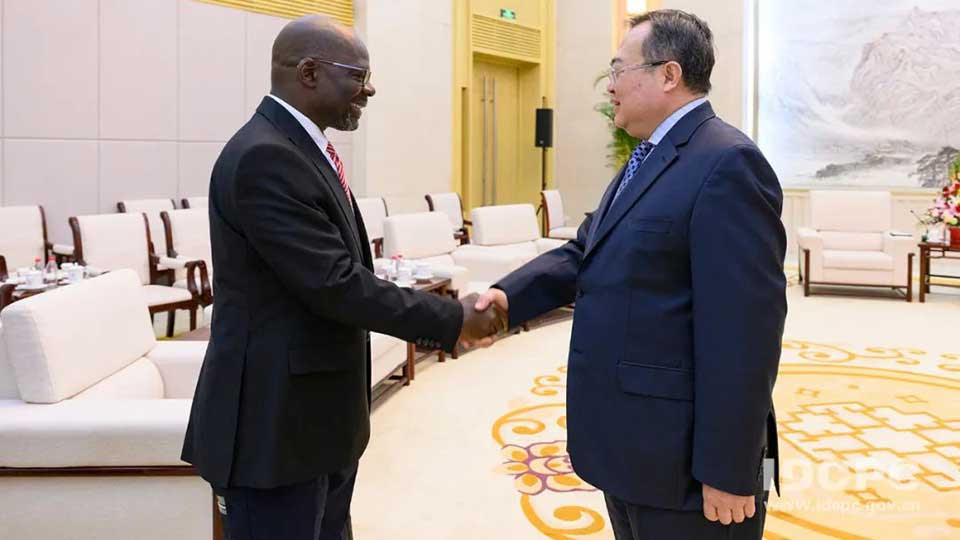
Li Mingxiang, vice minister for the International Department of the Central Committee of the Communist party of China, held talks in Kampala with leaders of Uganda's ruling National Resistance Movement party on March 1, 2023. Image via @NRMOnline.
While U.S. lawmakers see themselves in an “existential struggle” with the Communist Party of China (CPC), Party officials are getting a considerably warmer reception in Africa. Li Mingxiang, the Vice Minister of the International ...

Analysis from Cobus van Staden

The G20 Summit and the Half-Life of a Joke

When it was announced in 2023 that the African Union would become a full member of the G20, I darkly joked on a podcast that the AU’s entry into the body could very well mark the moment the G20 lost its status as one of the most important global coordination forums. Mark my words, I said, soon The Economist will be like “Uhhh, the G20 is OVER – it’s the ...

Ghana President Hopeful for IMF Deal in March

Ghana’s President Nana Akufo-Addo is optimistic that the debt-ridden country will reach a bailout deal with the International Monetary Fund by the end of the month.

Speaking at a gathering of ambassadors and high-level officials, Akufo-Addo said: “I’m confident that with the cooperation that we’re receiving from the Paris Club and the People’s Republic of China which has sent a delegation from China’s EXIM Bank to Accra over the weekend to meet with officials of the Ministry of Finance, we shall be able to go to the board of the Fund to conclude finally the agreement by the end of March.”

After the recent postponement of a trip to Beijing by Finance Minister Ken Ofori-Atta, the news that debt talks are ongoing signals some progress.

However, this may be affected by a 2021 deal between Ghana and the Chinese state-owned company Sinohydro for infrastructure backed by a massive bauxite concession. The IMF feels that the $2 billion deal should be counted as part of Ghana’s debt stock. However, Accra insists it is a barter deal, not a loan.

WHY IS THIS IMPORTANT? The Exim Bank delegation's visit could signal progress for Ghana, the second African country to default on its debt after the pandemic. However, it should be noted that China only makes up about a tenth of Ghana's external debt, which is dominated by Western private lending.

SUGGESTED READING:

Kenyan Merchants and Consumers Face Off Over Chinese Imports

Kenyan traders staged a street protest against Chinese competitors they say are undercutting them.

This follows the targeting of China Square by Trade Secretary Moses Kuria. The popular new Chinese-run store offers imported products at prices 50% lower than traders.

In late February, Kuria offered to buy out China Square’s lease and hand it to local traders. He tweeted: “We welcome Chinese investors to Kenya but as manufacturers not traders.”

Kuria took personal aim at Cheng Lei, the owner of China Square, threatening him with deportation and reportedly tweeting a screenshot of his passport, which has since been deleted.

In the wake of the protests, China Square announced it is temporarily halting operations after only two months in business.

Cheap Chinese Imports Divide Kenya:

  • KENYAN GOVERNMENT: Kenyan officials tried to downplay the controversy. Kenya is desperately searching for foreign investors to take the edge off its growing debt crisis. Korir Sing’oei, Principal Secretary in Kenya’s Foreign Affairs Ministry, tweeted that all investors are welcome, despite nationality.

  • KENYAN CONSUMERS: Many consumers complained on social media that the issue relates more to established traders lobbying to protect their import monopoly against cheaper competitors rather than about shielding Kenyan manufacturing.

  • CHINESE GOVERNMENT: Korir Sing’oei's statement was welcomed by China’s most senior official dealing with Africa, Wu Peng. The embassy in Nairobi also released a statement calling on the Kenyan government to “protect the legitimate rights and interests of Chinese enterprises and Chinese citizens” operating in the country.

WHY IS THIS IMPORTANT? The issue of cheap Chinese imports is pitting African trader lobbies against consumers. While Moses Kuria called for Chinese manufacturing to move to Kenya, the protests will likely slow down any such initiatives. 

SUGGESTED READING:

India to Build Massive Hydropower Plant Near Contested Border With China

The Indian government will build a $3.9 billion hydroelectric power plant in Arunachal Pradesh, very close to the country's disputed border with China known as the Line of Actual Control.

Environmentalists are condemning the $3.9 billion project saying the new 2,880-megawatt plant will destroy thousands of hectares of vulnerable ecosystems.

But constructing a huge power plant well within the range of Chinese short-range missiles also raises legitimate security concerns. In the event of a future possible conflict (it will take nine years to build the plant), a single Chinese missile into the dam would not only disable a key piece of Indian infrastructure but also create enormous havoc for populations downstream.

WHY IS THIS IMPORTANT? As one of the world's largest polluters, India is eager to bring down emissions but building a large hydroelectric plant like this in an environmentally and militarily volatile region is problematic.

SUGGESTED READING:

China Denies Ethiopian Media Report It’s Providing Addis Ababa With “Alternative Means” of Debt Relief

The Chinese Ministry of Foreign Affairs flatly denied a report published in the English-language Ethiopian news site The Reporter that "China agreed to restructure Ethiopia’s debt through alternative means."

Ethiopia is the second-largest recipient of Chinese loans in Africa, behind Angola, and has already formed a creditor committee to restructure the country's $28 billion external public debt.

Last week, a high-level Ethiopian delegation that included Finance Minister Ahmed Shide and Mamo Miretu, head of the central bank, went to Beijing, which prompted the speculation that a deal to settle Addis Ababa's estimated $13.7 billion of Chinese debt through trade, investment and other "alternative means."

But when asked about the report by a Bloomberg correspondent on Tuesday at the regular press briefing, Mao was clear:

BLOOMBERG: There are local media reports that China agreed to restructure Ethiopia’s debt through alternative means including swapping debt through various mechanisms to increase shipments of raw materials to China and awarding other projects to Chinese investors. Could the foreign ministry confirm this and do you have any comment?

MAO NING: According to our knowledge, what you described is not what’s happening.

WHY IS THIS IMPORTANT? While there was considerable excitement about the prospect of China employing new, creative methods like those speculated in that local news report, it turns out that Beijing's position on debt relief for Ethiopia is the same as it is for other highly-indebted countries.

SUGGESTED READING: 

China’s “Malign Influence” in Global South Emerges as Key Theme in U.S. House Hearings

The new Republican leaders of the U.S. House of Representatives convened a pair of hearings on China Tuesday that laid out a lengthy list of concerns and grievances about Beijing's "malign influence" around the world.

The inaugural hearing of the Select Committee on the Chinese Communist Party was more focused on specific U.S.-China issues where the committee heard testimony from Trump administration national security officials, a Chinese democracy activist and a representative of the U.S. manufacturing association.

Down the hall, a separate gathering was taking place when the House Foreign Affairs Committee convened their first hearing under Republican control on "combatting the generational challenge of CCP aggression."

The Foreign Affairs Committee hearing featured testimony from prominent U.S. diplomatic and development finance leaders, including Daniel Kritenbrink, assistant secretary of state for East Asian and Pacific Affairs, and the CEO of the U.S. Development Finance Corporation Scott Nathan, among others.

The comments from both witnesses and lawmakers provide a valuable index of the current talking points that are now deeply embedded in Beltway thinking about China and its engagement around the world, particularly in developing countries:

  • THE U.S. IS LOSING IN THE GLOBAL SOUTH: "Every day, we should make sure people around the world know that our aid is NOT the debt-trap diplomacy that the CCP uses to exploit developing countries. But we are not succeeding. Of the 6.3 billion people living in developing countries, about seventy percent have a positive view of both China and Russia. Seventy percent" -- Representative Michael McCaul, Chairman of the House Foreign Affairs Committee

  • INFRASTRUCTURE: "I think they've found out that often projects that are funded by the Belt and Road Initiative or by the PRC state-controlled entities turn out to be inappropriate for their local conditions and frequently not of high quality and leave them with burdensome debt loads" -- Scott Nathan, CEO of the U.S. International Development Finance Corporation

  • DRC COBALT MINING: "Nowhere in Africa is the CCP's malign impact more egregious than in the DRC. I've been to the DRC. I've been to the mines. I've not been to the cobalt mines but others previously and I chaired a hearing last Congress on the issue of cobalt and the fact that something on the order of 35 000 children forced labor for children many of whom get sick some die. They don't have any protective equipment, they shouldn't be subjected to child labor anyway and then the adults, something on the order of two hundred thousand are mining cobalt, all of which goes to China for refinement for batteries. You know no matter where anybody comes down on EVS um you know they're on the roads they're everywhere, but the supply chain should in no way be linked to such horrific practices as forcing children into those mines" -- Republican Congressman Chris Smith

WHY IS THIS IMPORTANT? Both hearings highlight the lack of nuance in the Congressional discourse on China. Whereas just a few years ago, there would have been differences of opinion among members of rival parties and various special interests, that does not appear to be the case anymore as "confronting China" is now among the only truly bipartisan issues in U.S. politics.

SUGGESTED READING:

Chinese Sci-Fi Blockbuster Wandering Earth 2 to Open in Southern Africa

The Chinese movie hit "Wandering Earth 2" will open next week in four southern African countries beginning with South Africa, Mozambique and Zimbabwe on March 10th, followed by Zambia the week after.

The science fiction blockbuster has already taken in $566 million at the Chinese box office, a figure that's expected to rise considerably now that the movie is opening internationally.

SUGGESTED READING:

IMF Head Flatly Rejects China’s Call for Multilateral Development Banks to Take Losses on Loans: “Not Possible”

IMF Managing Director Kristalina Georgieva spoke with Bloomberg TV following last weekend's debt roundtable at the G20 finance minister and central bank leaders meeting in India. Image via Bloomberg.
International Monetary Fund Managing Director Kristalina Georgieva flatly rejected China’s demand for multilateral development banks (MDBs) to accept losses or “haircuts” for loans to the world’s poorest countries. “Not possible” she bluntly ...

Germany’s Ambassador to Ghana Explains Why He Thinks China is Hesitating to Set Up a Creditor Committee

The German government is advocating on behalf of Ghana for China to stop stalling in the creation of a new Creditor Committee that will restructure Accra's debts.

Last week, Ghana officially became the second African country in the post-pandemic era to default on some of its commercial debts after it missed a $40.6 million payment to bondholders.

German ambassador Daniel Krull said China could be holding back out of fear of setting a precedent:

China has been very reluctant in terms of setting up a creditors committee, which is a key decision to take now, and we are aware that, so far, the Ghanaian government has not been able to enter into direct talks with them; so we are trying to talk to them, but China is a big player and has its agenda for dealing with Africa.

We must also be aware that other countries are having similar challenges and that is making it so complex because it might not be with only Ghana but other African countries. So, this is not only with Ghana but all of Africa and that explains China's hesitance in negotiating with Ghana.

Let's not also forget that China's economy has also been hit hard by COVID-19 and is not in the best of shape.

It's worth noting that no Chinese official has expressed such reservations and Beijing is already the co-chair of the Zambian Creditor Committee. 

With an Eye on China and Russia, Macron (Again) Tries to Reboot France’s Strategy in Africa

France needs to approach Africa with ‘profound humility’ to make up for its colonial past. This is the message from French President Emmanuel Macron, who is embarking on an African tour in part aimed at rejuvenating Paris’s engagement with a continent where its image remains shaped by its colonial and military ties.

Macron announced that France plans to diminish its military presence on the continent. It plans to replace its bases with military “academies” co-run with African armies.

Macron will visit Gabon, Angola, the Democratic Republic of Congo and Congo-Brazzaville. Three of these countries abstained from UN votes on Ukraine, and concerns about Russia’s influence in Africa is a key driver of the visit.

In contrast to other Western powers, France is less hostile to China. Last year, Paris agreed to trilateral infrastructure cooperation with China, and French companies are also involved in joint ventures with Chinese counterparts, for example, in Nigeria’s Lekki Port.

That said, Macron seems acutely aware that trade and investment lie at the heart of France’s competition with new powers like China:

France's More Pragmatic Response to China in Africa

  • DEVELOPMENT: As France withdraws troops from conflict zones like Mali, Macron wants to boost education, diaspora-based and small business cooperation. He expressed hope for "a new generation of French-African entrepreneurs."

  • BUSINESS: Macron publicly called on French companies to focus more on African opportunities: “Too many of our companies aren’t doing the best they could. I won’t defend those that aren’t ready to fight.”

France's plans for a "new security partnership" come amid both criticism of its conflict role and fears that withdrawing troops could worsen security in the Sahel.

WHY IS THIS IMPORTANT? France's relative amenability to trilateral cooperation with China in Africa could provide a little respite to governments chafing under pressure from both Washington and Beijing to choose sides in a new cold war, but it remains to be seen if it can break out of its historical role on the continent.

SUGGESTED READING:

Top Chinese Communist Party Official Visits Ruling Party Leaders in Kenya, Tanzania

In-person party-to-party exchanges between Communist Party of China (CPC) officials and African counterparts are ramping up again. Li Mingxiang, the Vice Minister of the International Department of the CPC Central Committee, recently visited Kenya and Tanzania.

The visit was ostensibly aimed at briefing the East African officials on the outcomes of China’s twentieth National Party Congress, which took place in October. According to Xinhua, the invitation came from Kenya's ruling United Democratic Alliance.

Kenya’s Ambassador to China Leaves Unexpectedly

Kenya's outgoing ambassador to China, Mary Muthoni, is leaving her post after only ten months on the job, far less than her predecessor, who spent three years in Beijing.

The Ministry of Foreign Affairs in Nairobi did not explain what prompted Muthoni's departure and why she is leaving after less than a year in her post. Nor did the Ministry provide any details as to who President William Ruto will name as her replacement. (THE STANDARD)

U.S. Discussed Debt Issues With China While Also Hinting Beijing Uses Loans for “Coercive Leverage” in South Asia

United States' Secretary of Treasury, Janet Yellen addressed the media during a news conference at the G20 Finance and Central Bank Deputies in Bengaluru on February 23, 2023. Manjunath KIRAN / AFP
There was a hint of optimism going into Saturday’s debt roundtable organized by India, the World Bank and the IMF that the U.S. and China might be able to find some common ground. ...

Xinhua: The U.S. Deliberately Distorts Chinas’s Role in the African Debt Crisis

HEADLINE TRANSLATION: Three Truths About Africa's Debt That the U.S. Deliberately Distorts
The burgeoning debt crisis in a growing number of African countries is increasingly seen by the Chinese government as another front in Beijing’s competition with Western powers like the U.S. A recent article ...

When it Comes to the Global South Debt Crisis, the Chinese Message is Clear: Don’t Talk About China, Just Focus on the West

HEADLINE LINE TRANSLATION: On the eve of global debt conference, the West is speculating again about "China Debt Traps" again, experts explain
Chinese scholars and U.S. and European officials seem to follow the same playbook on debt. Both sides are highly selective in their assessment of the worsening debt crisis in developing countries by focusing ...

Gyude Moore: Future of Global Development Finance System at Risk if China Wins Stand-off With IMF, World Bank

If China is successful in its effort to force multilateral development banks (MDB) like the World Bank and the International Monetary Fund to accept the same kind of writedowns (known as 'haircuts') on loans to poor countries as other lenders, it would endanger the entire global development finance system. So argues the prominent Africa analyst Gyude Moore, a senior policy fellow at the Center for Global Development (CGD).

Moore laid out the threat in a CGD blog post published on Friday that explored the question "will China play its part in addressing African debt distress?"

While Moore is widely regarded as a moderate in Washington with regard to his views on China, he nonetheless described dire consequences for developing countries, particularly in Africa, if Beijing achieves its objective to force MDBs to take the same losses as bondholders and bilateral creditors:

  • THE ENTIRE DEVELOPMENT FINANCE MODEL AT RISK: It strains credulity that policy banks and their multilateral counterparts will be treated on par during debt restructuring negotiations... It is difficult to imagine how one accommodates those demands without unraveling the entire multilateral development lending model.

  • MULTILATERAL DEVELOPMENT BANKS STAND TO LOSE IF CHINA WINS: If MDBs were to lose their preferred creditor status, it would immediately change how ratings agencies see them, inevitably increasing their cost of borrowing and reducing their usefulness to developing countries.

  • MDBS AND CHINESE POLICY BANKS NOT THE SAME: China’s state-owned policy banks, which have been active in the bilateral lending space, are instruments of Chinese policy, unlike MDBs, which are organized purely to help poorer countries. There is thus no setting in which the two groups of entities would receive the same treatment in the event of default.

WHY IS THIS IMPORTANT? Moore's assessment of the MDB-China standoff reveals just how polarized views on the issue in Washington and Beijing have become, with very shared space left for compromise.

SUGGESTED READING:

WEEK IN REVIEW: Tanzania Approves Construction of New Controversial $3.5 Billion Sino-French East African Crude Oil Pipeline (EACOP)

The Tanzanian government approved the construction of a new $3.5 billion pipeline as part of the controversial Sino-French East African Crude Oil Pipeline (EACOP). The 1,443km pipeline will transport crude from new oil fields in Uganda, currently being developed by Chinese oil major CNOOC and France's TotalEnegies. (AGENCE FRANCE PRESSE)

Philippine Foreign Minister Enrique Manalo met with one of China's top foreign policy officials, Fu Ying, for what he called a "candid exchange" about a recent incident between their Coast Guards in the South China Sea. Fu, a former ambassador to Manila, did not comment on the discussion held on the sidelines of the Munich Security Conference. (MANILA BULLETIN)

Former UK Prime Minister Liz Truss called on the G7 to create an "economic NATO" to counter China, particularly for control of critical resource supply chains. The G7 should also challenge Chinese financial engagement with developing countries by "providing investment that doesn't have strings attached, that doesn't lead to a debt trap." (NIKKEI ASIA)

A second batch of Australian coal will be shipped to China in March, the latest indication that Beijing is relaxing three years of economic sanctions against Canberra. Australia's share of the Chinese coal market plunged from 30% to just 4% as China shifted buys to Indonesia, Russia and Mongolia. (GLOBAL TIMES)

The local affiliate of the Islamic State in Afghanistan, Islamic State in Khorasan Province, published a new 117-page book that threatens China over its Uyghur Muslim minority population. The group also lashed out at the Hui Muslims for allegedly accepting all rules and regulations imposed by the Chinese government that are being resisted by the Uyghurs. (CNN-NEWS18)

The Philippines and the United States are in talks to launch new joint Coast Guard patrols in the South China Sea.  The discussions follow a series of incidents over the past few weeks where the Chinese Coast Guard harassed Filipino Coast Guard and fishing vessels. (REUTERS)

Chinese Foreign Minister Qin Gang arrived in Jakarta on Tuesday for a three-day visit. Qin will hold talks with his Indonesian counterpart Retno Marsudi and will also visit the ASEAN Secretariat. (XINHUA)

A Vietnamese court sentenced Nguyen Duc Tai to 13 years in jail for smuggling 10 tonnes of elephant tusks, rhino horns, and pangolins from Africa. Much of it is bound for sale over the border in China. Vietnam is now a major transshipment hub for wildlife trafficking in China and across Asia. (REUTERS)

Japanese trading house Sumitomo Corp. will launch one of the world's first supply chains for rare earth minerals that does not involve China. Sumitomo will substitute Chinese suppliers with competitors from Southeast Asia and the U.S. to provide the 3,000 tons of rare earths that it supplies to Japanese manufacturers every year. (NIKKEI ASIA)

Indian and Chinese officials met for the first time in three years to discuss de-escalating tensions along their disputed border. Both sides said Wednesday's talks in Beijing were productive and agreed to schedule a new round of negotiations between their military commanders. (THE HINDU)

Brazillian authorities have halted all beef exports to China after a case of mad cow disease was confirmed on Wednesday in the norhtern state of Para. The suspension is expected to be temporary but will still be a big blow to ranchers since China's is their largest export market. (REUTERS)

Pakistan will receive a financial lifeline from the China Development Bank in the form of a $700 million loan to bolster the country's beleaguered foreign exchange reserves. Pakistan's foreign currency reserves are now at their lowest point in ten years. (REUTERS)

Page 107 of 2171106107108217