Live Feed

The News Feed is curated by CGSP’s editors in Asia and Africa.

Ladies and Gentlemen, Xi Jinping is Back in the Diplomatic Game

After three years of avoiding major in-person diplomatic engagements, Chinese President Xi Jinping re-emerged on the diplomatic stage with a flurry of at least eight bilateral meetings on the sidelines of the G20 summit in Bali, Indonesia.

Spread among the President's schedule on Tuesday were meetings with three leaders from developing countries:

🇿🇦 SOUTH AFRICA: No specific issues or any major announcements came from the brief discussion between Presidents Cyril Ramaphosa and Xi Jinping. In fact, the meeting was little more than a reacquaintance between the two leaders and generated no media coverage in South Africa. (CHINESE FOREIGN MINISTRY)

🇸🇳 SENEGAL: President Xi reaffirmed China's support to build infrastructure in Senegal and increase agricultural imports from the West African country -- both key concerns for a number of African countries. Senegal is the current co-chair of the Forum on China-Africa Cooperation. (CHINESE FOREIGN MINISTRY)

🇦🇷 ARGENTINA: This is the second meeting this year between Presidents Xi and Alberto Fernández. Nothing tangible emerged from their talks on Tuesday but the get-together did highlight the growing closeness between these two countries. Argentina is going to be a new BRICS member and is emerging as one of China's most enthusiastic partners in South America. (CHINESE FOREIGN MINISTRY)

SUGGESTED READING:

It May Not Look Like Much, But This Handshake Between Xi and Modi is a Big Deal

They looked at each other, smiled, shook hands for an uncomfortably long time, and even exchanged a few pleasantries.

It may not look like much, but this brief interaction between Chinese President Xi Jinping and Indian Prime Minister Narendra Modi at Tuesday's gala dinner for G20 leaders marked a dramatic improvement over their last meeting at the Shanghai Cooperation Organization summit in Uzbekistan when they couldn't even look at one another.

In fact, Tuesday's handshake/chat was also the first time the two Asian leaders spoke since the 2020 conflict along their disputed border in the Himalayas. Both Indian and Chinese officials refused to comment on what they said to one another during their brief exchange.

SUGGESTED READING:

Why Détente Between China and Australia Could Be a Problem for Some Developing Countries

Anthony Albanese is the first Australian Prime Minister in six years to meet with Chinese President Xi Jinping and from the looks of their brief meeting on the sidelines of the G20 summit in Bali on Tuesday, there's a glimmer of optimism that the strained ties between these two countries may begin to improve.

Bilateral relations plummeted when Australia blocked Huawei from its 5G network and called for an independent investigation into the origin of COVID-19 , among other issues. China, in turn, imposed unilateral sanctions on Australian goods, including beef, wine, seafood, wood, and coal worth around $13 billion a year.

While those sanctions have hurt Australian exporters, they've been a boon to other countries, including South Africa and Zimbabwe, to whom Chinese buyers turned to make up for what they once bought Down Under.

Should China make amends with Australia and relax the various import restrictions on Australian goods, it's quite likely that would adversely impact Chinese demand for the goods now sourced from SA and other developing countries.

Australia is a formidable competitor for developing countries given its abundant resources that allow the Chinese to buy at a scale they can't replicate with most other countries.

SUGGESTED READING:

Even in a Foreign Country, China Made Other Leaders Treat Xi as the Host

One observation that emerged from Tuesday's flurry of meetings between Chinese President Xi Jinping and various world leaders on the sidelines of the G20 summit in Bali was that President Xi stood at the flags waiting to greet his counterparts as if he was somehow hosting them in his own country.

One might expect that in a third country, both leaders would approach one another from an equal distance. But that didn't happen and consequently sparked a lot of frustration from observers in the United States who felt it diminished President Joe Biden.

"Video footage of Biden excitedly prancing across a stage to shake hands with a patiently waiting Xi left no doubt who was the dominant of the two," said the conservative think tank Heritage Foundation.

Also, one other thing to note when President Xi greets visiting dignitaries is that he always stands to their left, so he never has to awkwardly reach across to shake hands -- he tends to reach his right hand out in a way that aims to project calm and confidence.

U.S.-led Coalition Rolls Out First Major Infrastructure Project Under the New Partnership for Global Infrastructure and Investment

The G7 group of wealthy countries unveiled the first major initiative as part of its Partnership for Global Infrastructure and Investment (PGII), which is ostensibly aimed at countering China's dominance in financing infrastructure in developing countries.

The coalition announced a $20 billion climate finance deal on Tuesday that will help Indonesia to transition from largely coal-based energy generation to cleaner renewable sources. Jakarta has pledged to cap carbon emissions from its power sector by 2030 and also aims to generate a third of its power from renewable sources, including wind and solar.

The $600 billion PGII, a successor to the defunct Build Back Better World initiative, was launched at last year's G7 summit in the UK with the stated intention to provide an alternative to Chinese development financing in the Global South. 

SUGGESTED READING:

Biden Expressed Concern to Cambodia PM Hun Sen About What China’s Doing at the Ream Navy Base

US President Joe Biden met with Cambodia's Prime Minister Hun Sen on the sidelines of the ASEAN Summit in Phnom Penh on November 12, 2022. SAUL LOEB / AFP
U.S. President Joe Biden on Saturday raised concerns with the leader of Cambodia about Chinese activities at its Ream Naval Base, stressing the importance of full transparency, the White House said. But Chinese state ...

Chinese PM Li Heads Home From Cambodia After Another Round of Diplomatic Speed Dating

Chinese Prime Minister Li Keqiang wrapped up a six-day visit to Cambodia on Sunday at the conclusion of a pair of regional summits where he also held a number of sideline bilaterals with both Asian and Pacific leaders:

  • SINGAPORE: Resolution of South China Sea tensions was among the top agenda items in talks between PM Li and his Singaporean counterpart Lee Hsien-long when the pair met on Friday. (THE STRAITS TIMES)

  • CAMBODIA: China and Cambodia will deepen law enforcement cooperation to crack down on human trafficking, online gambling and telecommunications scams that have taken hold in the Southeast Asian nation. (BLOOMBERG)

  • PHILIPPINES: President Ferdinand Marcos Jr. met informally, seemingly in passing, with PM Li and spoke briefly about the newly-elected president's upcoming state visit to Beijing in early January. (GMA NEWS ONLINE)

  • JAPAN: In the most closely watched bilateral meeting of the weekend, Japanese PM Fumio Kishida's talks with PM Li focused on re-establishing a sense of normalcy and stability to ties that have become increasingly contentious. (REUTERS)

  • AUSTRALIA: PM Anthony Albanese met with PM Li as part of an effort to get ties with China "back on track" and specifically to persuade Beijing to drop a number of sanctions that it imposed on Australian products. (9NEWS)

SUGGESTED READING:

Why Xi and Modi Should (and Shouldn’t) Meet on the Sidelines of the G20 Summit in Bali

While much of the attention this week at the G20 summit in Bali will be on Monday's meeting between the U.S. and Chinese presidents, in South Asia, many observers will be keeping a close watch on what happens between Xi Jinping and Indian Prime Minister Narendra Modi.

The last time the two were in the same room together at the Shanghai Cooperation Organization summit in Samarkand in September, not only did they not say one word to each other, they didn't even exchange glances.

Given how ties between the Asian superpowers are steadily worsening, mostly due to a prolonged stand-off along their disputed border high in the Himalayas, where each side now has 50,000 soldiers and heavy artillery facing the other, it would send a troubling signal if Prime Minister Modi and President Xi continued to give each other the cold shoulder.

Ananth Krishnan, the Beijing-based correspondent for the Indian newspaper The Hindu and a prominent Sino-India watcher, said in the latest edition of his newsletter that he's "not holding his breath" for any kind of meeting between the two leaders. 

Krishnan laid out the pros and cons for the Modi administration:

  • WHY THEY SHOULD MEET: The reason to meet, as I see it, is to convey India's stand -- no complete normalisation of ties until a restoration of peace on the border -- at the highest possible level and to chart a way forward for the relationship. 

  • WHY THEY SHOULDN'T MEET: India is understandably aggrieved at China's refusal to correct its transgressions at the Line of Actual Control (LAC) and return to the status quo -- and the Modi government's critics in India would expectedly pounce on a meeting as India "normalizing" relations.

SUGGESTED READING:

Why This European Man Is so Happy to Be in Vietnam

German Chancellor Olaf Scholz seemed visibly happy to be back in Southeast Asia over the weekend and specifically to be out of China. Chancellor Scholz arrived in Hanoi on Sunday to kick off a four-day visit to Southeast Asia that will also include a stop in Singapore.

The German leader was joined by a 12-member business delegation (considerably smaller than the high-powered 100-member group that accompanied him to Beijing) who are all eager to look for ways to reduce their dependence on the China market for both sales and manufacturing.

Although only a fraction of China's size, Vietnam offers German businesses a solid base for industrial production and a gateway to ASEAN's market of more than 600 million increasingly affluent consumers.
German Economy Minister Robert Habeck put it more bluntly on Sunday: "We are, of course, interested in trade with, but not in stupid trade with, China."

SUGGESTED READING:

WEEK IN REVIEW: Chinese President Xi Jinping and U.S. President Joe Biden to Attend Next Week’s G20 Summit in Bali

Indonesian President Joko Widodo confirmed that both Chinese President Xi Jinping and U.S. President Joe Biden will attend next week's G20 summit in Bali but said it's still not certain if Russian leader Vladimir Putin will be there. President Xi will spend much of next week traveling in Southeast Asia, first heading to Thailand for the APEC leaders summit and then on to Indonesia for the G20. (BLOOMBERG)

China's top envoy for climate change, Xie Zhenhua, backed calls for more aid to developing countries on the opening day of the COP27 summit in Egypt. Although Beijing is the world's largest carbon emitter, it nonetheless appears to be aligning with developing countries that are calling on wealthy states to pay billions of dollars for damage caused by climate change. (BLOOMBERG)

Pakistan and China have agreed to use bullet-proof vehicles for all outdoor movement of Chinese nationals working on the China-Pakistan Economic Corridor infrastructure projects to better protect them against terrorist attacks. The move comes in response to a series of incidents this year committed by separatist militants from the Balochistan region.(EXPRESS TRIBUNE)

China, Russia, and South Africa will hold a second joint naval exercise next February, according to the South Africa National Defense Force. Friday's announcement sparked an immediate backlash in South Africa where opposition parties blasted the government for giving support to Russia and its invasion of Ukraine. The first round of exercises among these three countries was held back in 2019. (DEFENCEWEB)

India will reportedly block a Chinese research ship, the Yuan Wang 6, from entering its exclusive economic zone. Indian authorities fear that the vessel could track Indian military activity. China’s state-owned Global Times tabloid said the move “is hindering the rebuilding of mutual trust after years of standoff in the countries’ border regions.” (GLOBAL TIMES)

China’s exports and imports both unexpectedly fell for the first time in more than two years. Exports in dollar terms fell 0.3% in October from a year earlier, Chinese customs authorities said Monday, well below the 4.5% gain projected by economists. Imports also fell by 0.7%, the first drop since August 2020. The declines are likely the result of recession abroad and domestic uncertainty exacerbated by COVID shutdowns and other economic woes at home. (BLOOMBERG)

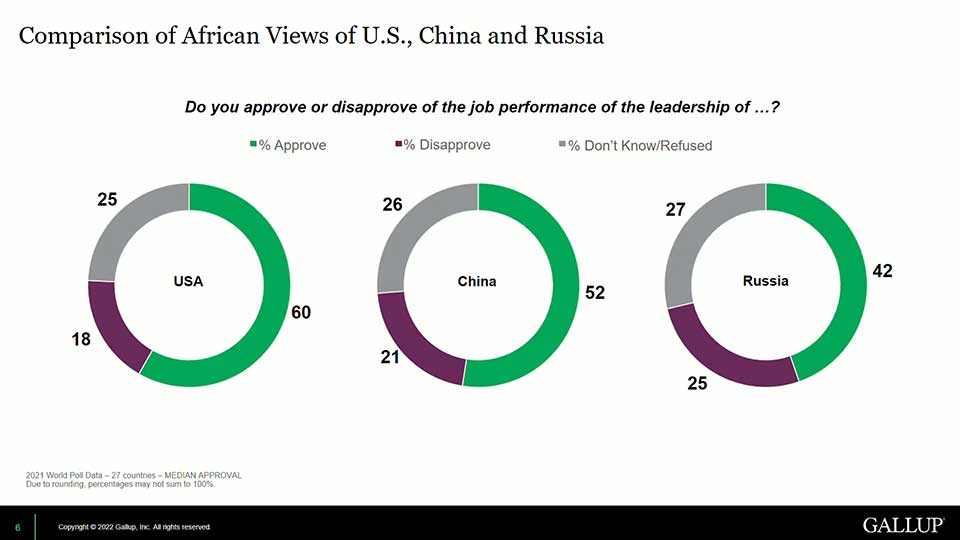
General publics in Southeast Asian countries tend to view China more warmly than elites in those same countries, according to a new opinion poll in fifteen countries run by the Sinophone Borderlands research project at Palacky University Olomouc in the Czech Republic. Similar to poll results in Africa, China and the United States are both viewed positively by large portions of the general public. (ASIA TIMES)

The Prime Minister of Antigua and Barbuda, Gaston Browne, called out China and India to demand compensation for the damage they've caused by polluting the environment.  "We all know that China, India - they're major polluters, and the polluter must pay," the PM said at the COP27 summit in Egypt on Tuesday speaking on behalf of the Association of Small Island States. "I don't think that there's any free pass for any country and I don't say this with any acrimony." (REUTERS)

China is reportedly offering El Salvador the opportunity to refinance its foreign debt obligations. “China has offered to buy all our debt, but we need to tread carefully,” Vice President Felix Ulloa told Bloomberg earlier this week when asked about a potential debt restructuring.  “We are not going to sell to the first bidder, we need to see the conditions.”(BLOOMBERG)

The consortium building a China-funded high-speed railway between the Indonesian cities of Jakarta and Bandung is seeking a $1.03 billion loan top-up from China Development Bank to fund a budget overrun on the project. The Indonesian government wants to launch the $6 billion project in June 2023, but it’s facing spiraling costs from complicated land acquisition processes, COVID disruptions and rising material costs. (REUTERS)

Chinese Premier Li Keqiang announced a large development assistance package for Cambodia on Wednesday. He alsooversaw the signing of 18 agreements on aid and cooperation, and attended the inauguration of a highway constructed with Chinese support. Li is in Cambodia for this year’s Association of Southeast Asian Nations (ASEAN) summit. (AP)

Philippine President Ferdinand Marcos Jr. said he will use his visit to the ASEAN summit in Cambodia to raise issues around the South China Sea. Beijing and Manila have competing claims in the region. He said the ongoing crisis in Myanmar and the Ukraine conflict will also be on the agenda. (ABS-CBN NEWS)

The China-Shaped Hole in Natural Gas Financing

Source: China’s Global Energy Finance Database, Boston University Global Development Policy Center
The role of natural gas in African green transitions has become a flashpoint as Europe tries to maximize its own access to African natural gas while also discouraging African countries from factoring it ...

China-Linked Group Will Run Angolan Transport Corridor

Map of the Lobito transport corridor linking the DRC to Angola's Lobito Port
The Angolan government has signed a $450 million agreement with the Portuguese infrastructure group Mota-Engil to run rail and logistics in the Lobito Transport Corridor, which connects Lobito Port to the ...

Kenya’s Supreme Court to Weigh In on SGR Contract

File image of Kenyan Supreme Court Chief Justice Martha Koome (L) and Deputy Chief Justice Philomena Mbete Mwilu (R) who will both hear arguments over the legality of the Standard Gauge Railway contract with China Road and Bridge Corporation.
Kenya’s Supreme Court will rule on the legality of the country’s Standard Gauge Railway contract. Opponents say the contract being awarded to China Road and Bridge Corp contravened Kenya’s competitive ...

China Cuts Import Tariffs for Ten Poor Countries

Zhang Lizhong is China's ambassador to Uganda.
China will cut tariffs on 98% of taxable imports from ten low-income countries. 8,786 different products from Afghanistan, Benin, Burkina Faso, Guinea-Bissau, Lesotho, Malawi, Sao Tome and Principe, Tanzania, Uganda, and Zambia will ...

Analysis from Cobus van Staden

The G20 Summit and the Half-Life of a Joke

When it was announced in 2023 that the African Union would become a full member of the G20, I darkly joked on a podcast that the AU’s entry into the body could very well mark the moment the G20 lost its status as one of the most important global coordination forums. Mark my words, I said, soon The Economist will be like “Uhhh, the G20 is OVER – it’s the ...

China’s Growing Influence in West Africa

File image of Ghana's President Nana Akufo-Addo together with Chinese Prime Minister Li Keqiang at the Diaoyutai State Guesthouse in Beijing. JASON LEE / POOL / AFP
As former colonial powers like France and the United Kingdom lose their relevance in West Africa, the region is pivoting to China. This trend comes as China’s own confidence in ...

Chinese Oil Buying in Africa Plunges Amid Shift to Suppliers in Russia, Persian Gulf

Chinese oil imports from African countries dropped 22.6% year-on-year in the January-September period, highlighting a decade-long transition away from the continent to suppliers in Russia, the Persian Gulf and Brazil.

The drop in 2022 further eroded Africa's total share of the Chinese oil market from 13.2% last year to just above 10% in 2022, according to new Chinese customs data. But this downward trend shouldn't come as a surprise as it's been underway for years.

In 2008, according to research done by George Washington University China-Africa scholar David Shinn, China's sourced nearly a third of its oil from Africa, predominantly from just three countries in Angola, Sudan (then a unified country), and the Republic of Congo. Ten years later, said Shinn, that volume shrank to 18% of China's total imports and still appears to be heading downward.

While Angola remains the only African country in China's top ten list of oil suppliers, it may not remain there for much longer as the Chinese appetite for the Southern African country's crude appears to be fading. In the first nine months of this year, according to data from S&P Global, the Chinese reduced their purchases of Angolan oil by a whopping 59.4% compared to last year.

SUGGESTED READING:

Algeria is the Latest Developing Country to Get in Line to Join the BRICS Group

The Algerian Ministry of Foreign Affairs officially submitted its application this week to become a new member of the BRICS club. Algeria now joins a growing list of developing countries, including Argentina, Saudi Arabia, and Iran, that all want to join the Chinese-initiated group.

The BRICS group accounts for 25% of global GDP and 40% of the world's population and is now increasingly viewed by many developing countries as a rival to the G7 and other Western-led blocs.

Back in July, when Algerian President Abdelmadjid Tebboune first spoke about joining the BRICS, he said admission would bolster Algiers's commitment to the principle of non-alignment and pull the country "away from the attraction of the two poles."

SUGGESTED READING:

Chinese Foreign Ministry Spokesman Said He’s “Not Aware” of Reports Xi Will Travel to Saudi Arabia Next Month

Chinese Foreign Ministry Spokesman Zhao Lijian tried to tamp down mounting speculation that President Xi Jinping will travel to Saudi Arabia next month to attend a pair of summits. Zhao brushed aside a question on the issue from Reuters at the regular press briefing in Beijing on Tuesday when he said he's "not aware" of any reports that President Xi plans to visit the Kingdom.

The Wall Street Journal on Tuesday became the latest media outlet to report with a high degree of certainty that the visit will take place. (REUTERS)

Chinese State Media Tries to Put a Positive Spin on Trade Ties With Tanzania

The Communist Party-run tabloid Global Times is trying its very best to send a positive message about the state of China's trade with Tanzania. On Tuesday, the newspaper featured an interview with Chinese ambassador Chen Mingjian who touted the recent announcement to remove tariffs on 98% of Tanzanian exports while boosting purchases of agricultural products like soybeans and avocados.

The problem is that Tanzania, like the overwhelming majority of African countries, simply does not produce enough high-value goods and services to sell to China that will have any meaningful impact on the gaping trade imbalance.

Last year, according to UN figures, Tanzania purchased $2.7 billion worth of Chinese goods but sold just $278 million of mostly agricultural products in return -- a 10x difference.

So, the fact that third-quarter trade volume went up, as showcased in Global Times, isn't actually as important as which way the trade flows are going.

Read the full article on The Global Times website.

Just as in Nigeria, Kenyan Lawmakers Are Also Confused About What It Means to Waive “Sovereign Immunity” in Chinese Loan Contracts

Anger is mounting across Kenyan society over the terms of the loan agreements with the China Exim Bank for the multi-billion dollar Standard Gauge Railway that were released by the government on Sunday.

Members of Parliament are sounding off in the media about what they perceive as grossly unfair terms on everything from the fact that Chinese law would be used to arbitrate any dispute to the stipulation by the Chinese that inbound cargo bypass the Port of Mombasa and instead be cleared at the Chinese-built inland container depot in Naivasha.

But it was the government's decision to waive "sovereign immunity" that appears to be generating the most concern now, prompting renewed speculation that Kenya is vulnerable to the Chinese seizing the country's infrastructure assets in the event of a default on the SGR loan. Gladys Boss Shollei, who is an attorney and the deputy speaker of the National Assembly, explained in an interview on Tuesday with national broadcaster KTN why she's worried:

"This is a contract between the Exim Bank of China, which is under the Ministry of Finance in China, it is the government of China and the borrower [which] is the government of Kenya. Interestingly, this should actually be a bilateral arrangement between government to government but instead, Kenya, in the contract has waived its immunity as a government and is subject to private commercial law.

Basically, we have exposed Kenya. 

[Normally] the government has immunity such that should you be in default, the property of the government of Kenya cannot be auctioned. But we have waived in this contract that immunity. Therefore, China is capable of auctioning government property... We have therefore lost the protection that we normally have as a government."

The same concern emerged in Nigeria in 2020 when lawmakers and multiple news reports incorrectly stated that a waiver of the sovereign immunity clause in their Chinese loan contracts made the country vulnerable to asset seizures.

Legally, explained international law expert Laure Deron, a country's national sovereignty is absolute. This means that assets cannot be seized by an outside party without legal consent under any circumstances. The sovereign immunity clause simply stipulates that in the event of a dispute, the state (Kenya or Nigeria) cannot use this national sovereignty as a justification to avoid arbitration.

So, waiving that clause only means that the borrower and the creditor agree to negotiate a settlement if problems arise. It does not grant the lender power to seize an asset. Apparently, many Kenyan and Nigerian lawmakers don't seem to be aware that this is a benign clause and standard language in most Chinese loan contracts.

https://www.youtube.com/watch?v=bEn7Ju-7eJ4&t=1s

SUGGESTED READING:

New Undersea Cable Will Link China to a Trio of Countries in Southeast Asia

Six telecom carriers from four countries in Asia signed an agreement to build a new regional undersea high bandwidth cable. The $300 million Asia Link Cable system will stretch 6,000 kilometers from southern China to the Philippines, Brunei and Singapore.

Read more on this story on the ZDNet website.

Kenyans React to Publication of SGR Documents

Cover story of Tuesday's Standard newspaper in Kenya that blasted the new government for failing to provide the full contract for the Standard Gauge Railway.
The decision by the incoming government of Kenya to release some documents relating to the controversial Chinese-built Standard Gauge Railway is causing massive controversy at home.  The main reaction has been anger that ...

People’s Bank of China Exec Blames Debtor Countries for Transparency Issues

HEADLINE TRANSLATION: Debt in developing countries needs better coordination among creditors
As controversy swirls over the role of Chinese lenders in successive Global South debt crises, China is still getting used to its new role as a global financier.  This was one of the ...

Kenyan Purple Tea Wows Hunan

A cup of Kenyan purple tea, its newest export to China
The first shipment of 240 kilograms of a rare kind of Kenyan purple tea has arrived in Hunan province. The tea, which is a clear lilac color when brewed, is only the latest ...

Climate, Geopolitics Greatest Threats to African Development: Study

Source: African Futures, ISS
For Africa to achieve its development potential, it needs uninterrupted cooperation with the United States, Europe, and China. This is a key finding of a recent set of future projections by the Institute for Security ...

Why Kenya Should Have Never Borrowed So Much Money From China to Build the Standard Gauge Railway

The Kenyan national television network KTN broadcast a scathing 10-minute mini-documentary on Sunday that detailed the controversial history of the Standard Gauge Railway and how the lack of proper due diligence set the project to fail from the start.

The focal point of the documentary is testimony by Transport Cabinet Secretary Kipchumba Murkomen during his confirmation hearings last month, where he explained in detail why this project was doomed to fail:

"We took out a loan of 20 years on an infrastructure of a hundred years. It becomes impossible to pay that loan from revenue that comes from the railway and even in 50 years, it will never break even. So, there was a strategic decision at that time that we invest in infrastructure and the government of Kenya pays back in 15-20 years. Now we are choked with loans."

"More due diligence should have been done in terms of financial factors," concluded Mombasa Governor Abdulswamad Nassir.

Watch the full documentary on KTN's YouTube channel.

Loan Revelations Spark New Confusion Over Whether Kenya’s Port of Mombasa Can Be Seized by China

There is renewed anxiety in Kenya over whether the Port the Mombasa is at risk of being seized by Chinese creditors in the event that the government fails to repay the loan for the Standard Gauge Railway (SGR).

Kenyan media began to circulate the rumor on Sunday after a set of loan agreements for the SGR were made public by Transport Cabinet Secretary Kipchumba Murkomen. "We authoritatively report today that the country's ports may not be safe," warned national broadcaster KTN.

That sentiment was then widely shared on social media, renewing fears that the port and other national assets may be vulnerable in the event of a default on the SGR loan. 

But nothing in the released documents says anything about the port itself serving as collateral in the event of a default. Instead, as has long been reported by scholars like Deborah Brautigam at Johns Hopkins University, revenue from the Port of Mombasa can be garnished to repay the loan if Kenya Railways falls into arrears.

"The collateral, or “asset” that could be at risk in case of default is not the port’s ownership, but the port’s revenues, which, in theory, could be attached in a lawsuit since they are part of the guarantee structure," explained Brautigam.

The port itself is not collateral and is not at risk of seizure by Chinese creditors in the event of a default.

SUGGESTED READING:

Even Amid Debt Crisis, Kenya Still Wants to Extend SGR to Ugandan Border

The burgeoning fiscal crisis in Kenya is not dampening the government's ambition to extend the Chinese-built Standard Gauge Railway from the Naivasha in the Rift Valley all the way to Kisumu near the border with Uganda.

“This project will only make sense when it goes past Naivasha as compared to the current situation where we are forced to transport goods by the lake instead of having it through the Kisumu port,” said Roads and Transport Cabinet secretary Kipchumba Murkomen on Sunday but he did acknowledge that the $3 billion initiative would only be possible if the financial resources are available.

Originally, the SGR had been scoped to go all the way to the Ugandan border, but China balked at financing the extension beyond Naivasha due to concerns that Kenya would not be able to fully repay the loans needed to build the railway.

SUGGESTED READING:

Huawei Eyes Expansion in the DR Congo

A delegation of senior executives from Huawei's Africa division met on Friday with Congolese Prime Minister Jean-Michel Sama Lukonde at his office in Kinshasa to discuss "the DRC's digital development." No other details about the meeting were made available.

Huawei is leaning much more toward Africa in part as a way to offset restrictions hampering its business in Europe, the U.S., and certain Asian markets. Last month, the company launched new 5G networks in both Kenya and South Africa. (AFRICA YELLOW AND BLACK -- in Chinese)

Why Sharif’s Recent Visit to Pakistan Wasn’t as Successful as Many Think

Dear Eric and Cobus,

Because I know you all care deeply about this topic, I thought I’d share my take on the Pakistan-China relationship and what came out of PM Sharif’s recent Beijing trip. I’m saying this because I’ve got a different take from what you wrote on Friday in your story Pakistan PM Sharif Had a Good – Very Good – Trip to Beijing and what Bloomberg Pakistan Bureau Chief Faseeh Mangi wrote in his recent story. For details, you can perhaps review this ghost-written English version of my Urdu-language audio interview with Aaj TV in Pakistan.

As for the ML-1 (also known as the Karachi–Peshawar Railway Line) and new infrastructure projects, the most interesting story is as follows:

  • Right before PM Sharif went to Beijing, Pakistan formally approved a 45% hike in the ML-1’s cost estimate which was one of the stumbling blocks on the ML-1 project’s financial deal closing. AidData recorded this in the 2017 commitment year as a “pledge” which in the OECD's Common Reporting Standard (CRS) parlance simply means a promise or expression of intent. Since then, both sides have been undertaking extensive engagements to work out the financial and technical details.

  • My view at the moment is that in addition to reasons stated in my Aaj TV piece, Chinese creditors will NOT move forward with the $10 billion ML-1 project unless they’ve got a sovereign guarantee from Pakistan and/or a Sinosure policy. They’re probably worried about the so-called ‘circular debt’ issue from the Chinese Independent Power Producers (IPPs).

  • Here’s an interesting development, though. For the first time, right before the PM’s visit to Beijing, Pakistan agreed to create an escrow account for IPPs, but it’s only $250 million and I have the sense that this will be a drop in the bucket and mostly just a confidence-building measure to show Beijing that they’re serious about maintaining the liquidity of their investments in Pakistan. 

  • Interestingly, the joint Pakistan-China communique did not even talk about the debt rollover issue. For Pakistan’s Ministry of Finance, this would have been the #1 issue since they’re continuing to face balance of payment problems and are in desperate need to get some debt relief. Perhaps that will come as a separate announcement later.

So the reason why I’m taking the liberty of writing this note is that I’m less positive than you all about the “success” of this visit. I certainly hope this is somewhat helpful.

Dr. Ammar A. Malik
Senior Research Scientist
AidData

If you have feedback on a story that you would like to share, please feel free to email Editor-in-Chief Eric Olander at eric@chinaafricaproject.com or Managing Editor Cobus van Staden at cobus@chinaafricaproject.com. All correspondences are republished only with the author's permission.

Page 117 of 2181116117118218

[ATTENTION SUBSCRIBERS] Delivery of the daily email newsletter will resume on Monday, January 5th.

X