By Saniya Kulkarni and Lukas Fiala
The tentative normalisation of Sino-Indian relations over the last year has sometimes been attributed to President Trump’s heavy-handed approach to trade policy, especially his “liberation day” tariff announcements. Going into 2026, however, it remains the case that regional priorities and difficulties rather than U.S. revisionism will be the determining variable in understanding the complex relationship between New Delhi and Beijing.
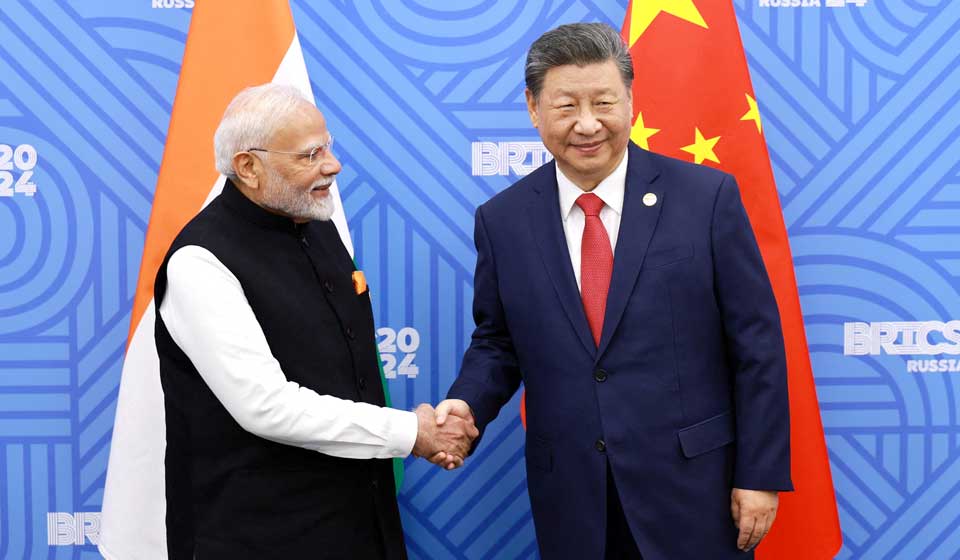
Despite friendly handshakes between Indian Prime Minister Narendra Modi and his Chinese counterpart Xi Jinping at the SCO summit last year, these longer-term developments will continue to limit the extent to which both sides will be willing and able to leverage a diplomatic rapprochement against an assertive White House.
For instance, India has continued to maintain caution – with perhaps a hint of scepticism – vis-à-vis Beijing, especially in the security realm, while attempting to normalise relations in less sensitive domains such as the economy. Although deteriorating relations with the US may have catalysed attempts at normalisation, it will likely not be enough to stabilize relations in the longer term.
Regional realities remain at the forefront of bilateral tensions, evidenced most recently by India’s objections to Chinese infrastructure projects in the contested Shaksgam Valley under the CPEC.
Chinese investment in Pakistan has surged under the second phase of CPEC, with approved SEZs rising from seven to 44. Despite the persistence of problems plaguing CPEC 1.0, including but not limited to long-delayed projects due to administrative inefficiencies, political instability in Pakistan, and attacks on Chinese personnel, Beijing seems to have an appetite for risk when it comes to maintaining ties with a strategically important partner.
New Delhi’s denouncement of CPEC and Beijing’s reiteration of its claim over the territories in question come at the same time as a delegation of the Chinese Communist Party met with officials from Modi’s BJP as well as the primary opposition party in India. It wouldn’t be wrong, therefore, to conclude from the events of last week that the two neighbours are exploring avenues for cooperation while refusing to compromise on their respective territorial claims.
The key takeaway is that both are now seasoned at decoupling economic and national interests within the wider bilateral relationship.
And such a common denominator approach makes sense. Indeed, from the perspectives of Beijing and New Delhi, greater stability throughout 2026 would be beneficial amid a more unpredictable US. While this may not solve the regional status quo or longstanding territorial disputes, Beijing may well see value in focusing on domestic reform priorities, especially those articulated in the upcoming 15th five-year plan, and on mitigating the fallout of a riskier international system.
While both Beijing and New Delhi certainly observe closely what happens in Washington and across the Atlantic, especially with regard to Greenland and the future of NATO, Sino-India relations will continue to be shaped primarily by the regional context and environment.
In this vein, any diplomatic normalisation between the two sides will likely focus on lowest-common-denominator solutions rather than making big strides on thorny security and territorial issues. From regional security concerns to the complex setbacks plaguing CPEC, there will be plenty to keep track of in the months ahead.
Saniya Kulkarni is the executive program manager at LSE IDEAS and Lukas Fiala is the head of China Foresight at LSE IDEAS