China’s economic footprint in Southeast Asia has two faces. The first is very visible: industrial parks in Vietnam and Cambodia, the China-Laos Railway, and the clusters of Chinese traders in the commercial districts of Sihanoukville and Mandalay.
The second face does not announce itself with groundbreakings or ribbon-cuttings, and it rarely appears in foreign direct investment statistics. It operates through software updates and equipment sales: present everywhere, visible almost nowhere.
The institutional vehicle for this digital presence is the Digital Silk Road (DSR), the digital dimension of China’s Belt and Road Initiative (BRI). The DSR’s metaphorical “silk” is data, a commodity increasingly central to economic and political power in the digital age. Launched in 2015, the DSR channels Chinese capital and technology into Southeast Asia countries’ communications infrastructure, mostly through private Chinese tech companies: Huawei, ZTE, ByteDance, Alibaba, and their subsidiaries.
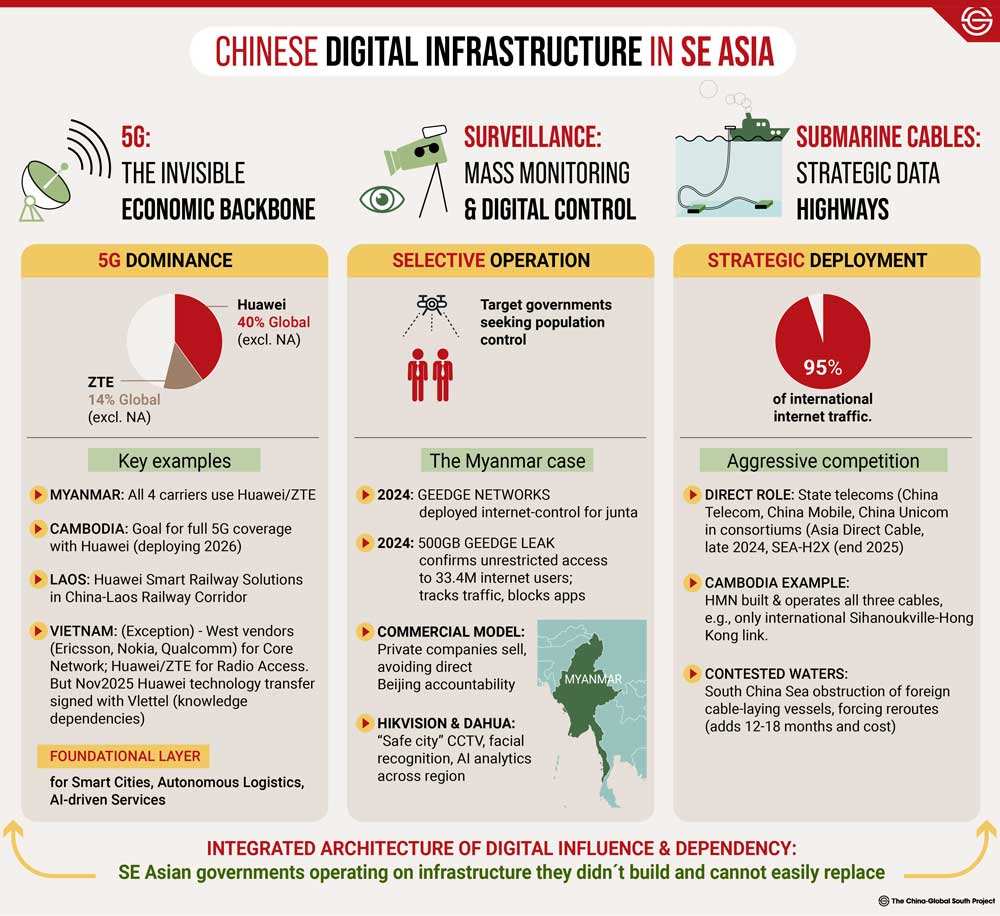
Three technologies sit at the strategic core of this deployment: 5G telecommunications infrastructure, surveillance technology and submarine cables. China’s position differs across the three. In 5G, it dominates. In surveillance, it operates selectively, targeting governments that share the appetite for digital population control. In submarine cables, it competes aggressively but faces a more contested landscape. Together, they constitute an integrated architecture of digital influence that is hard for a conventional (Foreign Direct Investment) FDI analysis to detect.
Much of this investment arrives through contracted infrastructure projects financed by Chinese policy bank loans, or as equipment sales recorded under trade rather than investment flows. The result is that the true scale of China’s digital presence in Southeast Asia remains undercounted.
5G: The Invisible Economic Backbone
5G is not simply a faster mobile network. It is the foundational layer on which the next generation of economic activity will run. It enables smart manufacturing and agriculture, autonomous logistics and AI-driven smart city services. In Southeast Asia, that foundational layer is largely being built by China.
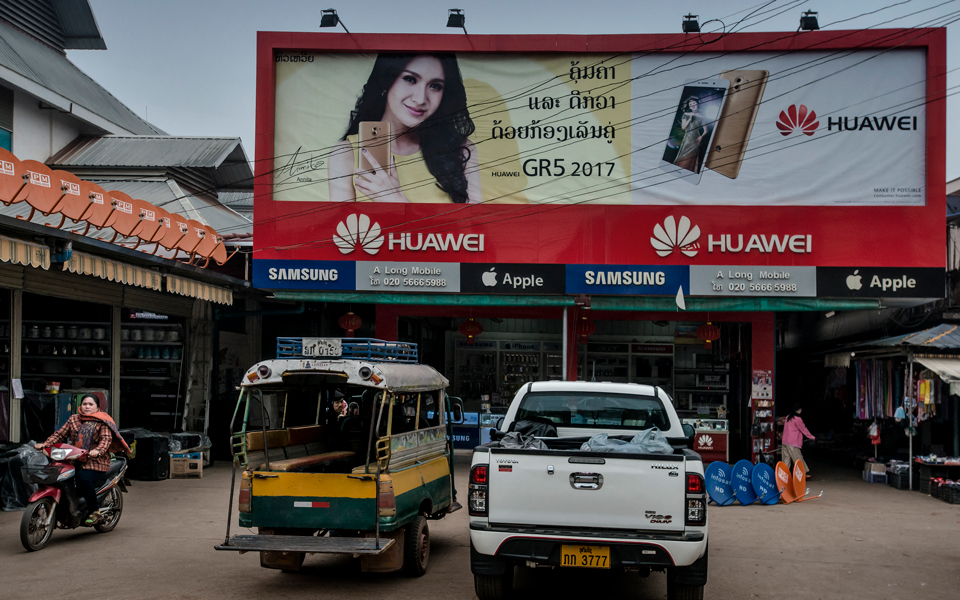
Globally (excluding North America), Huawei holds approximately40% of the telecom equipment market, with ZTE at 14%. The result is a market already structured around Chinese infrastructure. All four of Myanmar’s mobile carriers run Huawei or ZTE equipment. Cambodia’s government has pledged to achieve full 5G coverage with Huawei as the primary contractor, the deployment kicking off in 2026.
In Laos, Huawei has embedded its Smart Railway Solutions into the China-Laos Railway corridor, extending 5G infrastructure into the country’s most strategically significant transport system.
Vietnam once represented a more deliberate exception: In 2020, it joined the U.S. – led Clean Network Initiative and committed to keeping Huawei and ZTE out of its 5G rollout, with the Western vendors (Sweden’s Ericsson, Finland’s Nokia and U.S. chipmaker Qualcomm for the equipment) handling the core network. That position has since been reversed. By 2025, both Viettel and VNPT had signed radio equipment contracts with Chinese vendors, and Mobifone, the third major operator, entered similar talks in early 2026.

Vietnam’s approach is less about choosing sides than managing suppliers. In February 2026, Vietnam licensed Starlink (SpaceX’s low-earth orbit satellite internet service) to operate commercially, with services expected by mid-2026, making Vietnam the sixth Southeast Asian country to deploy it. Viettel, the country’s largest telecom operator and a military-owned company, has also developed its own 5G core, emerging as a core vendor. Cost and reliability, not allegiance, are driving the choices.
Surveillance: The Myanmar Case
If 5G is the invisible backbone, surveillance technology is the most politically charged application running on top of it. China’s domestic surveillance architecture is the most sophisticated mass-monitoring system ever built. It is now being exported to some global south countries.
The most documented case in Southeast Asia is Myanmar. In 2024, the Chinese network security firm Geedge Networks deployed a commercial version of its internet-control system for Myanmar’s military junta. A 500-gigabyte (GB) data leak from Geedge, reported in 2025, confirmed what investigators had long suspected: the system gives the junta unrestricted access to the online activity of Myanmar’s 33.4 million internet users. It can track individual network traffic in real time and block targeted applications.
The commercial model is worth noticing. Geedge is not a state enterprise. It is a private Chinese company, selling a product. This structure prevents Beijing from direct accountability while achieving the same strategic outcome: an aligned government with the technical capability to surveil and silence its population.
Geedge is not alone. Hardware manufacturers Hikvision and Dahua, are supplying ‘Safe City’ surveillance infrastructure across the region: CCTV networks, facial recognition systems, and AI analytics platforms marketed as crime prevention tools.
Submarine Cables: Strategic Deployment
Submarine cables are the strategic layer of ASEAN’s digital economy. It’s like the highway for data transmission. Approximately 95% of the world’s international internet traffic travels through submarine cables. These cables are among the most strategically important pieces of infrastructure, and among the least discussed when it comes to China’s oversea investments.
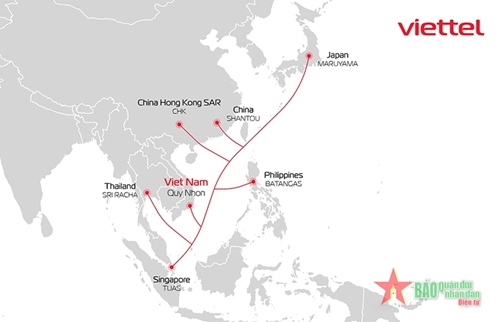
China’s cable strategy in Southeast Asia operates on two levels. The first is direct: Chinese state telecoms companies like China Telecom, China Mobile and China Unicom are members of the consortium building the region’s new cable systems. The Asia Direct Cable became operational in late 2024, linking Vietnam, Thailand, and Singapore directly to China. The SEA-H2X cable, completed by the end of 2025, runs from Hong Kong and Hainan to Singapore via Malaysia, Thailand, and the Philippines.
The second level is less visible: HMN Technologies. Formerly known as Huawei Marine Networks, the company was sold to Hengtong Group in 2019 and rebranded. HMN keeps Huawei Marine’s engineering base, IP portfolio and cable-laying fleet, and continues to secure contracts across the region. In Cambodia, it built and operates all three submarine cables, including the Sihanoukville-to-Hong Kong cable, the country’s only international submarine cable link.
In the contested territories, the cable laying competition is getting more complicated. The South China Sea, the most efficient routing corridor between East Asia and the rest of the world, is subject to Chinese territorial claims under the Nine-Dash Line. Beijing has consistently obstructed foreign cable-laying vessels operating in those waters, forcing reroutes that add 12 to 18 months and adding significant cost to Western and Japanese projects.
Taken together, the three technologies form a layered architecture of foreign suppliers. The political implications vary by country. But the structural reality is the same: Southeast Asian governments are increasingly operating on infrastructure they did not build, regardless of where it came from.
Chen Heyi is an independent China-Southeast Asian relations analyst.