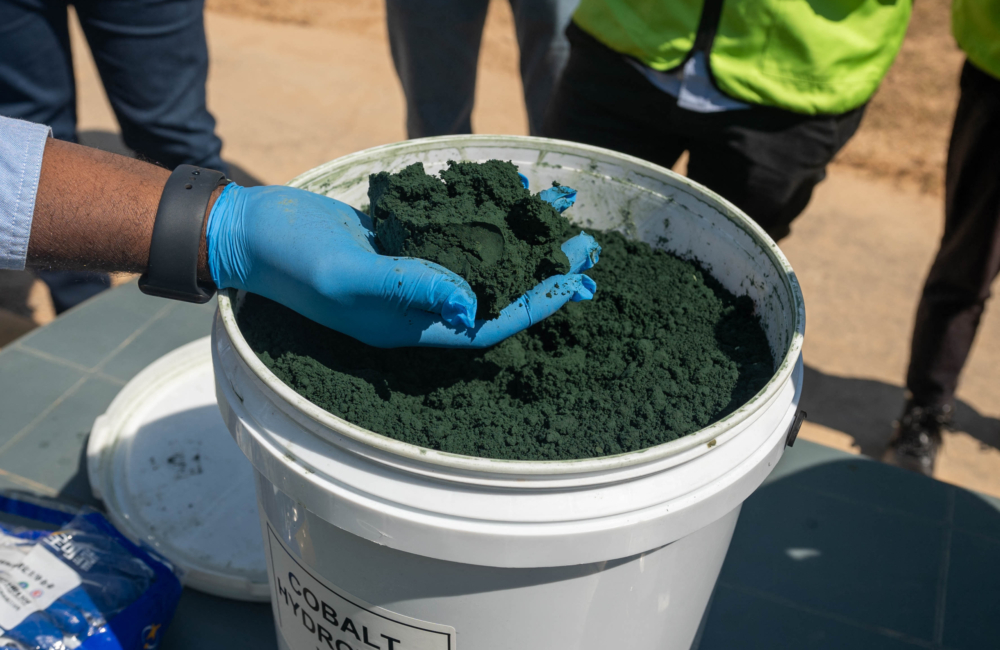
There’s mounting evidence from the United Nations and others that Chinese organized crime syndicates are moving more of their operations from countries in Southeast Asia to Africa. These groups are contributing to a surge in illicit crypto mining, scam centers, illegal wildlife trafficking, and black market weapons sales.
African countries with already weak governance systems are particularly vulnerable.
Géraud speaks with Adam Rousselle, a researcher and author who tracks the illicit arms trade, about his recent article on the topic published by the Jamestown Foundation. Adam explains how all of the different Chinese illegal trade networks in Africa are interlinked with one another.
Show Notes:
- United Nations Office on Drugs and Crime: Inflection Point: Global Implications of
Scam Centres, Underground Banking and Illicit Online Marketplaces in Southeast Asia - Jamestown Foundation: Illicit PRC-linked Finance Enables Arms Diversion in Africa by Adam Rouselle
- London School of Economics: Ghana and China Have a Shared Responsibility for the Illegal Mining (Galamsey) Crisis in Ghana by Nathaniel Ocquaye
Chapters:
- The Illicit Underworld – How illegal mining, logging, and weapons flows shape China–Africa debates
- Individuals vs the State – Why Chinese nationals abroad are often mistaken for Beijing’s agents
- South Kivu Gold Trail – What the recent court case reveals about Chinese smuggling networks
- Governance Gaps – How weak enforcement and political protection fuel illicit economies
- Cryptocurrency Networks – The rise of Chinese-linked crypto operations in Nigeria and beyond
- Weapons on the Move – Why Chinese-made guns keep appearing in Africa’s conflict zones
- The UAE Hub – How Dubai became the transit point for arms and illicit finance
- The Leaky Bucket – Why illicit flows don’t imply coordination or state intent
- Local Complicity – The real role of African politicians, militaries, and brokers
- Reputational Risks for Beijing – Embassy frustrations and the cost of unmanaged actors
- Media Distortions – How U.S. and European narratives simplify complex realities
About Adam Rouselle:

Adam Rousselle is a researcher, writer, and consultant specializing in threat finance, weapons technology, macroeconomics, and geopolitics. He has written for GNET, the Hudson Institute, Nikkei Asia, and Small Wars Journal, with a focus on the intersections of illicit finance, conflict, and state power. His research has been cited by the Financial Action Task Force (FATF), the U.S. Department of Defense, the U.S. Senate, and leading journals. He is the founder of www.btl-research.com, an independent platform dedicated to mapping global shadow liquidity and gray zone financial networks.
Transcript:
ERIC OLANDER: Hello, and welcome to another edition of the China in Africa podcast, a proud member of the Seneca Podcast Network. I’m Eric Olander, and as always, I’m joined by CGSP’s Africa editor, Geraud Neema, from the beautiful island of Mauritius.
A very good morning to you, Geraud.
GERAUD NEEMA: Good morning, Eric.
ERIC OLANDER: Geraud, over the years on this program, and it’s been an area of interest for us, we’ve been following a lot of the illicit flows of money and resources between China and Africa. So we’ve talked in the past a lot about the illegal rosewood trade, illegal mining in the DRC, and illegal weapons that flow from China or other countries into Africa.
And all of this contributes to the instability we see, particularly in countries like your own, the Democratic Republic of Congo. In many ways, this is the kind of thing you lift up the rock and find underneath the rock in the China-Africa relationship, which oftentimes doesn’t get the attention it deserves.
GERAUD NEEMA: Yes, because over the years, when you talk about all those topics, you start to have a trend of thinking, a trend of conversation where people are trying to understand if having China’s presence in those spaces, China’s presence is creating or fueling instability in those regions. We had comments and debates about, for example, having Chinese in the Eastern DRC, where the region is unstable. Are these Chinese presence there somehow fueling instability in those regions?
You had the case of Mozambique, where some Chinese are also trading illegal rosewood in a region where you have rebels and instability. You also had those kinds of debates where people were questioning all of that. So when you have China’s weapon finding itself somewhere in the DRC, in Rwanda, in Uganda, people start also asking whether China is playing a role in fueling conflict.
So basically, when you have all those elements all coming together, it’s rightfully so that you’re going to have some people trying to draw a conclusion or people in decision-making roles in certain spaces trying to say, you know, there is a connection or not. So, yeah, that’s the kind of thing that’s now coming. It’s a part of the debate that we have to be paying careful attention to because we want to make sure that there is intent or coordination or there is anything behind that that you can really pinpoint and say China is responsible.
Because there’s also an easy shortcut that people can take to say, because you have a Chinese presence there, it means that China as a country, as a government, is behind all of this.
ERIC OLANDER: Yes. And so that’s the key question here: when we see illegal mining in Nigeria or in the DRC or elsewhere, illegal logging in the Republic of Congo, or, as you’ve talked about, the weapons trade, is that something that is done by nefarious actors who are operating independently? Or is it something that is being coordinated or supported or tacitly supported by the Chinese government?
What is your quick take? And we’re going to dive into this in your conversation today. But let’s just kind of lay it out there.
What do you see when you hear those types of accusations?
GERAUD NEEMA: You don’t have a strong body of evidence connecting those illegal activities with the Chinese government as a state, as entities. And you have a case, for example, in the case of Eastern DRC, where in January this year, the Chinese ambassador in the DRC himself made a statement by saying there’s no legal Chinese company operating in the eastern part of the DRC and urging the DRC government, if you do arrest a Chinese operating them, please arrest them, trial them and let us know. This is it.
And you also have different statements from different Chinese embassies in Ghana and Nigeria. You have all those statements out there. So it’s tough to have, as I was saying, a strong body of evidence to say they are connected to the Chinese state.
You have a lot of Chinese individuals, given how China is now entrenched in African relationships, trade, and economics. It’s unavoidable that you’re going to have Chinese businessmen, individuals being there, and among them, being illegal ones and legal ones, and all of that. I think you even remember, if you remember a few years back, Uganda had an operation with the Chinese police to arrest a Chinese mafia in Uganda.
And something also happened in Nigeria. So you have much more Chinese individual operating in those space, taking advantage than having a case where you have a governmental support. Of course, there is a nuance to bring in that conversation, because in the case of illegal logging in the DRC, there was a case where we had one of the Chinese companies operating on the ground, which was a subsidiary of a state-owned Chinese mining company, a state-owned Chinese logging company in China.
So that way you have some specific nuances in some instances. But overall, when you look at the picture, you cannot say we have a strong body of evidence to say, yes, the Chinese government supports those activities.
ERIC OLANDER: Yeah, there’s not much evidence there. And I’m glad you brought up this question of what the ambassadors say. The Chinese ambassador to Ghana, Ambassador Tong Defa, in fact, earlier this year came out and said to the Ghanaians that if Chinese miners are acting illegally, arrest them and prosecute them.
This is not a question of us, the embassy, or the Chinese government defending the actions of illegal Chinese miners in Ghana or elsewhere. And we hear that consistently across the continent, that if the Chinese are violating the laws, then the embassies say prosecute them. They’re not.
There’s no. Now we run into a different problem, though, is that the governance and the prosecutorial process in many of these countries is quite weak. And so as a result, people get frustrated when they see the Chinese or others just walk away because either they have gotten a good lawyer or they bribed their way out of it or whatever.
The system just did not work.
GERAUD NEEMA: Or most of the time they have a strong local political support behind them helping them to get out. I remember I had a conversation with a Chinese diplomat telling me, what do you want me to do? What do we want us to do in a context where you arrest someone and yourself, you have a politician in general going to the court and say, release that person.
So what do you want me as a diplomat here to do in these cases? So you have those kind of situations also where you have the responsibility of local law enforcement and politicians in all those kind of situations where Chinese are released after the fact.
ERIC OLANDER: Well, there was an interesting article that came out a couple of weeks ago by the Jamestown Foundation. Illicit PRC-linked finance enables arms diversion in Africa. And it brings up all of these issues that we are talking about.
You had a chance to speak with the author, Adam Roussel, who is the co-founder and chief analyst of Between the Lines Research. Set up the conversation that you had, because you and I, in advance of your conversation with Adam, were a little bit sceptical about the article. But then, when you had a chance to speak with Adam, he brought a lot of nuance to the conversation.
But talk about the skepticism that you went into this conversation with.
GERAUD NEEMA: Yes, I was really skeptical when I approached this conversation. It was one of those things when you prepare the interview, you realize that, wow, I’m afraid to be sounding, you know, very defensive here, trying to push back and becoming confrontational. Given that when I was reading the article, I had the feeling there were a lot of shortcuts taken in how things were presented, in how connections were made in one case in Eastern DRC, creating a whole situation where we have a generalization of the situation.
You have a situation where in Nigeria of cryptocurrency and making it a whole situation where you have a connection with arm deals with UAE and especially when you have now Chinese weapons coming from the UAE, but landing in Sudan. And you have now a kind of sense, you had a sense where the article was creating a connection between China and the UAE and China and the Sudanese conflict and providing all of that. I was like really looking at it like, nah, this is not really, there’s something really kind of wrong.
The feeling I had was really something wrong in this conversation. And fortunately, I was really pleasantly surprised when I talked with Adam Roussel, it was really a very vibrant conversation because it brought the nuances and that allowed me to understand, like, OK, I understand better what you wanted to say and the idea behind. So it was much more nuanced conversation that the article itself can give you the feeling that the feeling or the impression that you are reading, the conclusion that you’re having there.
ERIC OLANDER: Well, let’s take a listen now to your conversation with Adam Roussel about his article, Illicit PRC-Linked Finance Enables Arms Diversion in Africa that was featured in the Jamestown Foundation website. And we have a link to that in the show notes. Let’s take a listen now to your conversation.
GERAUD NEEMA:
We are going to talk about a very interesting topic that sparked a lot of interest and discussion in certain social media, where we look into the connection between Chinese actors, illicit finance flow and the conflict economics in Africa. For that, we are going to receive today Adam Roussel, who is the chief analyst at the research consultancy called Between the Lines, is the author of this paper. And recently, he’s been working and looking into the Chinese presence in the illicit financial flow in Africa and what’s the impact, what the presence and what to understand of it.
He wrote this very interesting paper where he argues that Chinese national are increasingly involved in a network of linking resource extractions, stable coins and even weapons circulating across conflict areas in the region. And of course, it’s a very bold argument, given how much Chinese are present in Africa and sometimes now raising the question like what could be and what are the impacts of their presence in those spaces. And of course, the argument he makes in his papers is going to have people being agreeing on that.
Some would not agree on that. But the point for us here will be to be able to understand the context of it, to understand the facts, the elements on the ground that for our audience to come and pick up the nuances and to be able to understand really what’s happened on the ground with that situation. Because here in the China Global South, we try as much as possible to cover Chinese presence in the Global South, put it in a context so we can understand really what’s really happening here.
So during this discussion, I may really come up, push back on certain argument, not for the sake of argument, but for the need for Adam to give us much more insight and understanding from his perspective and how it got to the conclusion the way it got to. So we can, at the end, leave this conversation with a clear understanding of really what’s happening on the ground. Adam, thank you and welcome to this conversation.
ADAM ROUSELLE: Thank you, Geraud. Thank you for having me.
GERAUD NEEMA: So let’s dive deep into the conversation. Can you walk us through briefly on how you got into your main thesis and how you got into looking to and try to understand, explore the link between Chinese national illicit financial flow and conflict economies in Africa? And what do you think?
And that connection tells us about the future, about China-Africa relations and the evolution of conflict in Africa.
ADAM ROUSELLE: That’s a lot to unpack. When I wrote this article, I wrote it as a follow-up to something I wrote last year that was cited in a report by the United States Senate Foreign Relations Committee. It was about Rosewood smuggling and its fuming of conflict in sub-Saharan Africa.
This follow-up is based on new evidence that surfaced and kind of builds on it a little bit. What I want to acknowledge first is that there’s a lot we don’t know. We don’t know the exact mechanisms through which these things happen.
I want to say clearly that there’s no evidence that, of course, that the Chinese government is involved in this, that there’s no evidence specifically that we even have a coordinated effort across these conflict zones between the criminal actors involved. What I have found is a preponderance of evidence to indicate that actors from China are facilitating these conflicts in a way that is opportunistic and ultimately fueling them. And that based on analyses I’ve conducted in other parts of the world, specifically Southeast Asia, the likelihood of conversions is very high.
And this is something to watch very closely. Right now, financial enforcement is just starting to catch up in Southeast Asia. We just had the world’s largest cryptocurrency seizure of 15 billion dollars by FinCEN in Cambodia.
None of that is possible without deep research on the ground and a lot of analysis. And what I’m hoping to do is to spark more conversations about this part of the world. So that’s kind of a bit of a background on what the article is, what it is not and what I hope it will achieve.
GERAUD NEEMA: That’s really interesting. So can you tell us what have you found? What have you described in your article?
Because many of our readers and followers haven’t read the articles. Can you walk us briefly through what the point was that you developed in your articles?
ADAM ROUSELLE: So I started off with a recent court case that came to fruition after I’d written the first article about three Chinese nationals being actually charged in a illicit gold smuggling. They mentioned they had an amount of gold bars. They didn’t say the exact quantity or value of the bullion.
And they had four hundred thousand dollars in cash. And that’s nothing new from an anecdotal perspective. Locals have been complaining about illicit Chinese actors on the ground in that part of the world, in the eastern Congo for many years.
What is new is that an actual judicial case was brought forth. And what we have now is evidence of. These actors acting in this way, in addition to an ongoing conflict in the region that has some very interesting links to China that are indirect, we know, or at least we have very strong evidence, despite the denials involved, that Rwanda is backing the M23 movement in the Kivu conflict.
And strong evidence also suggests that Uganda is. We also know that these rebels have been outfitted extensively with Chinese weapons. Now, that’s not to say the Chinese are arming them.
The Chinese sell vast quantities of weapons to both Rwanda and Uganda. And given what the rebels are pilfering out of mines in the region, such as cobalt, gold, coltan, China is the natural endpoint. We don’t have a causal link saying, OK, M23 is moving it to Rwanda and then they’re sending it out directly to China.
But there is enough of a global gravitational pull in that direction that says China is the endpoint. And so I’m very careful in how I worded that article because of the nuance there. But again, my hope is that we spark more investigation into this.
In another example I drew on, there were dozens of Chinese criminals operating in the vast cryptocurrency economy of Nigeria that were rounded up in a in a series of arrests. And again, when you look at the nature of stable coins and the nature of illicit finance, the fact that we have so many Chinese nationals involved in a completely different continent in a critical resource economy tells us that this is worthy of further investigation. And then, of course, in the final component, I talk about how we are seeing the current embargo on Chinese arms exports being evaded and these weapons ending up in the Sudan conflict.
Again, different theater and that we know through investigations that Dubai is a central node in this and Dubai serves as or the Emirates, I should say, not just Dubai, has served as a central node and also the commodity extraction and how it ends up back in China. So, again, what I am not saying is that we have any indication the Chinese government is involved or that all of the criminals involved are colluding, but that the opportunities are presenting themselves and that this tells us a lot about the nature of involvement in the region as a whole and warrants further investigation.
GERAUD NEEMA: The nuance that you brought is very interesting when you say that there is no proof so far that we can establish there is a connection between those individuals or if there is a network of individuals or if there is a coordinated effort that connects those people with the Chinese government and all of that. It’s very important because it really allows us to ask the question about intent, about accountability and, of course, as from an African perspective, to try to understand if action needs to be made, where the point of action could be, because if the framing is not correct, people tend to believe that it’s China-related, China government and people are going to be pointing fingers on the Chinese government, where the Chinese government is going to react by saying, no, it’s not us, it’s individuals. And because you’ve mentioned that, it just reminded me, early this year, the Chinese ambassador in the DRC was making a statement and he said there is no legal Chinese entity operating in the eastern part of the DRC, basically saying to a Congress official, if there is, if arrest any Chinese individual operating in that region, please arrest them, put them in jail, just arrest them, you know, so in a way that we are not part of that conversation. And I really like that nuance because people will tend to like put PRC-linked individuals in the whole box, it’s China’s and China’s government behind all of that.
ADAM ROUSELLE: A lot of analysts, I’ve lived in China, and a lot of analysts that cover China, not all, and I’m very clear about that, but a lot tend to think of it as a monolith that, you know, like that Xi Jinping says, go do this, they go do that, to some degree. I mean, we see that and, you know, the way a five-year plan is conducted, but even in that, there’s a lot of nuance and a lot of agency. And so the best way to understand how China exports influences is that it’s networked, that it’s a friend of a friend of a friend of a friend.
And so it’s, of course… The Guinness system. Exactly.
Yeah. And when you have that level of nuance, it’s very difficult to prove anything from an evidentiary perspective that leads all the way back. I’m more interested in liquidity and the flow thereof.
Where is it coming? Where is it going? And how can it be disrupted in a way that benefits humanity?
Because if liquidity is flowing in a way that’s killing people in conflict, then it’s immaterial to me where it comes and where it goes in terms of countries, but rather that it be stopped. So that’s where I’m kind of focusing my efforts. And of course, when the flows link to one country, that’s where I’m most concerned.
GERAUD NEEMA: Yeah. Let’s break down a few of the components that you mentioned in your paper. In the case of…
Let’s go back in South Kivu, because I’m basically from the DRC and South Kivu is really my native space and that case is really interesting because we’ve been following that case for quite some time. We’ve been really following the presence of Chinese illegal gold smugglers in that region and how Chinese embassies have been reacting to their presence there and how communist authorities also have been reacting. There was a case a few years back where there was a conflict between the provincial government and national government over how to treat the Chinese nationals that were involved in those situations.
In your paper, you mentioned those cases in South Kivu. From my understanding, the Chinese were not in the specific region where the rebellions were happening when they were arrested at that time. But what we know in the fact, we know that there was a lot of official involvement, a lot of local politicians, local military officers being involved with those Chinese present in those cases.
So when I read your paper, I was like, my feeling was like, where do we put the responsibility? Where’s the part of local agency and local responsibility in those contexts where beside the Chinese, you also have other stakeholders, the Indians, the Pakistanis, the Lebanese, also taking advantage of all that context of that situation because of corruption, because of lack of governance?
ADAM ROUSELLE: And I mean, I think that it ultimately does come down to a matter of local agency and dealing with the vast global problem of corruption. And this is not at all an Africa-centric issue. We’ve had issues in the developed world of politicians being co-opted and officials being co-opted by dark money and particularly related to Chinese crime.
We have an ongoing issue in Southeast Asia with regard to it. But I think the judicial case was very interesting. And of course, evidence suggests that Kinshasa put a lot of pressure on the case locally due to its concerns over sovereignty and the ongoing insurgency.
So it is possible. I think it requires external assistance from global regulators. We’re dealing with a transnational issue.
And so the level of responsibility that is local is important, but it’s not the end point either. It requires a networked response to a networked problem.
GERAUD NEEMA: So in this case, when you look into those kinds of situations, what could be the action that a Chinese official can be taking to tackle those kinds of issues led by those individuals on the ground? Because that’s really something at some point, the African government has been complaining about that, complaining about the fact that we have Chinese nationals here, either we arrest them, or we send them back. And this is also a very interesting point where you notice that African officials arrest Chinese individuals, and instead of putting them in jail in African countries, they tend to send them back to China for reasons that we still don’t understand.
And this is a very tricky situation. So what could be the level of responsibility of the Chinese government in such a situation, if there is any kind of responsibility at all?
ADAM ROUSELLE: The Chinese government is concerned about the illicit behaviors of its citizens abroad. It’s actually even issued warnings, I mentioned in the paper, to Chinese citizens operating specifically in the mining sector in the region in this one case. And we’ve seen arrests, like large-scale arrests in places like Cambodia.
When we see an extradition back to China, I mean, unless there’s real desire to save face, which is essential to the Chinese system and Chinese culture as a whole, unless there’s sufficient pressure, I would suspect that those extraditions would go unpunished and you might see those people turn up in different countries.
GERAUD NEEMA: Let’s move on to the last portion of your paper that we also found really interesting, of course, the weapon part. It’s really interesting to us because we covered that a few weeks back in the China Global South, where we saw much more, and AFP mentioned that we are seeing more and more Chinese weapons landing in the conflict in Sudan. And of course, they’re not coming straight from China.
They’re coming from the UAE and they’re finding themselves in Sudan. But in that case, I’m going to push a bit again against the whole narrative that I’ve seen, not only on your paper, but other papers as well, where the connection made through Saudi Arabia tends to kind of overlook the fact that Chinese-made manufacture doesn’t mean Chinese supply. It doesn’t mean that there is kind of intent on that, that Chinese are supplying on that.
Otherwise, we’d have the case where people are going to ask, you have AK-47 coming out of Ukraine, coming out of Russia, you have AK-47 coming out of Turkey. It doesn’t mean that you have those involvements. So can you enlighten us on those kind of cases that we see of Chinese PRC weapon landing in that space?
ADAM ROUSELLE: There’s a lot of nuance in the paper that I wrote, but I want to state it as clearly, articulate it as clearly as I can, that I don’t see China as this purposeful malevolent force in this instance, but rather more like a leaky bucket, right? That you have all these networks coming out of there, they’re leaking money and they’re leaking goods into conflicts in a way that’s illegal. We know for sure that the export of Chinese weapons to these conflicts is illegal.
And so that we can say, now I’m not implicating the manufacturers themselves. We know that China is the largest legitimate supplier of weapons to Africa. And I mean, there’s ethical considerations, but there was ethical considerations when the French or the Americans were too, or the Russians.
The Turkish, anyone, yeah. Right. And we also know that if we want to really point fingers anywhere, the Emiratis are the ones that are bearing a lot of the responsibility.
They’re the ones treating the RSF in a field hospital across the border from Darfur. They’re the ones that are benefiting most from the gold flows, them and the Russians. And they’re facilitated through Emirati financial institutions.
The world is very, very careful with how it treats the Emirates because it’s such a global entrepot for energy flows and finance. And so I think the, again, we don’t even want to point necessarily fingers at the Emirati government in this, because again, you’re dealing with nuance here. But if I had to guess, I would say that the Emiratis are purchasing Chinese weapons illegally so that they’re not using the American weapons that are supplied to them and thus implicating their partners in DC and exporting them to the conflict in various ways.
That would be my guess. Again, the evidence is limited in this regard. But the fact of the matter is, is that these weapons are getting there.
And it’s not just in Sudan. We’re seeing like JNIM in Mali increasingly outfitted with Chinese weapons. In fact, I have a friend who’s a weapons expert, and he has this strange ability where I can send him any photo and within 30 seconds, he can tell me exactly the make and model of every single weapon that’s being held.
And just the sheer percentage of them, the overwhelming percentage of the weapons you see in the attacks that are of Chinese manufacture is quite astounding, given that China is also the end market for the things that JNIM exports illegally. Again, it’s not a causal relation. Yeah, it’s not a direct causal relation, but rather it’s the leaky bucket scenario where we have an end market for goods, a source of money that’s flowing in and on the ground example of weapons coming from that exact same end market, which provides us with a lot of things to chew on and a lot of things to consider.
Again, there is no causal link. We can prove it with enough evidence or enough research. But right now, I want to raise the points and to spark conversations about how to deal with this issue.
GERAUD NEEMA: The element that you mentioned in terms of ethical element just made me think of one of the criticisms, I think legitimate criticism that we have to make against, that we can put against China could be the responsibility in terms of like to make sure that weapons that it sells on a legitimate basis to different countries are really used for security purposes and not to feel conflict anywhere else. The reality is China is not the same way that East Europe is.
East Europe has been for so many years the market for all old weapons coming from ex-Soviet weapons, AK-47, you know, illegitimate actors could go straight to those regions without needing any kind of government support to acquire those weapons. The reality when it comes to Chinese-made manufacturing, because China doesn’t have an illegal market of that, those weapons are coming from legitimate stockpiled from other governments buying those weapons from Chinese officials, like a normal trade kind of deal, buying those weapons on a legitimate basis. But then those governments become those ones reselling those weapons for different purposes, either to finance rebels somewhere and to kind of act on someone else, on some other countries.
And of course, people can argue in that regard, if that’s found, if that’s proven, Beijing should and maybe could be more assertive toward those governments by saying, you know what, I don’t feel comfortable seeing you using the weapon I sell you on a legitimate basis, using them to go and fuel other conflict elsewhere. And this may be, I think this is the point where people could be using a point of pressure to say, you know, China, we like you or we don’t like you, whatever, but we’d appreciate if you could be much more careful on what you or the government are doing with the weapons that you’re selling to them.
ADAM ROUSELLE: That kind of contradicts Beijing’s way of interacting with the world where they say, we don’t judge in the way that the West does, but we’re seeing the ramifications of that manner of interaction coming about. With the Eastern European example too, we were also, particularly in the 1990s, that flow of old Soviet weapons was born of a vacuum of governance. We were dealing with new countries whose governments were just finding their way.
And a lot of things happened completely outside of their control. China is, the way it presents itself is meant to be different. But I think that there is critical similarities in this regard where, you know, we do know that, for example, one of the largest arms manufacturers in the country, Norinco, which has produced most of the weapons that I’ve seen in these conflicts, that their top leadership has been subjected to several purges in the past few years by the Central Committee.
We’ve seen former company leaders go to prison. We’ve seen court cases brought about them over graft and corruption, not related to overseas dealings, but noteworthy nonetheless.
GERAUD NEEMA: I mean, you’re making good point there. And I really wanted to look into those points because the nuances are really interesting and important to bring in those conversations. Especially my feeling when I was, frankly, when I was reading your pre-report, I was kind of puzzled.
I was like, is there any connection that we are building in this paper? Or I’m not perceiving the nuances. I’m really happy that you provide the nuances compared to when I was reading the paper.
That really helped me to understand better your views on those points.
ADAM ROUSELLE: I’m glad you brought that up because with editorial constraints, what I wanted was to just put as much evidence in there as possible and spark this exact kind of conversation. I’ve written elsewhere that the world sees illicit finances as completely uncontrollable, but as regulations unfold and as AI technology gets better, we are getting enforcement getting stronger. And in this regard, the kind of analysis that I’m producing here is trying to help train those systems as they come online, to train this generation of professionals looking at illicit finance and surfacing as much evidence as possible so that further links can be established as time goes on.
And as local people start to see, okay, well, we have this and this. What if we connect this kind of thing? It’s meant to spark a conversation in an area where I just don’t think there’s enough going on.
And I’m glad that you saw right to the heart of it in that paper.
GERAUD NEEMA: Thank you very much. And I hope that our listeners understand the context of your paper and the nuances that needs to be brought on that. And I’m really, as I mentioned earlier in the beginning, my hope is to see the Chinese government being much more involved in those kinds of situations and really show itself being more present into helping local law enforcement to tackle those kinds of issues.
Because the more you have Chinese national being present there, the more you see Chinese weapons circulating in those areas, the more it’s becoming a reputational issue. And they’re going to have to act on that. They’re not going to have just to sit on the sidelines saying, no, it’s not me, it’s them.
But at some point they’re going to have to take a stand on that and take a position. And thank you for being my guest in this conversation. I’m going to remind people the title of your paper, Illicit PRC-Linked Finance Enables Armed Diversion in Africa.
It was written by Adam Roussel and China Briefs Note at the Jamestown Foundation. And I’m going to put the link in the show notes so people can read your work. And where people can follow you on social media if they want to know more about the work that you’re producing and the analysis that you’re producing, where they can find you on LinkedIn, on X, or where?
ADAM ROUSELLE: They can look at Between the Lines Research. They can just Google that or www.btl-research.com. We’ve got a solid community going around the kind of questions I’m raising.
I’m always happy to see new people, new faces, new voices, and just interact.
GERAUD NEEMA: Thank you, Adam.
ADAM ROUSELLE: Thank you for having me.
ERIC OLANDER: Geraud, absolutely fascinating conversation with Adam, really enjoyed it. I agree with you that the conversation had a lot more texture to it than the article. So I highly recommend people both to read the article, but also to then absolutely listen to what Gilles had to say.
Let me just ask you a question. I have a problem with some of these kind of characterizations of the Chinese, in part because it lacks the context of how the Chinese compare to others. It makes it sound like the Chinese are in some way exceptional here.
But when we look in Ghana and we see who is doing a lot of the illegal mining, the majority of the arrests that the military is making are Nigerians and other West Africans. The Chinese are certainly there. But when you look at it in the context, the Chinese are one player among many operating in these environments and these spaces.
And we don’t have any sense of proportion. Are they more? Are they less?
I certainly know from my time, the brief time that I lived in the DRC, that the Lebanese were very active in some of these spaces. The Nigerians were also there. Obviously, we’ve got Dan Gertler, who’s the Israeli who was there.
I mean, lots of Europeans have been in these spaces. The South Africans don’t have the cleanest hands in a lot of these areas. And so I’m just trying to get a sense of proportion.
What’s your understanding, at least in the DRC, of how the Chinese factor against these other populations?
GERAUD NEEMA: It’s really going to be difficult to be able to come up with a number or with the proportion of whether the Chinese are big or small or anything. So what you can say for sure is the fact that the fact that when you look at the relationship between China and those countries, you’re going to have more and more Chinese individuals in those spaces, being legal or illegal. And of course, because of bad governance and weak governance in many of those countries, you’re going to have opportunistic Chinese businessmen who are going to come and say, let’s take advantage of bad governance in those countries.
And we can now make a quick buck and make it easy business for us. And this is the part where, because of that, you can expect to see more Chinese here and there. And it also depends on the spaces, of course.
When you talk to mining activities in Cope and Cobalt, you can find more Chinese. But when you talk about financial crimes somewhere else, still in the DRC, you may find fewer Chinese there because you have many more of the other nationalities there. So when you look at all of that, it’s just only, as you say, to put it in the context of the whole environment of those countries, in terms of governance, in terms of law and order, in terms of policies and politics and all of that, to understand exactly when I’m dealing here, do I have general cases or do I have a much more isolated situation?
But the fact of the matter is we are seeing more and more arrests happening on the ground in many African countries. Not later than 10 days ago, we had a case in Ethiopia where Chinese were, among many, arrested for criminal financial activities in Ethiopia. There were illegal trading of US dollars and all those financial activities.
You have more and more of those cases taking place here and there. But as we were saying in the beginning, you cannot come and say you have a coordinated approach or that we have governmental support behind those activities. But yes, we should be expecting more and more Chinese.
But in terms of compared to others, it’s still going to be difficult to have a straight clear numbers because even compared to others, local authorities do not always arrest those people. So yeah, you don’t have a general population numbers to be able to evaluate them with.
ERIC OLANDER: I think that’s the biggest takeaway from the conversation that you had with Adam, is that a lot of people, particularly in the US and Europe, will conflate PRC, CCP, Chinese, the state, the actions of individuals, and they will put them all together as one. So when you’ll see illegal mining happening in the Kivus, for example, in the Eastern DRC, that again, the Chinese embassy, as you pointed out, over and over again, and you spoke with the former Chinese ambassador to Kinshasa, even on this topic, they’ll say, listen, we don’t want to have anything to do with this. We’ve told them to leave over and over again to the point where we’ve even said that if you don’t leave after a certain deadline, we’re not going to be able to help you.
And I find that many of these illegal actors in various African countries oftentimes turn out to be more of a pain in the ass for the embassy than actually anything that’s part of some coordinated grand plan. These actors who are conducting illicit financial, logging, mining, weapons trades, oftentimes create the very instability that China, the government, doesn’t want. China, the government wants stability because stability is better for business, or at least for the kind of business that the Chinese do, which is large infrastructure, lending, belt and road type of things.
So I get a little frustrated when I see the conversation kind of conflate the actions of a PRC or Chinese national with somehow being part of the Chinese government, which is kind of ridiculous.
GERAUD NEEMA: Exactly. And this is where people need to understand why the Chinese embassies in Africa will always be in a tough spot in those situations. Because we have the case where, as I’ve mentioned in the beginning, Chinese are arrested.
Because they have local support of politicians and military office and everything, those Chinese are going to be released. But the public opinion do not know, do not understand as those Chinese were supported by local politicians, you know, political leaders and militaries and all of that. So at the end, when they see them released, there is a shortcut by saying they’ve been released because Chinese embassy here put pressure on our government to release them because our government does not want to have a bad relationship with China.
They do not factor in that our own bad governance. They do not factor in our own weak, low and older situation. They do not factor all of that.
So it becomes like a very shorthand, a very short cut. Yeah, they got released because China’s embassy puts pressure on our government. That’s why they got released.
But in many of those cases, you’re going to find out that, no, they had nothing to do. The Chinese embassy just discovered, like, anybody that’s like, yeah, we arrested 10 Chinese in this place and they got released.
ERIC OLANDER: OK, what do you want to do? Let’s move on very quickly to a couple other topics. Just before we go, I want to take advantage of your time today here.
We’re recording this before the G20 summit gets underway in South Africa. That will start over the weekend. As many of you know, Chinese President Xi Jinping will not be attending the summit in Johannesburg.
I wrote a column on LinkedIn that said, you know what? That’s not a big deal. Xi, in many respects, has handed over summit duties to Prime Minister Li Qiang.
Li Qiang will be going. Interestingly, Li is also going to be making a stop in Zambia. And I’d be interested to get your take on why you think they chose Zambia for Li to make a stop.
I was speaking with a couple of reporters today about this and suggested that Zambia, in many ways, has deep historical links between the Chinese and Africa. The Tazara Railway, of course, is one of the showcases of China-Africa cooperation in Zambia and in Africa more broadly. But at the same time, Zambia is really ground zero and the center now for the great power competition over critical mineral supply chains in Africa.
Copper, obviously, is very important. Would love to get your sense of whether you think Li will help with damage control in response to the Sino-Metals Leach Kafue River disaster. What’s your take on the decision for Li to go to Zambia?
GERAUD NEEMA: It’s a mix of all these factors all together. You have the case of Kafue because it is the latest scandal that we had about Chinese. In that case, we have a state-owned Chinese mining company being involved in that situation.
So we have that of that Kafue case. You also have the narrative of the debt trap narrative because let’s not forget, for the last four years, Zambia has been at the center of conversation about debt relief and debt issues and where China was mentioned so many times through the Paris Clubs and all of that. So of course, when you take all those elements all together, and I also mentioned the Tazara Railway, when you put all of them together, yes, Zambia has become that hotspot in terms of narrative of China-US relationship where you have having the prime minister visiting Zambia.
It’s also somehow damage control, public relation, and all of that to try to address all those issues in the same time. But it really has that value in terms of visibility. We are there.
We are present. We have good relationship. And everything is good.
And everything is normal in our relationship with Zambia. And we’re going to keep on moving forward with Zambia. So it’s a combination of all these factors together that just make Zambia, quote unquote, a perfect stop, one stop on its way back to China for Litian.
ERIC OLANDER: Yeah. And it might also be a boost to Hakainde Hichilema, the president, who is starting to ramp up his re-election campaign. He’s got an uphill battle here right now because he came into office on the youth vote, saying he was going to deliver results.
And here we are. And there’s a lot of criticism that’s mounting against Dehishelema that he hasn’t lived up to the promise. And the Kifuwe River disaster is part of it in that sense, the pressure that he’s facing.
So maybe getting the photo up with the Chinese prime minister might be a good thing to bolster his support in the beginning of the election campaign.
GERAUD NEEMA: It’s dependent because some can also weaponize having Chinese presidents there as a bad thing. When you knew, for instance, how the US Congress or the US media had covered those Kafue case being before the courts. And we know the amount of money that have been taken there.
We know the communities have been impacted. So having Li Qiang being there, it’s also at some point, the question is, is it going to address the demand for local communities? Is Sino-Metals Leave going to make a gesture to those communities?
If it doesn’t, it can really easily go the other way. And having that visit become a liability more than something good for Hakainde Hichilema to show to the Zambian public. So it’s a very delicate exercise that’s going to have to be made here during this trip.
ERIC OLANDER: The president took a lot of attacks and grief on social media after he posted a picture of himself with Don Trump Jr., who was vacationing in Zambia. And people said, this is absolutely disrespectful to Africa and to Zambians. Because if, let’s say, Ndichilema’s son went to go vacation in Washington, would Trump take time out of his schedule to have a picture with him?
And they just felt that this was demeaning that a son, who’s not even in power technically, gets a picture with the president. And yet, Ndichilema himself, when he went to Washington on his first visit, if you recall, didn’t even get Biden to visit with him or to take a picture with him. He got relegated down to the vice president.
Which, by the way, I speak with American officials about that still to this day. They don’t understand why that is so problematic. And why they said, well, of course.
I had a conversation about this the other day with a US official. And I said, you know how disrespectful that is? And they were like, well, no.
I mean, the US president’s busy. I said, you cannot imagine someone like Ndichilema going to Beijing and getting relegated down to Vice President Han Jeong. Impossible to think about.
But the Americans, this is a block with them. They don’t get it. One last topic before we go.
And this is really interesting. We talked about the Kifui River disaster. That’s with sinal metals leach 50,000 meters cubed.
This is something that it’s not 50,000 liters. It’s 50,000 cubic liters is what I was corrected on. Of how much toxic spill went from this tailings dam at the mine into the Kifui River system.
I’ll be honest with you, Giro. After studying this now for the past four or five months, I have no idea if the situation is under control or if there’s a hellscape that is now forming along the Kifui River. It’s very difficult.
The narratives are complicated. They’ve been weaponized. Very, very difficult to ascertain what’s going on.
That being said now, about a week or two ago, we got news though that in the DRC, another dam spill occurred. This one from Zhejiang Huayou Cobalt. You’re saying it’s not on the same scale as what happened in the Kifui River.
Nonetheless, here we have yet another toxic spill. Tell us about what happened in the DRC.
GERAUD NEEMA: We have a subsidiary of Zhejiang Huayou Cobalt in the DRC called Congo Dongfeng Mining, which has its operation on the outskirts of Lubumbashi. Lubumbashi, which is the second city in the DRC, southeast of the country. The capital of copper of the country.
The CDM has a plant, a copper and cobalt plant around in that town. There was a spill coming out of its plant into the neighboring neighborhood around this plant, and they enter into communities entered into the small body of water that’s around those communities. Of course, it led some people in the communities to move away from the plant.
Of course, it created a scandal, rightfully so. The minister of mine had to visit the CDM plant, talk with the leadership of the company, trying to understand what happened, especially having the guarantee that that will not happen again, but apparently there was a strong enough guarantee provided to the minister of mine, and he decided to suspend the CDM license for three months. That happened before, not for the CDM, but for another company, for ERG, it happened before.
So yeah, that is the standard procedure of DRC mining code that we commend when those kinds of cases happen.
ERIC OLANDER: It did not take long after this happened that the United States Department of State turned to draw attention to this. And I’m quoting here now from the Bureau of African Affairs. This is the assistant secretary of state, which I don’t think they have an assistant secretary of state.
So that’s a little bit weird right now, but okay. They said the devastating mine spill in the DRC by CDM, a Chinese mining company, highlights its negligence and disregard for the Congolese people. The same company’s workers recently kidnapped and assaulted the chief operating officer of the Rendezvous, a US citizen, Preston Mendel, in September.
These actions contrast with US companies who follow environmental regulations, create jobs, transfer skills, and expand opportunities for the Congolese people, underscoring the importance of the US DRC relationship. We commend Minister Wattam for suspending CDM’s license and look forward to working with the DRC government to attract more responsible investment that drives mutually beneficial growth.
GERAUD NEEMA: When you hear that, Giroud, what do you think? It’s not helping at all. It’s really not helping.
It’s just like in the case of the Kafua River, where the US also made similar comment in that situation. So it’s really not helping. There’s no need and there’s no point of politicizing this kind of situation.
It doesn’t help anybody. That situation happened. It needs to be dealt with.
But to use it now to make it a kind of geopolitical point of narrative point to try to move forward in those conversations, to kind of to move your own agenda into the DRC, I think it doesn’t help. I understand the appeal. I understand it’s an easy three-point that you can use in terms of political narrative, but it doesn’t help.
On the ground, it doesn’t change anything. And when you see US companies being different, I don’t think that the Jamaicans will agree with that statement, when we know how US companies have been behaving in Jamaica. So yes, it’s really not something that you can really come and say yes.
Now, for me, politicizing the issue has even more the risk of, it even create the risk of like having China also react by saying, if we see Congolese NGO reacting and trying to have more action, the Chinese are going to say, it’s not because of Congolese agencies and the Congolese wanting justice, wanting clarity in all the situation. It’s because the United States has weaponized the DRC to counter China’s presence there. It’s going to take us back to what we saw in Zambia.
We’ve covered that a few weeks back where we had all the Chinese social media standing up and talking about how Zambian NGO asking for that. It was because of the US being behind. So all the situation, when you create those situation, it helps you in terms of USC for your narrative, but for the DRC, for the Zambians, how does it help us?
It doesn’t really help us to move forward.
ERIC OLANDER: Okay, well, let’s leave the conversation there. Obviously a lot going on. We’re going to talk next week.
We’ll bring Kobus on to talk about Lee’s visit to Zambia, the G20, and we’re going to get Giraud and Kobus’ take. We’ll do a round table on that one. So much obviously going on.
This always happens at the end of the year where everything just kind of ramps up. By the way, we have some fantastic shows also lined up with researchers at the Rhodium Group and AidData about new reports that they’ve just released as well. So keep an eye out for those shows.
So a lot to talk about. Giraud, thank you as always for your time and your insights, always appreciated. And want to remind everybody that if you’d like to support the work that Giraud does, Kobus, and the entire team at CGSP, the best way to do it is to go to ChinaGlobalSouth.com and then check out our site and also sign up to receive our daily newsletter and get full access to the site. Subscriptions are very affordable. And if you are a student or a teacher, don’t forget you get half off. We just signed up a whole bunch of students from Georgetown, University of Chicago, Williams College.
So we’re very excited to have our growing student readership. So thank you to all of you. Email me eric, E-R-I-C at ChinaGlobalSouth.com and I will send you the links for the half-off discount rate. Make sure to send it to me from your school account. So that’ll do it for the latest edition of the China in Africa podcast. Cobus, Geraud, and I’ll be back again next week with another episode.
Until then, thank you so much for listening and for watching.