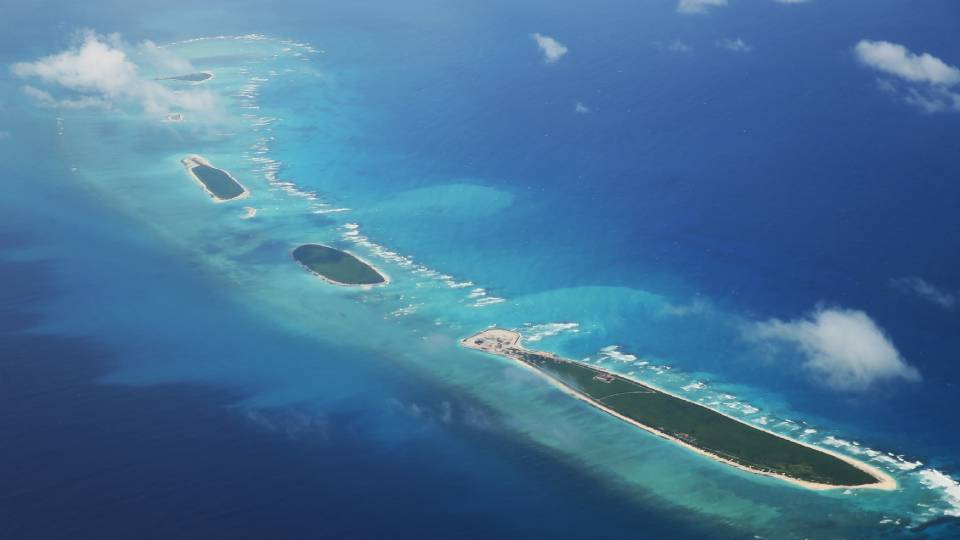
After nearly a decade-long hiatus, China in October quietly resumed artificial island construction in the South China Sea, according to commercial satellite imagery. Rather than focusing on the Spratly Islands, where Beijing already has de facto control over seven maritime features with airbases on three of them, it has turned to developing Antelope Reef, located in the northern part of the South China Sea in the Paracel Islands. China is not only enlarging the reef through land reclamation, but it is also building a new airbase there, which would represent its second such facility in the Paracels and fifth overall in the South China Sea.
Beijing’s decision to restart dredging operations for the first time since 2017 has perplexed even longtime analysts of the region. They wonder: why there, and why now?
One plausible reason is to send an unambiguous message to China’s neighbor, Vietnam. Since Beijing forcefully took over the Paracel Islands from South Vietnam in 1974, Hanoi has strenuously protested Chinese control of the archipelago and demanded its immediate return. But Beijing has ignored Hanoi and instead solidified its civilian and military presence there.
In 2012, for example, China incorporated the Paracel Islands administratively into Hainan Island, making it indisputably and irreversibly Chinese territory, from Beijing’s perspective. China has also built an airbase on Woody Island in the Paracel Islands, equipped with hangars, support facilities, and sensors and military communications infrastructure. China has deployed combat aircraft to Woody Island, including bombers, in a show of force.
Yet none of this explains the timing of Antelope Reef. For that, it is important to consider Vietnam’s own land reclamation efforts over the past few years. Hanoi has been quietly expanding artificial island construction at nearly all of the 29 maritime features under its purview, and it is estimated that on the high end, Vietnam has thus far matched 70 percent of Beijing’s total land reclamation in the South China Sea.
To be sure, Hanoi’s efforts have been mostly defensive, focused on survivability and logistics, rather than preparing to deploy offensive capabilities. But that might have been just enough to convince Beijing to counter.
Another possible reason for China’s island-building at Antelope Reef relates to its military contingency planning for Taiwan. Although Beijing already has three airbases in the Spratly Islands (Fiery Cross Reef, Mischief Reef, and Subic Reef), these features are also highly vulnerable to disruption given their location in mostly open water. By contrast, Antelope Reef is closer to China’s Hainan Island and the mainland and thus is more defensible in a future conflict.
It would also provide a layer of resiliency if or when the Spratly Island outposts become compromised. Indeed, Chinese land reclamation at Antelope Reef has resulted in a new island that is nearly the size of Mischief Reef, and one that may, in the end, feature even more military assets. Moreover, Antelope Reef is closer to Taiwan than are any of the Spratly Island airbases, making it more strategically valuable as a platform from which to launch military operations. It could further support Chinese military operations to stem the likely flow of U.S. military forces through the Strait of Malacca into the theater to intervene in the conflict.
The reality is that China probably saw value in both sending a message to Vietnam and preparing for a Taiwan contingency through its land reclamation and militarization of Antelope Reef. Regardless, the U.S. has done nothing in response, emboldening Beijing to proceed at Antelope Reef and perhaps elsewhere one day, like at Scarborough Shoal, which is disputed with the Philippines, a U.S. treaty ally.
And this is not exclusively a second Trump administration phenomenon: indeed, since China began land reclamation in the South China Sea in the early 2010s, no president—whether Obama, Biden, or Trump—has spoken out or taken meaningful action against China’s bad behavior.
What is most striking is not simply that China has resumed land reclamation, it is that it has done so with little expectation of meaningful pushback. For all the rhetoric about the need to maintain a “free and open Indo-Pacific,” Washington and its allies have yet to articulate, let alone enforce, clear red lines against further physical expansion in disputed waters.
Freedom of navigation operations and diplomatic protests, while important, do not prevent dredgers from fundamentally altering the strategic landscape. Beijing understands this gap all too well and appears increasingly willing to exploit it.
If Antelope Reef is any indication, China may be entering a new phase in the South China Sea—one that moves beyond consolidating existing gains toward selectively expanding them when conditions are favorable. That should raise concerns not only for Vietnam, but also for other claimants and external powers alike. The question is not just whether China will continue to reshape the maritime domain to its advantage, but whether anyone is prepared to stop it.
Derek Grossman is CGSP’s Non-Resident Fellow for the Asia-Pacific.