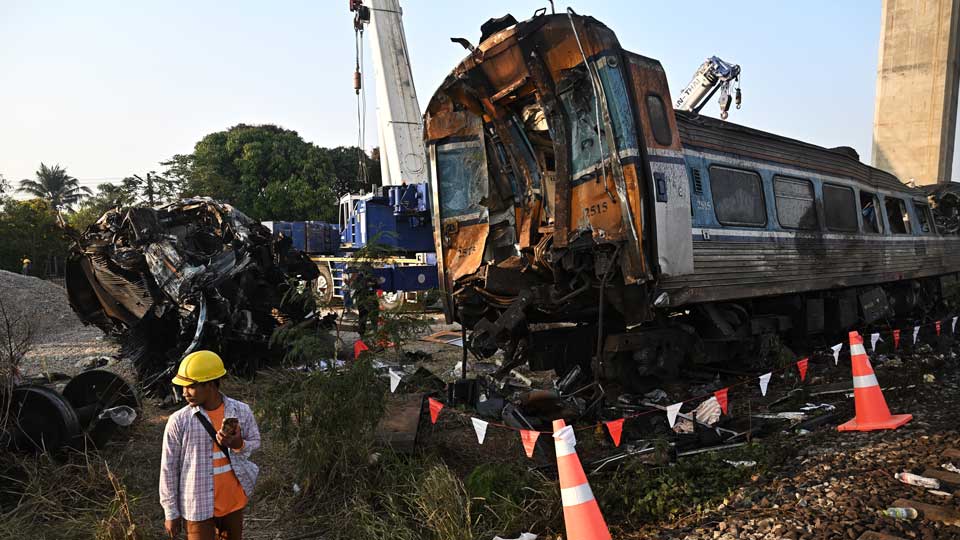
When a crane collapsed onto a moving passenger train in Thailand, killing dozens, the tragedy quickly became a major topic on Chinese social media. Discussion was not absent, but it followed a clear and defensive pattern, one that worked less to examine responsibility than to preempt it.
Public anger in Thailand and in the Western media has so far mostly focused on Italian-Thai Development (ITD), the contractor responsible for the site. For China, however, the incident carried an added layer of sensitivity.
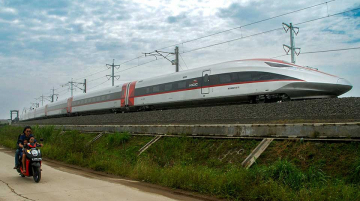
The accident occurred on a railway line that forms part of the Thai–Chinese high-speed rail project, a flagship Belt and Road Initiative corridor intended to link China with mainland Southeast Asia. Any suggestion that Chinese companies might be implicated, directly or indirectly, had immediate political and reputational implications.
On mainland platforms, this sensitivity did not produce outright silence. Instead, it generated a wave of posts warning that Thailand was attempting to “blame China.” China, they argued, was being unfairly dragged into a foreign contractor’s failure simply because the project carried a Chinese label.
What was largely missing, however, was substantive discussion of China’s actual exposure to the project, or of past precedents that might explain why such suspicions arise.
Those precedents are not hypothetical. A year earlier, the collapse of Thailand’s State Audit Office building had already drawn sustained scrutiny from Western and overseas Chinese media. Hong Kong–based independent outlet Initium reported that ITD, the Thailand developer giant, was deeply tied to Chinese capital in that project, operating a joint venture in which China Railway 10th Bureau held a controlling 51 percent stake.
The New York Times quoted Bangkok workers who said China Railway 10th underpaid contractors, leading to inferior materials and unusually narrow columns. According to the NYT report, an anti-corruption watchdog said twisted metal from the ruins contained substandard steel bars produced by a Thai factory owned by Chinese investors, which authorities shut down soon after.
By December, investigative reports listed the Thai branch of China Railway 10th—under China Railway Engineering Corporation (CREC)—among other companies accused of noncompliance.
In mainland China, discussion of the building collapse quickly faded. Even a 2024 press release by China Railway 10th Bureau celebrating the project’s structural topping-out quietly disappeared from its website after the accident.
Following the crane disaster, a similar dynamic emerged. While responsibility remains under investigation, Chinese officials emphasized that “at present, the relevant section appears to have been constructed by a Thai company.” Official media coverage focused squarely on ITD.
On social platforms, this framing hardened into certainty. Some popular WeChat articles went further, fabricating details about the crane’s supposed Eastern European origin and inventing unrelated past accidents involving ITD. The conclusion was familiar: infrastructure is inherently risky; China is the world’s most capable builder; and compared with other countries, Chinese projects are statistically far safer.
WHY IS THIS IMPORTANT? What stands out is not a lack of discussion, but the direction it takes. After a previous Thai building collapse had already produced detailed, evidence-based reporting on Chinese firms’ involvement, mainland discourse around the train disaster shifted toward anticipatory defense, casting China as a potential scapegoat before questions of responsibility were even settled. In Belt and Road projects, where Chinese capital and branding are deeply embedded, this reflexive framing reveals how past scrutiny continues to shape what can and cannot be openly debated online.