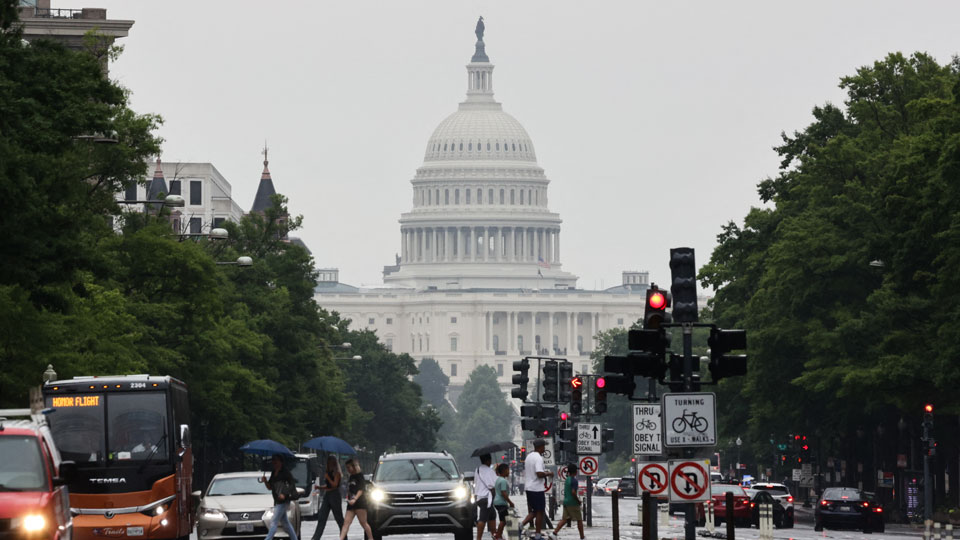
Conversations on China, Africa, and global power at the heart of the American policy establishment are increasingly shaped by insular narratives. What emerges is a portrait of a U.S. policy ecosystem struggling to reconcile its ambitions with shifting global dynamics. From critical minerals and electric vehicles to energy security and trade.
In this episode of Awkward China-Africa Conversations in Washington, D.C., Eric Olander explores how American discourse often centers on extraction and competition, while overlooking deeper structural gaps in technology, infrastructure, and long-term engagement. At the same time, China’s growing influence—particularly in industrial capacity and supply chains—continues to reshape opportunities and constraints for African economies in ways that Washington appears increasingly reluctant to fully acknowledge.
Joined by Cobus van Staden in Cape Town and Géraud Neema in Mauritius, the trio unpack a striking disconnect between Washington’s strategic assumptions and the rapidly evolving realities across Africa and the broader Global South.
📌 Topics covered in this episode:
- Disconnect between Washington and global realities
- U.S.–China competition in critical minerals and EVs
- “America First” and shifting U.S. policy toward Africa
- China’s evolving role in Africa’s energy and infrastructure
- Africa’s energy strategy amid global disruptions
- Rise of regionalism and intra-African trade (AfCFTA challenges)
- De-dollarization and financial shifts in Africa–China relations
Show Notes:
- Global Issues: Global South Demonstrates How Countries Can Deal with an Aggressive United States by Alexandra Sitenko
- Global Times: Amid US-led war, Global South prioritizes stability and cooperation
- Quincy Institute: Winning the Majority: A New U.S. Bargain with the Global South by Sarang Shidore
Transcript:
ERIC OLANDER: Hello and welcome to another edition of the China in Africa podcast, a proud member of the Seneca Podcast Network, America Olander. And as always, I’m joined by CGSP’s Africa editor, Géraud Neema, joining us from the beautiful island of Mauritius and CGSP’s head of research, Cobus van Staden from lovely Cape Town, South Africa. A very good afternoon to both of you.
COBUS VAN STADEN: Good afternoon.
GÉRAUD NEEMA: Good afternoon, Eric.
ERIC OLANDER: We’ve got a lot to get through this week. We’re going to do kind of a roundtable, very quick kind of, you know, run through on a bunch of different topics. I’m here today in Washington, as many of you can see who was watching the show.
My background is a little bit different. I’ve been spending the week here doing what we’ve done many times, the three of us. And we go on these fact finding missions where we get to speak to universities.
We speak to think tank analysts, to government stakeholders and try and get a sense of what’s happening. We do this in many cities around the world. This time it’s in Washington.
I’ve been coming here for the better part of 10, 15 years. And not surprisingly, Cobus and Géraud, this year is unlike any of the previous times that I’ve been here. It is an absolutely surreal experience in many respects.
Let’s first talk a little bit about the China track and then we can move to the Africa track. Cobus, you spend a lot of time, you’ve been here before, you spend a lot of time thinking about this. One of the things that I’ve noticed in this trip in Washington is how the United States and this ecosystem of thought leadership that exists within the Beltway is becoming increasingly detached from the reality of what’s happening out there.
And what I mean out there is outside this echo chamber of the Beltway, where narratives here are very strong because the U.S. has the ability to generate its own stories that either you get on board or you just resist. But there’s oftentimes very little middle ground. But one of the things that I keep hearing, and Géraud, I want to get your take on this, is that we can catch up to the Chinese on critical minerals.
We can catch up to the Chinese on new energy. We’re not worried about the growth in EVs because the U.S. isn’t doing EVs and the rest of the world is. And what I’ve been trying to tell people, and I’ve got to be honest with you, I’ve seen more frustration with kind of how I approach this on this trip than any other time that I’ve been here, where people will just kind of yawn and say, Eric, you’ve been saying this over and over again.
The gap between the U.S. and China on many of these 21st century technologies is now so large that I don’t think the U.S. can catch up specifically on critical minerals, new energy, automotive and things like this. Cobus, you oftentimes have this disconnect when you talk with folks from Washington as well. What’s your take when you hear this discourse that happens in Washington that is disconnected in many senses from the realities on the ground?
COBUS VAN STADEN: Well, you know, I think we’re increasingly also seeing that discourse being disconnected even from realities within the U.S. But in relation to minerals and EVs and so on, I think it is an interesting test of a longer term trend. So the U.S. has for a long time, with good reason, seen itself as buffered from the rest of the world. It’s essentially a big island with two mountain ranges and huge amounts of natural resources and really not beholden to anyone for anything.
And that has always stood in contrast to the need in the U.S. and I think, well, from my perspective as an outsider, like even the popular need among Americans to be in the world, to be a leader, right? Kind of like a global leader. So there’s always been this kind of like isolationist side and this global side is always in tension, I think, in the U.S. But there seems to be a real kind of pullback from the world, you know, and with it, you know, kind of maybe just again from the outside, a refusal to take the world’s word for what it’s feeling, right? Like, you know, like the world is shifting towards electric vehicles, for example. There’s just simply, there seems to be simply a kind of a refusal to engage with that trend rather than a counter trend, you know, rather than a counter offer. So that’s a kind of an interesting development for me.
But again, you know, I think it probably looks different when you’re inside the U.S. Well, it looks very different here.
ERIC OLANDER: And again, one of the things is that when you talk to the policy community here is just to say, Eric, this is, we’re just not there. We’re just not thinking that way. You either, again, understand what Trump’s worldview is, you can fight, flight, or just quit, you know, just kind of, you know, accommodate it.
And that’s what the choices that a lot of people have made. The civil service here is beaten down. There’s no, I mean, morale is terrible in many of the of the agencies.
But one of the areas where the U.S. thinks it’s getting momentum and there’s actually quite a bit of excitement is on this topic of critical minerals. And I am having these very surreal discussions because they talk about only one of three parts of the critical mineral debate here. They talk about extraction.
That’s something that everybody’s very happy with the DRC mining deals, the Central Asian mining deals. There’s so many that have been announced. They aren’t talking about the refining and processing here, nor are they talking about the gap that they have in technology, research, and human skill development in terms of staffing these refining processes in these refining facilities.
So we don’t have the universities that are training the battery metal engineers. We don’t have the research. Now, in China, BYD has, you know, the new Blade II battery is a battery that can fill up in five minutes, recharge 80 to 90 percent in five minutes.
This is a concept that they don’t understand here. So, Giro, when we look at the battery metal debate, again, I just find this disconnect. And, you know, people are getting frustrated with me.
They’re just being like, go away. That’s what it feels like when I when I kind of bring up these issues. But I mean, that’s why it’s a little bit surreal to be here.
GÉRAUD NEEMA: I think what you notice is just symptomatic to the philosophy of the MAGA itself as what we’ve seen over the years and over the last of the months since they came to power. That sense of like, for me, it’s really American exceptionalism in a sense where we see the world the way we want to see it. We shape the narrative the way we want to see it. It’s not about what is on the table. It’s not about what is happening.
It’s about what we wish could happen, what we wish is going to happen, no matter how you people see the thing on the ground, no matter how you people believe things are going to happen. But we create our own alternative narrative. We are really in that space of alternative reality where when you hear U.S. officials, when you hear President Trump talking, tweeting and writing on truth social, you realize that in what world are we living in? In what what is he talking about? We seem that we’re living in a very alternative reality where things are not really the same. And that really reflects on different topics that administration is covering when it comes to battery metals.
You know, they’re going to make big thing and big noise about like, yeah, we got that mining, deleting the DRC, where you’re going to have big objective, huge, immense game changing and all of that. But when you look into the data, you look into it, it’s like, no, that’s a minor deal. That’s not something major.
And as you pointed out yourself, like, yes, you’re talking about extraction, but what’s the rest? Where’s where are we when it comes to mid, midstream and downstream? Where are we when it comes to development and all of that?
They don’t talk about it, but they’re going to take one portion and they’re going to conflate it. They’re going to really make it big and say, you know, this is a big thing. It’s really part of a narrative of a type of narrative that we’re seeing coming out of the U.S. where we create our own reality, we create our own alternative reality that you people need to fit in. If you don’t fit in, you are bad. If you don’t fit in, you are against us. And this is what you’re seeing when you see the public servant just like, you know what, I don’t want to fight it because I don’t have the strength to fight the narrative.
I’m just going to let them go. I’m just going to let them be. But the danger by let them be is now you have a U.S.-friend policy driven by alternative reality, alternative facts, alternative narrative, where you see now what we see in Iran happening, where we see the president’s announced that he’s going to commit a genocide, a war crime against another country just casually. And that’s just nobody’s happening. And I’m mentioning that because someone said that in all of that, all Americans, all the check and balance within the United States, no one can come and say, you know what, we’re not going to let one person drive us over the cliff. Somehow U.S. institutions were not strong enough. We thought it’s going to be.
ERIC OLANDER: On that point, it was surreal being here in Washington when that post, that true social post came out. First of all, we had the Easter Day post where he was dropping F-bombs and then followed by the post that says he was going to wipe out the entire civilization. And for the most part, it was a Tuesday here.
Like, it was just a Tuesday. I mean, there was not. This is a problem.
GÉRAUD NEEMA: This is a problem.
ERIC OLANDER: I know. I mean, you were kind of expecting. Maybe I’m not.
I should say you were kind of expecting, but I should be beyond that. But at some point, you know, during the McCarthy era, there was that breaking point that said, you know, Mr. McCarthy, Senator McCarthy, have you no shame. And that was the breaking point when people when the tide turned.
And at what point, if ever, are we going to get to that? And here it really will clearly threatening to wipe out an entire civilization and an entire country of 90 million people was not the breaking point. So that was absolutely fascinating.
Gentlemen, one of the other things that’s come up in terms of thinking about Africa and China specifically is that it’s very clear in all the conversations that I had with China, Chinese experts or China experts and Africa experts was that China is no longer the organizing principle of U.S. foreign policy towards Africa. Now, that shouldn’t come as a big surprise. It’s been that way for about a year.
But I just want to give you a report from the front lines that that is a deeply held sentiment now within the administration and within the D.C. discourse. Whereas, you know, for the better part of 15 years, ever since Hillary Clinton was secretary of state, Africa mattered in Washington because of China. That doesn’t seem to be the case, at least in the discourse.
Maybe on Capitol Hill, there’s still a lot of concern about what China is doing. And you hear this in these testimonies that I was about to say. But in the think tanks and in the White House and in the State Department and in a lot of the foreign policy community, even in the security establishment, China is not the pacing issue for the Americans in Africa.
Cobus, what do you think?
COBUS VAN STADEN: So, I mean, just to clarify, how do they frame what is the new organizing principle? Because, you know, from the outside, just from reporting, it seems to be just extractivism, you know, like minerals, health data, that there’s nothing else essentially than just extracting value from Africa. Is there anything more?
ERIC OLANDER: Yes, it’s the America First agenda. What benefits the United States? Now, the irony of it is that But I mean, what is that different than extractivism?
Well, I guess, tomato, tomato, maybe, depending on how you look at it. They look at it as deals and trade that can better American companies. They look at, obviously, health deals that can provide data for the United States.
And obviously, critical mineral and access to secure, you know, these resources are important. So maybe that all boils down to extractivism. In their language, it’s America First.
They don’t articulate it that much beyond what America First is.
COBUS VAN STADEN: Yeah, there seems to be a solipsism for me there, you know, kind of where every single thing that’s raised under America First is then also explained via America First. So there’s this kind of like this kind of circular logic where anyone who raises any question is then answered by, well, you don’t understand, this is, we’re America First now. And you’re like, yeah, so, you know, like, it’s not really, it’s not, you know, like, I’m not seeing how that translates into a relationship with the continent, you know, which, of course, I mean, I think they probably don’t see that either.
ERIC OLANDER: Well, remember, Nick Checker, who’s the top US diplomat for Africa, he sent in a memo to State Department staff that they are supposed to extract gratitude from African governments for US generosity. That is the tone that the State Department has said. Now, one of the things that they said is that, remember, we heard about those deal teams back in the Biden administration, and in the embassies, they were going to go out, and they were going to start kind of fostering deals in order to kind of facilitate trade and whatnot.
There is a lot of excitement that apparently the embassies and consulates across Africa are doing better in those deal teams. So, trade and commerce, a more mercantilist type of foreign policy, all the idealism, the values-based diplomacy, you know, the LGBT flag over the US embassy in Ghana, all that stuff is gone. And there is very little talk about China.
That is, it’s very interesting, just not much. Go ahead, Joël.
GÉRAUD NEEMA: Since you mentioned that, something really I picked on like a few weeks back, because you mentioned Capitol Hill and the disconnect with what we may see in the state and maybe in the White House. I picked it up when I was following Frank Garcia, who is going to be, if he’s confirmed, the new Assistant Secretary for African Affairs in the State Department. During his hearing in front of a Senate committee, Ted Cruz, the whole Ted Cruz questioning was around China.
China, China, how are you going to ring China? How are you going to make that US is moving forward against China? How are you going to counter China in the Diego Garcia situation in Chagos Island in Mauritius?
All of that were about China. Even on the minority side, it was still about China. But the nuance here that was really interesting, even in his presentation, even his answer to those questions, Frank Garcia did not a single time mention China.
This is something just stuck to me. I was like, interesting. The way he was answering, he did not mention China once, even in his response to that China question, the way Ted Cruz was shaping the question, but he did not really went into China, what the US is going to be about.
It was more focused on like what the US is going to do, what are we going to move forward and all of that. We are aware of the disconnect and all of that, but we are moving forward for further, for our own interest. The US is going to do this and that.
He did not mention China, even in his own response to those questions.
ERIC OLANDER: And that is really important. You have heard that consistently in the Capitol Hill presentations by nominees for the administration, where legislators have been saying China, China, China, China, and the nominees have been very skillful. It is not even just the nominees, by the way.
When AFRICOM commanders go up before the Hill, when ambassadors go up before the Hill and assistant secretaries and others, China is being pulled back. Whereas on the Hill, it is still very much a priority.
GÉRAUD NEEMA: Except in one region, Southeast Asia, the US ambassador to the Philippines, it was during the same hearing when they were asking about China, he made all his presentation about China. So China really moved away from Africa, but remained more focused when it comes to Southeast Asia.
ERIC OLANDER: That makes a lot of sense, obviously, given the issues that are going on there. But it is interesting. And again, it will be interesting now, Cobus, as we move into this ceasefire.
Okay. Who knows if it is going to last? We have two weeks to see.
Let us hope that things calm down. But one of the things that we have seen in the past couple of weeks, since the war started, is how more and more countries, and I can say this as somebody who lives in Southeast Asia, and I have seen Southeast Asian countries now heading to Africa to secure oil supplies that are not having to pass through the Strait of Hormuz. So the Vietnamese, within two weeks of the conflict starting, went to Algeria and went to Angola to try and secure new oil and gas deals that are, again, independent of the Strait of Hormuz.
It just got me thinking a little bit that this might be a moment now for Africa’s oil and gas and fossil fuel producers, that they have a moment to recapture some of the limelight, because the Chinese over the past 20 years have steadily weaned themselves off of African oil and gas and shifted towards the Gulf to the point where now 40 percent of China’s imported energy comes from Gulf countries. That may not make a whole lot of sense anymore, and so China’s deep relationships in Africa could be something, Cobus, that I think could be a renaissance for the African oil and gas industry that has languished a little bit over the past 10 years.
COBUS VAN STADEN: I think we are seeing that already. We covered today in our newsletter, we were covering the announcement of a new planned shipping route between Libya and Qingdao in China, where it would be between Benghazi, I think, and Qingdao, and it would avoid the Strait of Hormuz and go through the Straits of Malacca and then through the Red Sea. So that’s interesting, and notably, all of those transactions is happening in RMB.
So that’s interesting. The other thing I think that that’s developing is that African countries, like one of the kind of unintended consequences of the war, I think, is that it’s hastening African economic integration and intra-African trade, because one of the things that the South Africans announced is that they were like, we’re fine around the world because we get our oil from Nigeria and Angola. And so we are seeing kind of increased buys from Nigeria and so on within Africa as well.
So it’ll be interesting to see whether there are Chinese refiners, Chinese other kind of actors, financers, and so on, getting involved in some of that trade as well.
GÉRAUD NEEMA: This is a nuance I wanted to bring in this part that Eric, you mentioned. As much as it’s an opportunity for revival of China-Africa oil relation, but it’s also maybe more risky for African countries in so many ways, because so far, Africa is more impacted so far. Africa and Southeast Asia are directly impacted by the Strait of Hormuz crisis and the oil that’s not arriving on the continent, because other shipping are still arriving in Latin America, in Europe, and all of that.
But in Africa, we’re already impacted by that. When Corbis mentioned the fact that you see now more transaction happening between West African countries and Nigeria, refinery from Dangote, and South Africa coming from Nigeria, where Dangote has its own refinery there, you realize that many African countries may find themselves in a situation where, do we really need to sell to China where we have our own crisis, or we need now more than ever to find our own oil first and sell to ourselves before selling to China? It’s important that we see that China can come and we can still start to sell to China, but what’s the point for us now selling to China where else we’re going to be on our own crisis? At least now we have one or two big refineries on the continent.
Let’s prioritize those refineries, refining our own oil and producing to ourselves. So I think there is an opportunity there, but that may be nuanced by the fact that we have more risk on the continent than any other part of the world right now.
ERIC OLANDER: Well, the challenge in Africa is not the quantity of crude oil, there’s plenty of crude oil, it’s the refined petroleum products that’s the problem. And the Dangote refinery, Gérard, that you mentioned just came online this year, I think, and has been really providing an enormous amount of relief, not only in refined fuels, but also in providing fertilizers as well, and urea and some of those other resources that have been cut out of the Gulf. On the question of refinery, we had a story that we’ve been following quite well, quite a long time in Angola, the Lobito refinery is something where the Chinese are actively involved in, it’s a 6.2 billion dollar refinery. Sonengol, the state oil company, is looking to China for a 4.8 billion dollar loan. Also, Ugandan President Yoweri Museveni announced that he is going to build, or Uganda is going to build a refinery for the East Africa crude oil pipeline. So one of the renaissances we may see in that, and by the way, that’s a Sino-French pipeline, so the Chinese are involved in that as well.
So refining may be the big issue right now in Africa, and that may insulate, as Kovas pointed out, from the shocks that traditionally hit Africa the hardest whenever they happened further afield. Kovas, this question of, should Africa export more energy to China? China has an insatiable demand for energy, even fossil fuels still to this day, they have a huge, huge demand for it, given the size of their market.
Or as Giraud says, should there be emphasis put on domestic or continental priorities first? What do you think things should happen, and what do you think will happen? Those are two different things.
COBUS VAN STADEN: I think, you know, I think continental priorities should probably count for more. You know, like, you know, Africa is not used to putting itself first, you know, but it should. And, you know, and particularly around fertilizers, I think, you know, we’re going to see that, I think.
I think what will probably happen in reality is that it’ll be a little bit of both. You know, there’ll be some countries will be selling to China, some will be selling within Africa, there’ll be a push, I think, for refining and fertilizer production and so on happening in Africa, but all of this will also happen on the back of a lot of importing of Chinese renewables, I think. And, you know, so I think in a lot of ways, the people have been making this point, obviously, a lot in relation to the Iran crisis, but I think you really can’t overstate this point of, like, how much of a game-changer renewables are, how they have been completely decoupled from climate conversations as a whole, and they’ve been completely, like, reframed as national security provision.
And that logic has just taken off everywhere.
ERIC OLANDER: So, you know, so I think… Yeah, let me… Can we just pause right there?
Because this is a very important point. I just want to expand on this a little bit. And this is something that I’ve seen in Southeast Asia, where, you know, renewable energy and green mobility were always seen as in the portfolio of the environment ministry, or even a little bit in the commerce ministry.
And what you’re saying, and what we’re seeing on the ground is that has now shifted to the defense ministries, because it’s now considered a point of national security to be energy self-reliant. In addition to that… That would accelerate the transition much faster.
COBUS VAN STADEN: Yeah, but it’s even bigger than that, because it’s not only that it’s been re-routed to the defense industry. It’s the securitization of all of these decisions that have moved from a logistic and economic space into a security space. And you see, you know, so…
And you see that the most in China. So China yesterday announced sweeping new laws about supply chain security. You know, so these are like supply chains across numerous different sectors, not just in critical minerals or something, but, you know, across many, many sectors, giving agencies the role to essentially impose sanctions on who they see as being hostile to Chinese supply chains.
So that logic, I think, is going to probably be taken up by many other governments too. So we’re talking about the securitization of the entire manufacturing sector rather than just the, you know, kind of like defense industries getting kind of like hip to renewables. I think, you know, so I think that it’s a paradigm shift.
I think that that’s coming.
GÉRAUD NEEMA: I do believe that we may see an opportunity here, as you mentioned, that African countries may enter into a border system with China. We give you our crude oil, you give us more, you give us more renewable that you do have. You have plenty of it and we need plenty of them as well.
Because by the time we refine our own oil to meet our demand, may not be efficient, but if we get renewable directly accessible, we have direct access to energy. We don’t need to go to the process of like refining oil and all of that. We can do that.
And I think as what will happen is, obviously, it’s going to be a bit of both, but I’m going to lean toward a bit of both, but to a 60-40 for now, where 60 is going to be more domestic consumption and 40 sold to China. But if they played smart and here, you know, let’s give ourself a bit of advisory to our government. If here they can listen to us, like if you can go in a system where you can exchange crude oil for renewable energy, for investment in renewable sectors in Africa, you don’t need to worry about, you know, crude oil going to China because you’re going to have direct access to energy and clean energy that you can use for industrialization for so many things that you need right now.
And I do believe that they need to play it smart in this context. And the Iran rule is often opportunities for renewable in Africa to be boosted and to African countries to think differently. But so far, many of them are not really thinking ahead the way I’m seeing how some of them are reacting to the Trump administration.
But I think there is an opportunity here more than a crisis that we have to look into.
ERIC OLANDER: Well, there’s good news and bad news on the China solar front in Africa. Let’s start with the good news. So, Cobus, as you’ve talked about in South Africa, you can see it as plain as day when you drive through Johannesburg and Pretoria, solar panels have come up everywhere in response to the incompetence and the corruption and the just terrible service that your state utility, Eskom, provides.
So that’s helped contribute to a very sharp uptick over the past five years, not only in South Africa, but across Africa of Chinese solar panels. The bad news is, and this is a story that came out late in late March, is that China is now starting to cut many of the export incentives and some of the subsidies that made both solar panels and battery storage so affordable. And so the prices may be going up, which brings us back, Cobus, to your suggestion that African countries may want to start thinking more in a barter context than in a cash outlay context, because if the cost goes up, they’ll get more by exchanging for raw materials, for example.
What do you think of that?
COBUS VAN STADEN: Exactly. Yeah, I think there is that possibility. Like I’ve seen, you know, discussions about what the actual impact of the stopping of these subsidies will be.
And a lot of, you know, kind of the ones, the experts I’ve read have said that they expect a slight price rise, but not a massive price rise. And that a lot of that will probably be, like, supportable by the African, you know, kind of by, you know, in the African sectors. The, you know, kind of, I think the overall situation we’re in is still that the large scale, the larger trend, the global trajectory is that battery storage and solar is falling in price, particularly compared to any other fuel.
And that it’s now officially the cheapest form of electricity, you know, out there. And I don’t think that the halting of the subsidies will necessarily change that.
ERIC OLANDER: Yeah. One other area to look at is automotive. Ethiopia right now is, I think, the only country that has eliminated all tariffs on imported electric vehicles.
And it’s one of the reasons why you’re seeing a lot of uptake in Ethiopia for EVs. In Kenya, for example, the tariff is still 30%. Now, Cobus, this is very interesting.
And Géraud, I’d like to get your take on this as well. There have been a range of deals coming out of South Africa for the Chinese to take over some of the GM and the Nissan automotive plants to build EVs. It gets me thinking that one way to circumvent these import tariffs that the Kenyans and most other countries have on vehicles, including EVs, would be to produce them in places like South Africa and Morocco, and then to ship them across the continent through the AFCFTA.
So EVs also are, yeah, one would have to think, I mean, and this is the kind of thing that when I bring those conversations up here, it goes, they are not thinking about that at all. And I just, I was just saying because Ford in particular has been hit very hard by AGOA and by the tariffs and the withdrawal of AGOA and now the resumption of AGOA. Fair enough, it’s back, but it’s back with the Liberation Day tariffs.
One of our good friend, Judd Devermont, who’s the former national security director in the White House for Africa, he’s made a point on his sub stack that you have to remember that AGOA is not the same AGOA that it was before Trump because it still has the Liberation Day tariffs. Ford was a company that was making cars in South Africa and exporting them to the United States duty-free. Now we’re probably going to see those cars either go, they’re not going to go to China because even with duty-free entry into the Chinese market, China doesn’t need Africa to make a car, but they could go elsewhere on the continent.
But Géraud, the question I have is let’s say we make a car in South Africa, getting it to the Congo is not an easy thing to do. The infrastructure for transporting vehicles, it’s not great in much of Southern Africa. So how would you get cars from South Africa to other parts of the continent if the roads and rail aren’t there to transport them?
GÉRAUD NEEMA: In Southern Africa, the logistic is quite, it’s fairly easy.
You can go from South Africa to Lubumbashi in a few hours, even to Harare, to Mozambique, and to Zimbabwe quickly in a few hours, they’re pretty good.
For me, that’s not really a big issue, at least for Southern Africa. The issue is going to be even if you have EVs, but you have energy supply issues in many of those countries where at the end you can have EVs, but you don’t have energy to power those cars. You’re going to find yourself with cars that cannot really be used in many of those countries.
ERIC OLANDER: That’s where big solar panels come in. I mean, that’s where solar comes in, right?
GÉRAUD NEEMA: Exactly. And you need now to have the whole infrastructure of transmission lines and building all those infrastructure to be ready to be built on the ground. This is another part that we have to also integrate when you think of the whole supply chain, the whole infrastructure of clean energy in Africa.
We’re only having the solar panel, it’s one thing, but having the infrastructure where they’re going to be connected to the grid, it’s something else. The transmission lines where you need billions of investment to be built between the place where you’re building the solar power plants to where the energy is going to be consumed. This is another challenge to have to be addressed.
But what you mentioned, yes, when you don’t have those logistic routes being present, when you don’t have those connections being present, yes, you can build in South Africa, but you’re going to stop at the maximum in the DRC, but you’re not going to reach Uganda, Burundi, you’re not going to reach Central African Republic. You’re going to have to rely on Morocco. But if you’re built in Morocco, how are you going to go down from Morocco?
You go down where you have to cross the Sahara Desert. So it means that you’re going to have to have different hubs taking place in Nigeria, in Ghana, and if it needs to take place in South Africa, you need to have many of those hubs in Ethiopia to be able to cover the entirety of the continent. If you only have a few countries, only one country doing that or two countries doing that, not really covering the whole region, that’s going to be problematic.
But another thing, again, we talk about ACFTA, we’re going to have to think about regulation and taxes because we have the ACFTA on paper, that’s good, but many African countries still have not changed the regulation when it comes to taxes and all of that, to the duties and all of that. So that’s going to be something else you’re going to have to address. And I think when I look at all those debates, harmonization, all of that, you don’t see many talks, many conversations taking place between African countries to address those issues.
And the sad part for me is like, when you have those kinds of crises happening in Iran, and the opportunities and the risks get present, you realize that countries and regions that were prepared, they’re ready to take on the challenges. But you have a continent like Africa where opportunities are there, but we just were not prepared to address those challenges. At the end, when opportunities will pass, we’re going to realize that we’ve missed a very key moment for us to change our economy, to change our whole industrial base, but we’re just not ready to do that.
ERIC OLANDER: So, Cobus, we are 2026 now, 2027, if I’m correct, is going to be the 10th forum on China Africa cooperation. Is that correct? Do I have my math right?
Every three years it happens. Okay. Listening to what Giro is saying about the difficulties of logistics and connectivity between countries, it seems to me that if I was the African Union, I would get everybody together and say, okay, we’re going to be, you know, going to Brazzaville in 2027.
What do we want from the Chinese? If we said that we need, I know, I know, but I’m just talking here an ideal kind of, you know, utopian kind of context here. But think about, imagine this saying, you know, normally you’re giving us $60 billion of export credits, you’re giving us training, you’re giving all the menu of things that I’ve given in past FOCACs.
We don’t know how much of that actually materializes. But if they said, what we need in this FOCAC is connectivity, because that will then facilitate the AFCFTA, and we want all of it to be driven towards connectivity. That feels to me like that would be a really great strategy to take because that would jumpstart growth in an incredible way within Africa and within the AFCFTA.
What’s the chances of that happening?
COBUS VAN STADEN: Not high, I think. Not because it’s a bad idea, but because, you know, in the first place, there’s a lot of different continental priorities, connectivity being a key one, but many others too. And many, obviously, country specific and regional priorities, you know.
So I think, you know, the thing that I think both of you have been hinting at that, you know, is that what we’re probably going to be looking at is, even though the Holy Grail is this kind of full continental plan and collective bargaining and integration, in reality, what we’re probably going to see is centers, like, you know, like, like, you know, different kind of hubs popping up, you know, in different regions, which in the end may kind of be a kind of a way station on the way to continental integration.
But I think more importantly, it’s maybe a more realistic take. Because the thing is, the thing that no one ever says about Africa is, Africa is so damn big. That’s the thing.
Like, Africa is so big. Like, it’s so much bigger than one sees on maps, you know. And it’s diversified.
Exactly. So, you know, so Africa is the size of several other continents together. So in lots of ways, a regional approach is actually the only approach that really works, right?
Because a continental approach is taking the EU. That’s right. It’s taking something that’s three times the size of the EU and trying to make a collective decision when even the EU can’t make a collective decision, right?
ERIC OLANDER: Yeah. Let me just understand what you mean by a regional approach, just for people who may not be familiar with this. You’re talking about the East Africa community.
They would then form some type of union. SADC, the Southern Africa Development Community, they would form some type of union. ECOWAS in the West, that would be a block.
Those are the regions you’re talking about, right?
COBUS VAN STADEN: For example, or even smaller than that, you know, because for example, there is discussions in Southern Africa between South Africa, Zimbabwe and Namibia about possibly different kind of like supply chain and electricity integration, right? And there’s already in Southern Africa, like South Africa and the states around South Africa already have electricity sharing arrangements that’s been going on for decades. So there are cross-border integration kind of between these different areas.
It’s just not continental scale because the continent is so incredibly big. So in that sense, these kind of like relatively ad hoc kind of regional approaches will then in the long run, I think, start connecting with each other and start integrating in that way.
ERIC OLANDER: Géraud, I know you’re not an auto analyst, but one thought that just crossed my mind as Cobus was talking was, so Cherry is building out its new factory, taking over from Nissan in South Africa. Right now, a lot of the cars that come to Africa come by boat. I mean, literally from China, they come by boat and they land in all of these beautiful new ports that the African community has built along the East Coast and then the new port of Leki in Nigeria.
Maybe one thing we could see is the AFCFTA benefits from maritime transport. So those cars from South Africa get shipped up to Nigeria by car transport, by maritime car transport, offloaded in Nigeria and then sent into the Western African community from there. That’s a thought that could happen.
I don’t know what the costs are on that, but it certainly could be a solution.
GÉRAUD NEEMA: Yeah, that could be an opportunity to take into account. But when you think of, I’m not really an expert on maritime logistics, but you think of some of those… Sounds great, but it could be costly.
Exactly. Leaving China, when they aim for West Africa, it means that they’re already loaded from Chongqing or from Shanghai port with merchandise to West Africa. So even if they make a stop in South Africa, I don’t think they’re going to release enough space for cars to go in and then go to Nigeria to be really cost effective and even to be really financially viable for transporters to do that.
So it’s an opportunity, it’s an option to look into. I think that experts who are listening to us, they can come up with some comments.
ERIC OLANDER: I wish we could talk to maritime logistics experts.
GÉRAUD NEEMA: Exactly. What could be the better option to do that? But I wanted to get back to the element of connectivity that you mentioned earlier.
One of the things would be, yes, you go to China in making the case, but are we making the financial case for those kinds of situations? Because we are seeing right now how already Tanzania, Uganda and Kenya have been struggling to get financing from China. They have to think, they have to maneuver to new financing model to be able to get a few millions from China to be able to build those railways.
So the same question would also be about how do we finance this kind of project? What’s the financial structure to incentivize China to say, you know what, I’m going to put $2 billion on a railway, on a highway to connect five African countries for connectivity. Those are the things that I think that’s going to be the main challenges.
Having an idea is one thing, but having a viable and economic idea to present to incentivize China to put money on the table, that’s going to be another challenge for African countries in the next focus if they go with such idea.
ERIC OLANDER: On that front, Géraud, one of the different ways of financing some of this railway development started to emerge this past week, when we heard that some of the biggest mining companies in the world, including CMOC Group, among others, are going to help finance some of the Tesara railway rehabilitation. So maybe it’s not going to be the policy banks that will be involved in financing a lot of this, but the mining companies and the companies that use these railways could finance it. Let’s not also forget that Tanzania financed its SGR, Standard Gauge Railway, without Chinese help and without big loans from the Chinese policy banks.
So there are some very creative ways that we can see that development happen beyond just borrowing and what we’ve seen for the past 20 years. Very quickly, speaking of borrowing, another thing that happened this week was we’ve seen both in Kenya and in Ethiopia efforts to move away from reliance on dollar-denominated loans. So Kenya in particular now has doubled its share of yen-denominated loans from 5% to more than 12%.
And now the yen is the third largest in terms of how much debt the Kenyans have for its external obligations. So the U.S. dollar is still number one, but going down. Euro is number two, and the yen is now number three.
Cobus, this has been a trend that we’ve seen over the past few years where de-dollarization is taking off, but not for any ideological reason that they are anti-U.S. or they want to kind of, you know, punish the United States for anything. It’s just pragmatic realism and a pragmatic decision to not rely too much on any single currency. And that seems to be the approach that Kenya, Ethiopia is also trying to pursue something similar with its debt restructuring.
COBUS VAN STADEN: Yes. So, you know, as you say, there are these pragmatic reasons, one being, you know, avoiding, you know, kind of additional costs through conversion, you know, rates, for example. But I think it’s also, there is a kind of a, it’s not ideological, as you say, but there is, it’s everything is being securitized, right, kind of.
And so, post Ukraine, the, you know, the role of the U.S. dollar as a, you know, kind of as a global, you know, sanctions mechanism has become clear. And so, you know, so there’s a certain amount of kind of hedging against whatever, you know, the Trump administration is going to be doing next in that logic. You know, so the diversification is one thing, but there’s also this, I think, logic that in some kind of ways, China represents a more predictable, you know, option.
So it’s like trading in UN then has this kind of additional kind of like slight bit of kind of de-risking kind of aspect to it as well, you know, which I think gets pulled into the equation a little bit.
GÉRAUD NEEMA: Some would say, some would say why China and Africa would, trading between themselves or borrowing from each other, in the case of Africa borrowing from China, why they would use dollar to begin with. That was, some would say, this is the beginning of just changing and putting things as it was supposed to be, using UN to be borrowing. And one thing that also, Eric, you mentioned, the fact that Kenyans are saving a lot of money out of this kind of deal.
I think when we covered the story last year, we’re talking about it’s something about saving around $255 million. Exactly. They were saving a lot of money.
And we have also other countries that we had, I think we had reports of other countries also considering this kind of option. Zambia looking into paying attention to that, because I remember the finance minister was asked at that time from Zambia, he was asked when he heard about what’s happening in Ethiopia was saying, yes, Zambia is looking into and saying what option we’re going to take to make that happen. And what Zambia did, it decided that mining companies, Chinese mining in Zambia, are going to pay their taxes in UN, in renminbi, instead of using US dollars.
So we are seeing that kind of shift in the way that African countries are deciding now to work with Chinese companies. In Tanzania, we have the case where Chinese construction companies are paying in the operation in UN, because you have big Tanzanian banks that are betting more on Chinese construction companies with their account in UN to transact with China. So we are seeing small bits and pieces here and there where people are moving away from the dollar and trying to create space for China in terms of UN renminbi transaction.
And it kind of makes sense. It’s not ideological, it just makes sense for us in terms of trade, in terms of loan, to deal with that, to deal with UN with China.
ERIC OLANDER: But Géraud, the one thing that is a detail, there should be an asterisk. Yes, there is a money saving opportunity here on the table. However, that is only if the Chinese UN does not appreciate.
Should the Chinese UN appreciate and change value, guess what, the cost of those Chinese denominated UN loans are going to go up. So this is not a risk-free endeavor. Now, the UN so far has only appreciated 2% this year against the dollar, and the Chinese do kind of hold, not quite a peg, but they do keep a range.
But that is, it is not guaranteed in this uncertain time that we live in that the UN doesn’t appreciate dramatically against the dollar. And this is, so we could find African borrowers back in the same problem.
GÉRAUD NEEMA: True. But this is the thing I think African countries were betting on before the Iran crisis, the fact that we know on overall that China maintained, really it’s a policy to maintain its renminbi to a certain level. So there is more predictability than compared to how the U.S. dollar fluctuates. It’s more easy for African countries to say, I can plan ahead based on the UN, that plan ahead based on U.S. dollar. Because the rates of change, how the central reserve in the U.S. changed, the exchange rates are just like crazy, like the interest rates change, drops in high. It’s just so unpredictable for African countries.
But for the UN, you kind of have the sense that Beijing is going to, has more incentive to maintain its UN within a certain range, allowing African countries to more predictability and to plan ahead. And but given the current, the circumstances we are finding ourselves right now, it’s not impossible that we see that’s policy to change, even to have more changes than what was anticipated before.
ERIC OLANDER:
You know, what’s funny is that when I had originally planned today’s show, I thought we were going to dedicate the whole hour to us talking about the U.S. and Washington and what happened here. Fifteen minutes into our show, we took a right turn and never looked back to the U.S. And this is kind of what I’ve been trying to explain to people here, is that the U.S. is becoming just increasingly irrelevant in many of these discussions. It’s not necessarily that people in developing countries in Africa, Asia, Latin America or elsewhere have anything for or against the U.S. It’s just they’re not relevant. And a lot of these conversations that we’ve had about logistics, about AFC, FTA, about infrastructure, the U.S. just isn’t part of that conversation. Cobus, as you pointed out, the U.S. right now in Africa is focused much more on taking things out of Africa than putting things in Africa. And as a result, I think people are just going to move on and just like what we did here today, this was not planned that we would take that right turn and kind of focus on everything else.
So I think that’s a sobering lesson for anybody here in Washington to realize that, you know, there was that movie that you remember that movie that said, you know, she’s just not that into you. And it’s just kind of like people are too busy trying to figure out how to get things done. And if the U.S. is going to be a constructive partner, great. But if they’re not, you know what? Great. We’re going to move on and we’re going to go find people that are.
COBUS VAN STADEN: Yeah. And, you know, kind of obviously the, you know, the kind of withdrawal of USAID, right, kind of in Africa has caused a lot of problems, you know, a lot of suffering, a lot of issues. But in the end, like I think one, you know, what it also showed was also the limits of that influence, right?
Kind of because the continent didn’t fall apart, right? Kind of, I mean, sure, certain aspects.
ERIC OLANDER: And a lot of Trump people, by the way, but a lot of Trump people take that as vindication that the decision was actually the right decision to do it, even if the execution was flawed.
COBUS VAN STADEN: Yes. I mean, yeah, you know, I can see that logic, but that doesn’t, it isn’t being replaced by any more robust American influence, right?
GÉRAUD NEEMA: Bilateral deal though.
COBUS VAN STADEN: Yeah, some bilateral deals, but again, like, you know, kind of like there, like it’s, the point I’m making, I think, is that the withdrawal of USAID was a spending of leverage that has now been spent. There’s no re-spending that leverage, right? There may be other leverage that is exercised bilaterally, but that is bilateral, you know, in a continent of 54 countries.
So, you know, so again, like there’s, the influence is more piecemeal. The influence is very diluted, I think, across the continent now. And the thing to keep in mind is, I think, what is really, I think, which is maybe a part that folks in DC miss, is that in the past, this influence was on the back of massive, massive cultural influence, right?
Kind of that, on the power of Hollywood, power of Hollywood is waning very, very fast. There’s very few, there’s very little kind of American music. I mean, there’s a lot of American music being consumed in Africa, but there’s a lot more African music being consumed.
There’s a whole generation of new African pop stars. There’s a whole generation of new African TV. There’s entire kind of like, you know, YouTube has, you know, not YouTube, well, YouTube too, YouTube and TikTok have, you know, have spawned an entire full on flanks of African cultural production.
ERIC OLANDER: But the U.S. influence is waning. I know, but a lot of that is happening because of Netflix, American, YouTube, American, Google. But they’re not American.
They’re not considered as American anymore.
COBUS VAN STADEN: Yeah, but it’s platform rentierism, right?
ERIC OLANDER: I know, but they are American.
COBUS VAN STADEN: They are American, they are American in this way, but they function as vectors for transnational content. And, you know, kind of, and so, so they may be American in the taxpaying sense, but, but they, but, but, but the reality of Netflix is that Netflix is a, is a provider of African content.
ERIC OLANDER: I know, but made possible by an American brand.
COBUS VAN STADEN: Yes, but it could also be made possible with someone else, right? Kind of, so, you know, the moment, the moment TikTok wobbled, like Red, Little Red Book was there, right? So, so like replacing the platform isn’t a problem, there’s other platforms.
That no one is dependent on that platform, that it just happens to be those platforms right now. No one is, no one is married to Google, right? Google can fall over in Africa tomorrow and Africa will find something else.
So, you know, so, so, so that sense like this, there’s no, that, that, that, that kind of emotional connection, right? Kind of that, that connected to the U.S., you know, via, via this kind of cultural influence isn’t being replaced by platform capitalism. Like no one is feeling any kind of like, like loyalty or like, like the heart feeling towards YouTube, you know, no one cares whether YouTube lives or dies, you know, it’s, it could just, it could simply be replaced, you know, kind of by another platform later.
GÉRAUD NEEMA: But Cobus, I’d, I’d beg to differ into one point about American influence. Beyond the soft power, there is the way of life that you should not be, we should not be neglecting in terms of like how Africans perceive how the way of life should be. In many African countries, you still see that the way, not the violence, not the, but the, you know, the freedom and the kind of life that people see in the West, in the U.S. is the quote unquote way of life. This is, for instance, this is where you see China still not being able to succeed in its soft power operation in Africa, despite everything they do. But people are still not identifying in the way of life of China and Chinese, but still, despite not having Hollywood, despite not having consuming American music anymore as much as before, but people somehow still see the way of life, the West see way of life coming from France, from coming from the U.S., still the norm, still the standard of way of life. So I think that we should be having to nuance that element of like American influence in a very different spectrum.
One thing in soft power, in terms of soft power, but it’s also in a very entrenched way that American has become part of the identity of the world. That’s why China is fighting very much to say modernization is not westernization, modernization is not Americanization. So because that way of life has been very much entrenched in many of us, in the way we live, without even noticing.
COBUS VAN STADEN: I think that’s true, but I think it’s also increasingly a generational thing. Because, you know, it’s been fascinating over the last year or so to see the kind of waning of that in South Africa, as all of these South Africans, these Afrikaner refugees went to the U.S., right, kind of like thanks to the Trump administration. Because a lot of them are, in the first place, they’re all communicating back to the country.
And they’re all saying, oh God, this sucks. Like some of them are like in Georgia and Atlanta, they’re like, this is a complete nightmare. So that’s been repeated very heavily in the country.
And a lot of them are coming back. Like many of them have now come back to South Africa, right. So I think South Africa may be a little bit ahead of the curve in that, compared to the rest of the continent.
I think in other African countries, the U.S. would still count as just rich and successful, right. I think that… When it comes to identities, South Africa has always been ahead of…
GÉRAUD NEEMA: Yeah, yeah.
COBUS VAN STADEN: I think that the South African experience has really complicated that narrative now, I think.
ERIC OLANDER: Well, this is a conversation, obviously, we’re going to continue. Géraud, by the way, I don’t think you’ll be coming back to Washington anytime soon, simply because Mauritius has been added to the list of countries in Africa that must now post a $15,000 bond. I didn’t understand that.
I really don’t understand.
GÉRAUD NEEMA: I was like, why Mauritius? I mean, they barely travel. They barely travel.
They barely go anywhere. They have visa for many countries, but they barely travel. Mauritians don’t travel.
They’re like, you know what, we like our small island.
COBUS VAN STADEN: They’re living in paradise already.
GÉRAUD NEEMA: When I saw the name, I was like, why Mauritians? Why do they have to do anything? But for me, I’m still Congolese.
I still have my Congolese passport. I’m still able to do that, but we’ll see. Your luxury is Congolese passport.
ERIC OLANDER: Whoever thought Congo would be a passport-privileged country, but here we are. But I asked somebody who is close to the White House, I asked somebody close to the White House why Mauritius was included on that, because Mauritius also has a standard of living that’s much higher than the rest of Africa. And the answer was, they don’t care.
They just kind of went on to chat to the TVT, asked the countries, and said, there we go. And the Chagos was one thing, but sometimes it’s very important never to assign conspiracy when mediocrity will do. And this person told me, they said, yeah, there’s probably not a lot of thought put into it.
You’re like, why Mauritius? I mean, come on. Okay, there you go.
So, okay, gentlemen, we’re up and on time. Thank you both. I will be reporting next week from California and then back in Southeast Asia.
So I am leaving this kind of very strange, odd place. I mean, if you’ve not been to Washington lately, it is a very, very weird place to be. So we’ll be back again next week with another edition of the China Global South podcast and the China Africa podcast.
But I do want to thank everybody before I go. People have been incredibly generous with their time. They’ve been very generous with sharing insights.
And we also have a very large reader and listener base here in Washington. And I want to thank everybody in the Beltway who has supported us and listens to us and finds these conversations valuable. Hopefully it provides a outside the Beltway perspective on some of the issues that they work very hard on.
And again, we can say a lot of criticisms of what comes out of Washington, but all three of us know that the people who work here, many of them work very, very hard to try and put some nuance and some clarity on these issues. And so we do want to acknowledge that this is not an individual thing that we criticize. It’s more a collective thing that happens here.
And by the way, it’s the same in domestic politics here as well. There’s a disconnect between Washington and the rest of the United States. So this is not something that’s actually unique to Africa.
But with that said, we’ll be back again next week with another episode. If you’d like to support the work that we’re doing and we really need your help. Many of our funders are starting to back away.
Foundations are not supporting this kind of work much anymore, and not only with us, but also with universities. And we’re going to see a real retrenchment now in the next couple of years in the China space more broadly. So it really relies on support from you individuals to kind of support the publications and the brands that you like and you find useful.
And we hope that this podcast and the newsletter that Cobus and the team put together and the French site and our Spanish site all contribute to making your understanding of what China’s doing in the world just better and more well-rounded. So go to ChinaglobalSouth.com slash subscribe, and you can try out a subscription free for 30 days. And if you don’t like it, you can cancel anytime.
And if you are a student or a teacher, don’t forget, email me, Eric at ChinaglobalSouth.com, and I will send you the discount links for a half-off discounted subscription. That’ll do it for Cobus in Cape Town and Géraud in Mauritius, who is not allowed to come to the United States. Cobus, who can migrate to the United States if he chooses.
I’m Eric Olander. Thank you so much for listening and for watching.