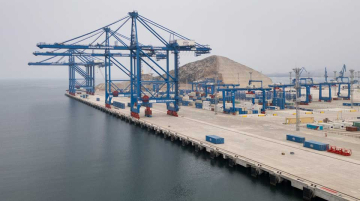
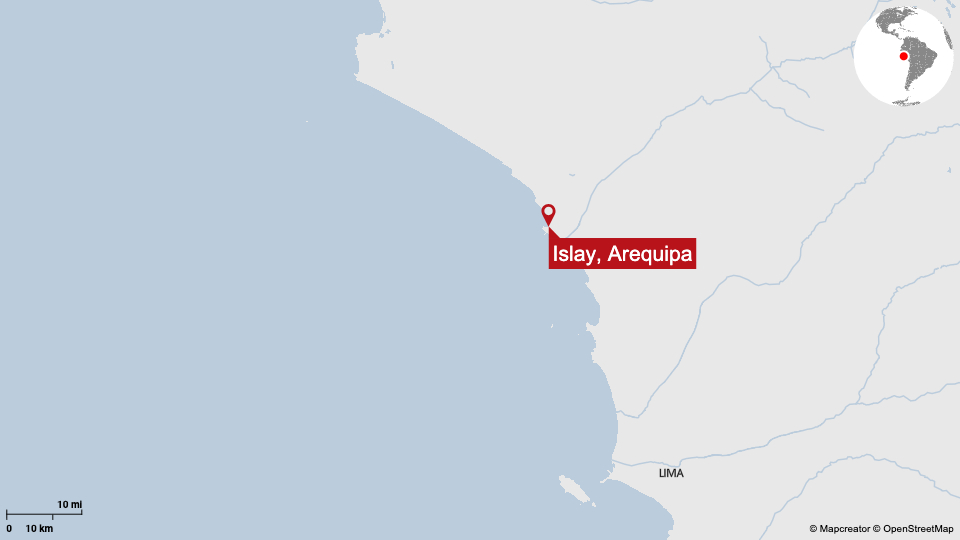
The Corío port infrastructure project, located in Islay, Arequipa, is shaping up to be one of Peru’s most strategic initiatives in the 21st century.
With a natural draft of nearly 28 meters, it is one of the few enclaves in South America capable of receiving post-Panamax megaships without costly dredging, positioning itself as a logistics hub of hemispheric reach.
At the institutional level, the project has evolved from a regional announcement into a state priority: in August 2025, the National Port Authority (APN) granted temporary technical viability to the Consorcio Hub Corío Megapuerto del Sur, and in November of the same year, ProInversión and the Ministry of Transportation and Communications (MTC) signed a formal agreement to promote the “Megapuerto de las Américas – Corío”.
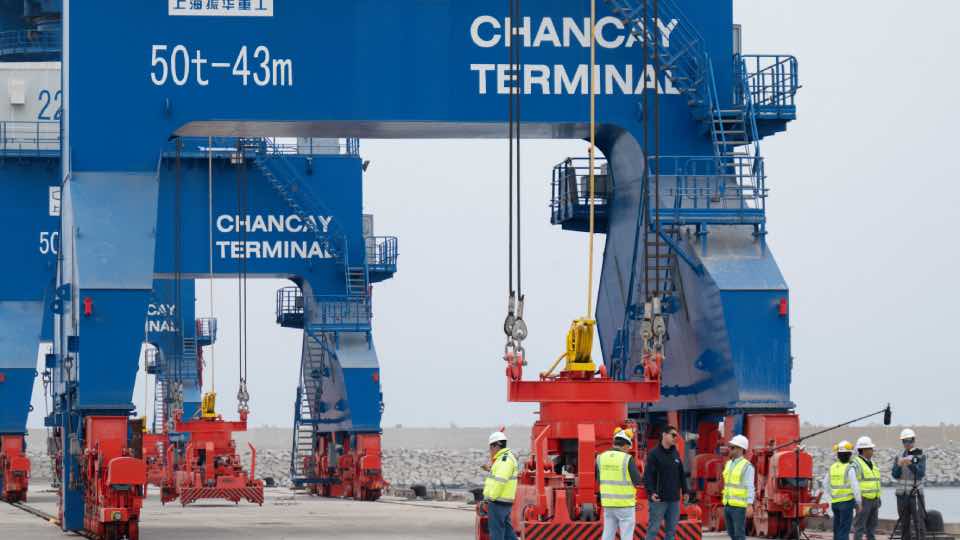
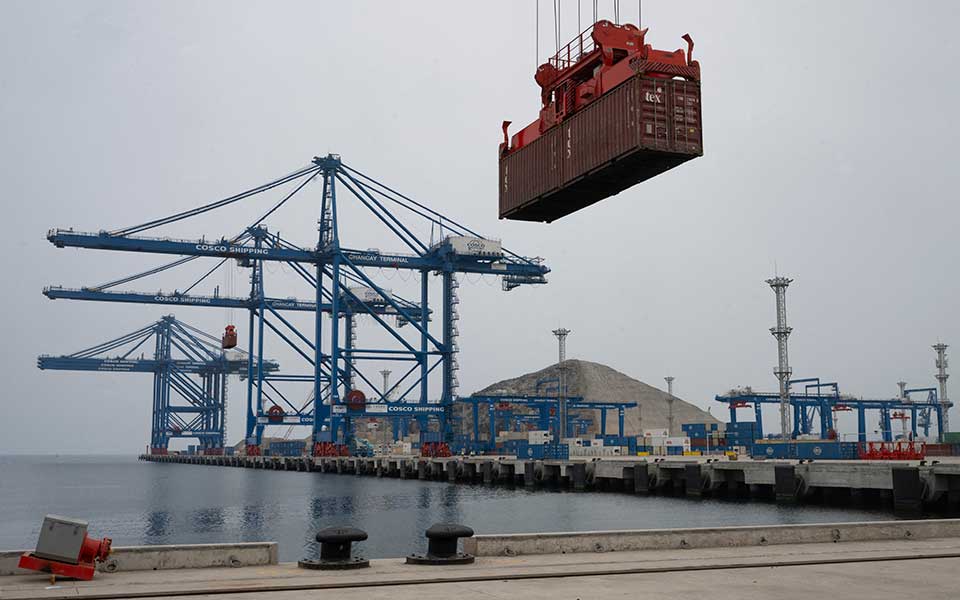
However, Corío’s geostrategic value cannot be understood in isolation. Its relevance has skyrocketed following the operational launch of the Port of Chancay, controlled by Chinese capital, which has begun to modify the regional balance of supply chains in the South American Pacific and to consolidate the PRC—through COSCO Shipping Ports—as the predominant actor in regional port infrastructure.
In this scenario, ports have ceased to be strictly commercial nodes to transform into “strategic assets” within the geopolitics of transportation—that is, infrastructures whose control directly influences territorial resilience and major-power disputes over global flows. Facing the advance of Chancay, Corío’s operability—estimated at a multimodal investment of $7 billion—offers Peru the opportunity to diversify routes and prevent a single power from concentrating regional logistical control, shaping a national port system with strategic balance and sovereign governance.
Added to this situation is a web of international pressures demonstrating that decisions regarding the Peruvian coastline do not possess a neutral character. On one hand, the United States’ National Defense Strategy (2026) reaffirms the centrality of great-power competition and the protection of critical infrastructures in environments where access to maritime nodes acquires a growing security relevance.
Simultaneously, the formalization in the U.S. Congress (in December 2025) of the intent to designate Peru as a “Major Non-NATO Ally” drastically increases the geopolitical sensitivity of these projects. In a 2026 global context shaken by geoeconomic volatility, supply chain risks, and disruptions in energetic chokepoints like the Strait of Ormuz, Corío becomes an instrument of state power and maneuverability. Under this dynamic of opposing forces, the future of the initiative is debated among three strategic financing and governance scenarios:
1. American Scenario: Strategic Counterweight to China
The first scenario contemplates the possibility of the U.S., or companies linked to its strategic environment, leading the financing and operation of Corío. According to the Regional Government of Arequipa, exploratory meetings have been promoted with American investors, presenting the megaproject as a logistics hub destined to connect southern Peru, Brazil, Bolivia, Chile, and Argentina with Pacific trade routes toward the United States.
In this alternative, Corío could consolidate itself as a strategic counterweight to the Port of Chancay, currently controlled by COSCO Shipping Ports, contributing to preventing the concentration of regional maritime trade under a single actor.
Additionally, the United States could provide state-of-the-art port technology, logistical interoperability standards, and facilities for hemispheric integration, consistent with the priorities of supply chain resilience and critical infrastructure protection established in the National Defense Strategy 2026.
Likewise, it would facilitate access to logistics networks with Western standards of financial transparency, regulatory compliance, and port security.
Nonetheless, this alternative implies significant strategic challenges. Opting for a predominantly American financing model would mean reconfiguring diplomatic balances, considering that the People’s Republic of China (PRC) is Peru’s main trading partner, while the United States maintains a relevant role as a political, economic, and military ally.
In such a context, diplomatic and commercial frictions could arise if not managed with pragmatic balance. At the same time, it would offer relevant advantages: strengthening strategic alliances with Washington, attracting advanced port technology, and articulating cooperation schemes in maritime security and regional defense, without compromising the Peruvian state’s decisional autonomy.
Therefore, the viability of this option will depend on Peru’s capacity to manage an active and multifocal diplomacy capable of maintaining constructive relations with both powers, avoiding exclusive alignments, and prioritizing national strategic autonomy.
As Robert Evan Ellis, an expert in inter-American relations and assistant professor at the U.S. Army War College, has pointed out, the strategy of “active neutrality” could offer Peru a viable framework of action to sustain simultaneous relations with the PRC and the West, especially in the 2026 international context characterized by the return of realist approaches and increasing competition for strategic logistical nodes, without compromising its sovereign capacity to make decisions on projects like Corío.
Similarly, in January 2026, the United States Department of State (DOS) approved a potential sale of approximately $1,500,000 destined to support the relocation of Peru’s main naval base in Callao. This measure is linked to the expansion of the commercial port and the regional logistical competition associated with the Port of Chancay, reinforcing the idea that Peruvian port infrastructure is beginning to be embedded in hemispheric security and logistics decisions.
Therefore, this precedent evidences that the port dimension and the strategic-military dimension are beginning to intertwine in the international perception of Peru.
2. Chinese Scenario: Consolidation of the Maritime Silk Road
This approach posits that China, through conglomerates such as COSCO Shipping Ports, leads the financing and operations of Corío, integrating it into its global Belt and Road Initiative strategy. According to the Observatory of the National Center for Strategic Planning (CEPLAN), China has invested more than $3,600,000 dollars in the Port of Chancay, projecting it as a large-scale logistical node that reinforces its control over trade flows in the South American Pacific and consolidates its influence over South America’s main export routes destined for Asian markets.
If Corío were incorporated into this network, Beijing would consolidate its maritime influence in the region and strengthen its negotiating capacity over strategic export routes for minerals, gas, agro-industry, and manufacturing. This would configure an articulated logistical axis under Chinese leadership on the Peruvian coast.
Such an alternative, however, poses complex challenges for Peru’s strategic autonomy. The simultaneous control of Chancay and Corío by Chinese capital could generate a structural dependency, limiting the diversification of trading partners and reducing the margin to balance diplomatic relations. Furthermore, various studies argue that Chinese megaprojects in port infrastructure tend to generate circles of technological dependency and financial conditioning that hinder sovereign renegotiation.
To this is added the growing concern over the presence of large Chinese vessels operating near the Peruvian coast, often associated with predatory or illegal fishing practices, affecting hydrobiological resources and weakening the State’s capacity to exercise effective control over its maritime domain.
Therefore, this type of activity not only erodes the country’s economic and environmental sovereignty but can also facilitate transnational illicit networks linked to species trafficking, tax evasion, or labor exploitation on the high seas. In that sense, the challenge lies not solely in the origin of the capital, but in the design of contractual and regulatory frameworks that guarantee operational sovereignty, transparency, and effective state control.
This situation could place Peru at the center of direct geopolitical competition, forcing the State to manage opposing pressures from its main trading partners and powers with divergent agendas, in which territorial and maritime sovereignty will be tested by external interests.
At this point, it is crucial to establish strategic port governance principles that align with international standards to prevent the exclusive control of national logistics assets by foreign powers. Consequently, the priority must be to preserve national decision-making capacity over critical infrastructure, regardless of the source of financing.
3. Multipolar Scenario: Diversification and Strategic Autonomy
This model contemplates a diversified financing scheme involving countries such as South Korea and Portugal, as well as European or Asian consortia. This approach seeks to maximize the Peruvian state’s bargaining power by avoiding excessive concentrations of power and influence.
Likewise, this scheme could incorporate emerging actors from the Middle East, such as the United Arab Emirates (UAE), Qatar, or Saudi Arabia, that are interested in port, energy, and logistics investments in Latin America, thereby broadening the geoeconomic spectrum of strategic partners. Under this logic, Corío could be developed as a port of shared governance, capable of attracting advanced port technologies, fostering knowledge transfer, and establishing special economic zones to boost industrialization in southern Peru.
The multipolar model offers the greatest strategic autonomy to Peru, allowing it to balance relations with different power blocs and reduce its exposure to hegemonic conflicts. Even so, it represents the most complex scenario to materialize, as it demands solid political leadership, active economic diplomacy, and the implementation of a competitive regulatory framework that generates trust among investors of multiple origins.
Furthermore, this model could face direct resistance from powers seeking to consolidate their influence in the South Pacific, which would force the State to legally protect the project, reinforce its international negotiation capabilities, and safeguard sovereign control over its coastline and maritime spaces. Therefore, it requires strong institutions, legal stability, and a coherent foreign policy that backs strategic diversification.
Beyond the analyzed financing alternatives and management models, the Port of Corío positions itself as a nerve center in the global competition for control of South Pacific logistics routes; its potential to alter commercial and strategic balances makes the megaproject a sensitive asset for major international actors.
Regardless of the predominant scenario, the project will inevitably be embedded in dynamics of systemic competition; consequently, the challenge for Peru will not consist solely of choosing who will finance or manage the port, but of defining how to protect its strategic decisions to guarantee that these respond to a comprehensive national strategy, aligned with the principles of strategic autonomy, cooperative security, and a governance model for critical logistical infrastructures that preserves the state’s decisional sovereignty.
Strategic Risks and Mitigation Measures
Any national planning regarding Corío must anticipate that a megaproject of this significance will face geoeconomic containment or neutralization attempts by actors whose dominant positions are perceived as threatened.
| Category | Type of Risk | Description | Potential Actors | Recommended Strategic Actions |
|---|---|---|---|---|
| Direct Risks | Diplomatic Pressure | Attempts to politically influence the project’s financing model or governance scheme. | U.S., PRC, and other regional powers. | Active and multifocal diplomacy; diversification of alliances; strategic positioning of Peru in APEC, the Pacific Alliance, and hemispheric security forums. |
| Financial Blockades | Restriction or increased cost of access to international financing for dissuasive or competitive purposes. | Multilateral banks, economic blocs, global financial actors. | Mixed and multipolar financing schemes; strengthening national financial structuring capabilities; incorporation of contractual shielding clauses. | |
| International Litigation | Activation of legal or arbitral controversies aimed at delaying, increasing the cost of, or conditioning project execution. | Competing companies, state actors, shipping consortia. | Legal shielding from the planning stage; contracts with sovereignty and balanced governance clauses; permanent accompaniment by the Chancellery (MFA) and MEF. | |
| Targeted Disinformation | Information operations aimed at eroding the project’s public legitimacy or generating social conflict. | Media operators, pressure groups, geopolitical actors. | National strategic communication strategy; informational transparency; early engagement with communities; specialized media and network monitoring. | |
| Indirect Risks | Internal Regulatory Conflicts | Regulatory mismatch or overlapping competencies that slow down state timelines. | Institutional bureaucracy, regional and local governments. | Centralization of strategic decision-making in an autonomous national authority with national security standing. |
Manolo Eduardo Villagra is a Research Analyst in the Peruvian Army. This article has been lightly edited for space.