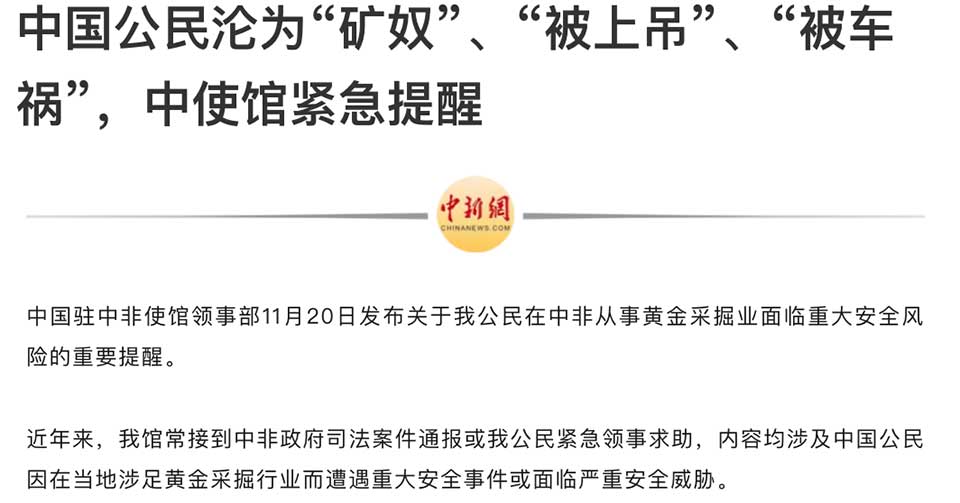
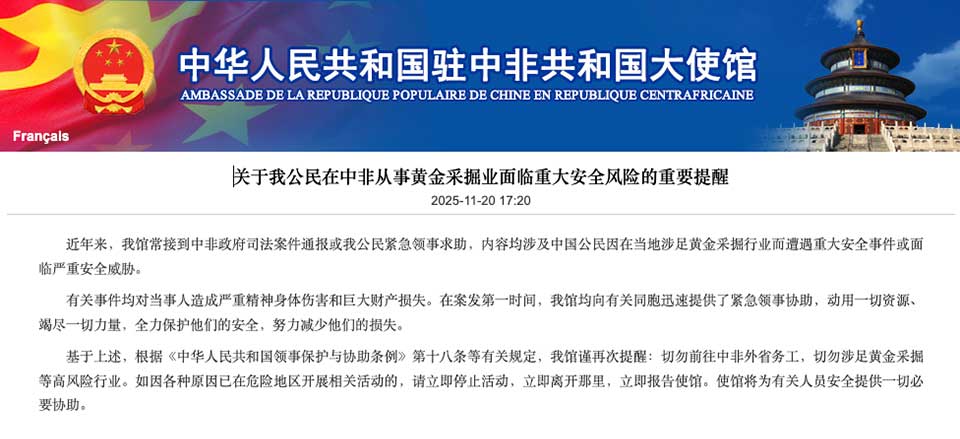
The Chinese embassy in the Central African Republic issued one of its strongest warnings to date last week about the extreme dangers facing Chinese nationals involved in gold mining in the Central African Republic (CAR). The warning circulated widely on Chinese news platforms, prompting reactions that expose both the domestic pressures behind risky, resource-driven emigration and the expectations placed on Chinese and African governments.
According to Reuters, the embassy’s message was direct and uncompromising. Chinese miners were warned that they risked being attacked, kidnapped, deceived, pulled into violent disputes between armed groups, or maimed in staged “car accidents” or “hangings.” The embassy also noted that miners could have their documents confiscated and effectively turned into “mining slaves.” All areas outside Bangui were designated as extremely high risk, and miners in these regions were advised to stop work, evacuate, and report their situation to the embassy.
A Tencent News article on the warning generated a large volume of user comments that can be grouped into several themes. The most prominent tension lies between the desire for personal safety and the economic pressures that push people abroad—pressures felt most acutely by those in lower socio-economic groups.
Many users, while acknowledging China’s difficult job market, argue that life is paramount and that no level of income justifies risking one’s life overseas. Others highlight low wages and limited mobility at home as key push factors driving workers into high-risk regions of Central Africa, suggesting that a lack of opportunity forces them to gamble their futures under dangerous conditions.
Another major theme concerns the gap between public expectations for security guarantees and geopolitical realities. Some users question why the People’s Liberation Army (PLA) cannot intervene, while others, recognizing China’s non-intervention policy, call for greater reliance on private security companies to protect Chinese personnel and assets. Some argue that security should be a negotiated precondition for Chinese investment in unstable regions, with clear plans for how to maintain it.
Several commenters also stress that African governments must strengthen their own security measures and uphold their responsibilities to protect Chinese nationals. Some suggest that China should use its influence to encourage local authorities to meet these obligations.
Perhaps the darkest theme in the discussion is suspicion of “Chinese tricking Chinese,” where domestic recruiters lure vulnerable workers into hazardous environments. This also reinforces the expectation that the Chinese government should take stronger action against intermediaries who deceive or exploit workers.
In recent years, Beijing has taken multiple steps to address the vulnerability of its citizens overseas, including some measures mentioned by netizens. These include expanding the use of private security companies and supporting capacity-building programs for local armed forces. Some of China’s training for African security actors, for example, focuses specifically on protecting Belt and Road Initiative assets and personnel.
Beyond these hard-security measures, China and African states have also been developing legal and prosecutorial cooperation mechanisms targeting transnational crime, illegal mining, and the protection of citizens. The China-Africa Prosecutorial Cooperation Forum, for example, has facilitated high-level dialogue aimed at closing gaps that criminals exploit across borders.
The Forum on China-Africa Cooperation (FOCAC) Action Plan (2025–2027) explicitly lists “illegal mining of gold,” “trafficking of human beings,” and crimes that “infringe upon the safety of life” as priority areas for joint action. This signals a policy shift toward addressing the concrete grievances raised by the public.
Additionally, the China-Africa Joint Arbitration Centre (CAJAC), with various centers in both Africa and China, provides a platform for resolving commercial disputes between Chinese and African entities before they escalate to insecurity or conflict.
Indeed, security is assuming a more prominent role in China-Africa cooperation as expanding economic engagement links the vulnerabilities of both sides more directly. The public reactions to the Bangui warning highlight the structural pressures driving Chinese workers into high-risk environments, the limits of China’s non-intervention approach, and rising expectations for stronger protection mechanisms.
China’s proposed Global Security Initiative (GSI), together with emerging legal and prosecutorial cooperation mechanisms, provides a promising pathway to address these demands. Yet the deeper issue remains: unless domestic economic pressures are stabilized and China-Africa security coordination becomes more systematic, similar crises will continue to expose the gap between public expectations and the realities of operating in insecure regions.
Lungani Hlongwa is the Editor of The China-Africa Security Radar Substack. This article was originally published on The China-Africa Security Radar and was reprinted with permission.