To international visitors, Bonn—tucked along the Rhine River valley in western Germany—can feel like a time capsule. “Many things never change,” my local hosts told me, gesturing proudly toward the Bonn Minster, the Romanesque church that has anchored the city center since the Middle Ages. After more than two dozen visits to this peaceful former West German capital to cover United Nations climate negotiations since the late 2000s, I have found it hard to disagree. Much here feels remarkably unchanged.
In recent years, that sense of continuity has taken on a less comforting meaning. It is strikingly difficult to spot an electric vehicle in Bonn—and, more broadly, across Germany. Coming from China, visits to Bonn once underscored a familiar contrast: institutional maturity abroad versus uneven development at home.
Increasingly, that comparison has flipped. What stands out now is not Germany’s stability, but the persistence of outdated legacy systems at the heart of Europe alongside the rapid advance of new technologies elsewhere.
This tension sits at the core of the current global clean tech transformation. In the deployment of critical technologies needed to sustain growth while addressing climate change, a striking picture is taking shape: parts of the Global South may move faster than their Global North counterparts.
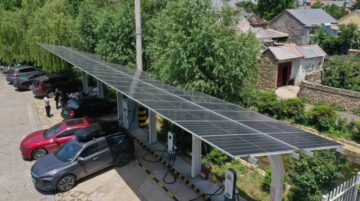
On electric vehicles market penetration, the United States is not only trailing China in the share of new sales; a number of emerging markets—including Vietnam, Thailand, and Indonesia—are also surpassing the U.S. on specific adoption metrics and converging toward European levels.
That momentum may accelerate over the coming decade, upending long-held assumptions about development—and even our definition of what constitutes a “developed” or “developing” economy. The half-century-old narrative—that countries in the Global South are necessarily late adopters, dependent on technologies and support from the Global North—looks increasingly outdated.
China’s Industrial Engine
At the heart of this technological and geoeconomic shift is China’s formidable industrial capacity. After more than two decades of sustained industrial policy, consistent government support, intense domestic competition, and relentless scaling and innovation, China has established a leading position across most of the critical technologies needed to power the energy transition.
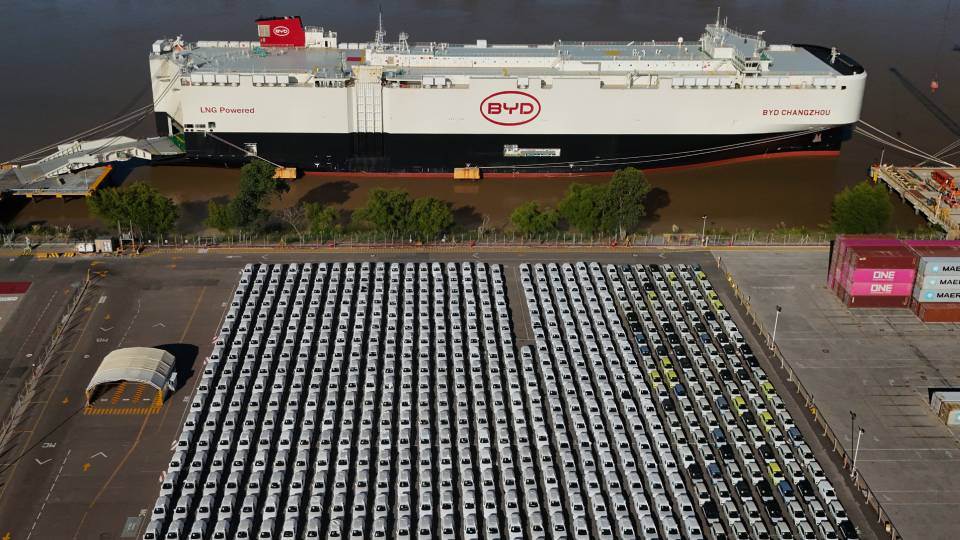
This transformation has made China the world’s largest clean technology market and pushed its firms to expand abroad. But here is the catch: As developed economies adopt more protective measures and partially close their markets, Chinese clean-tech exports are increasingly flowing into the Global South.

A cargo ship carrying wind power equipment for export to Romania sets sail from Penglai Port Area in Yantai City, Shandong Province, China, on February 8, 2026. (Photo by Costfoto/NurPhoto) (Photo by CFOTO / NurPhoto / NurPhoto via AFP)
In 2024, developing economies absorbed a larger share of China’s solar exports than developed countries for the first time. In electric vehicles, the share of China’s exports going to Global South markets rose sharply—from roughly 10 percent in 2022 to nearly 40 percent in 2025.
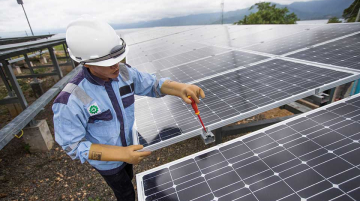
These flows are already reshaping local energy systems. Pakistan, for example, has experienced a surge in solar photovoltaic imports from China in recent years, helping to alleviate chronic power shortages. More broadly, energy security considerations, exacerbated by the closure of the Strait of Hormuz, are likely to further accelerate demand across the Global South.
Why the Global South is Moving Fast
Two factors make China and Global South countries natural allies in this new phase of the energy transition.
First, they are complementary supply-and-demand partners bound by a shared development mindset. For many Global South countries, rapid population growth, urbanization, and industrialization create an urgent need for affordable and scalable energy solutions. China’s highly competitive clean-energy technologies offer a practical pathway to close infrastructure gaps, while also providing a model of development that many find compelling.
Second, Global South countries tend to view Chinese technologies less through a geopolitical lens and more through a pragmatic one. A low-cost Chinese solar panel is not primarily seen as a strategic risk, but as an opportunity.
For countries like Pakistan, long constrained by energy shortages, an influx of affordable solar technology can be transformative. And if, as critics in the West argue, these products are supported by Chinese state subsidies, then it’s even better for Pakistani consumers suffering from high energy costs and blackouts.
Projecting the current dynamic forward by a decade, it is not inconceivable that an Indonesian, Ethiopian, or Vietnamese observer arriving in Germany or the United States might join me in thinking that their destination is not quite as “developed” by certain standards as the label suggests.
This fundamental shift is only beginning to unfold. As the Western approach to driving climate action continues to stall — hampered by rightward-leaning politics and deepening uncertainty over whether to welcome or resist Chinese low-carbon technologies and investment — a new playbook is emerging.
Built on infrastructure expansion, commercial ties, and electrification, and powered by cost-competitive low-carbon solutions from China, it offers a different path toward global decarbonization precisely at the moment when this agenda is confronted with the most serious challenges since the adoption of the Paris Agreement in 2015.
The threat to Western climate leadership now comes from two directions: a rightward political shift that shows little sign of reversing before the end of this decade, and the uncomfortable reality that decoupling from China and decarbonizing at the same time may simply be incompatible.
In this emerging landscape, the Global South is poised to become the driving force of climate action—not out of ideology, but out of pragmatism. Many countries will deploy solar, wind, batteries, and electric vehicles at speed, not because of any alignment with China, but because these technologies offer the most efficient route to economic growth and energy security. Rather than treating Chinese clean technologies as a threat to domestic industries, they will prioritize deployment—using them to power much broader economic development at home.
The New Climate Order
In this world that is taking shape over the next decade, three questions will be particularly important to watch.
First, could a more confident Global South begin to rewrite the rules of climate politics? International climate governance has long been anchored in the principle of “common but differentiated responsibilities,” which assumes slower and later action from developing countries.
But as access to affordable clean technologies expands, assumptions may become increasingly detached from economic reality. Climate change could become the arena for a profound reversal in global influence, allowing the Global South to assert a level of leadership that has long been aspirational.
Second, how will the West respond? The threat to Western climate leadership now comes from two directions: a rightward political shift that shows little sign of reversing before the end of this decade, and the uncomfortable reality that decoupling from China and decarbonizing at the same time may simply be incompatible. Simply put, where will the “China-free” solar panels and electric vehicles come from? Will they arrive in time to make a meaningful dent in the climate crisis, and if so, at what cost?
The West may remain mired in this muddled middle ground for some time. A more pragmatic strategy, one that redefines where competition with China is necessary and where conditional engagement with its industrial capacity is unavoidable, remains within reach. But it demands political courage that is currently in short supply. The longer the struggle continues, the more power and influence risks being ceded to China and the Global South.
Third, could deepening low-carbon economic integration between Beijing and the Global South reshape China’s own climate diplomacy? Chinese leaders would do well to recognize an emerging reality: rapid global decarbonization is increasingly aligned with the country’s political and economic interests.
That recognition should translate into a more proactive role in supporting and leading global climate efforts. Such a shift would not only advance China’s commercial interests but also strengthen its international credibility while delivering a much-needed boost to an otherwise faltering global climate agenda.
If the past decade, turbocharged by the adoption of the Paris Agreement, marked a political high point for climate action, driven by collaboration between Beijing and the United States as the most powerful Global North actor, the new chapter of the global climate story will be written elsewhere. Bound by a shared development imperative and deepening economic integration, it will increasingly be shaped by China and its partners across the Global South.
Li Shuo is CGSP’s Non-Resident Fellow for Climate.