By Deng Yaowen
In January 2024, China Baowu Steel Group issued the first tranche of a bond that raised CNY 10 billion ($1.45 billion) on the Shanghai Stock Exchange.
Media reports described it as one of the largest corporate bond issuances by a Chinese state-owned enterprise in recent years. But perhaps most notable is how the money will be used. At least 70% of the proceeds are allocated to developing a massive iron ore mining project in Guinea, West Africa.
Transition bonds issued in China’s steel sector are typically aimed at decarbonizing existing steel production rather than upstream mining projects. The “low-carbon” label stems from the intended use of high-grade ore to produce steel with lower emissions, specifically through direct reduction.
Guinea has expressed ambitions to use the project to develop its own steel-processing industry. However, experts have raised concerns about the feasibility of this goal, as well as the environmental, social, and climate impacts of the mining project.
Why High-Grade Ore Matters
In China, “transition finance” has emerged as a tool to support emissions reductions in high-carbon sectors such as steel. It differs from “green finance,” which typically funds projects with clearly defined environmental benefits.
There has been a steady rise in transition loans and bonds since 2021, when regulators began publishing guidance documents for industries such as steel, coal power, and building materials.
Issuance of transition-labeled steel bonds rose sharply in 2024, with 12 bonds totaling about CNY 22 billion, according to a 2025 report by the nonprofit Climate Bonds Initiative (CBI). Only CNY 5.1 billion had been issued prior to 2024.
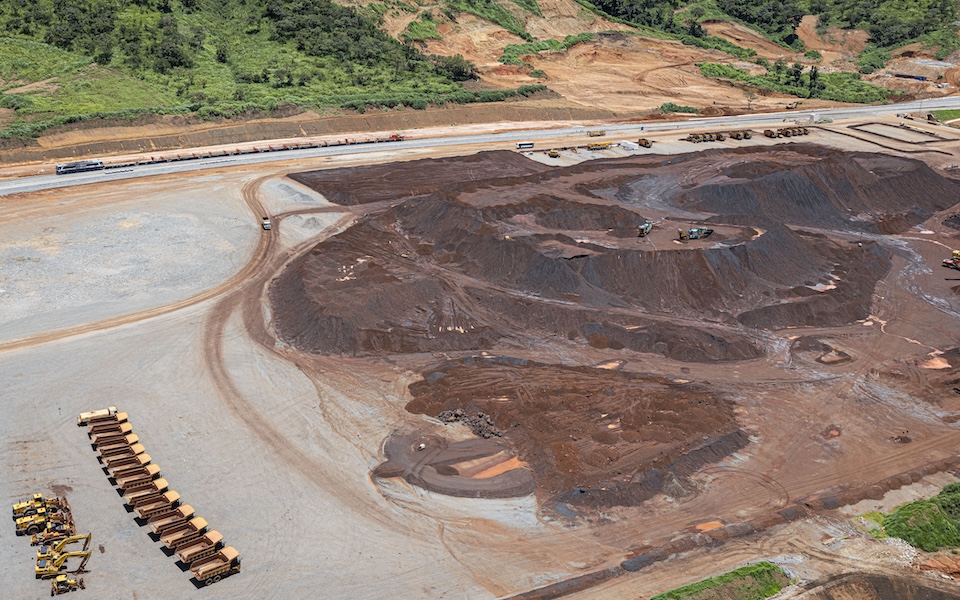
The destination of these new funds has drawn particular attention. The northern blocks of the Simandou project in Guinea are reportedly the world’s largest reserve of unexploited, high-grade iron ore.
The bond prospectus argues that Simandou’s ore could support hydrogen-based direct reduced iron, a process seen as central to long-term steel decarbonization.
Xu Xiaoyun, senior research analyst at CBI, called the bond “quite innovative,” noting that it is relatively rare for proceeds from labeled bonds supporting steel decarbonization to be used to secure high-grade iron ore.
“Direct reduction using hydrogen replaces the coal and coke used in blast furnaces and can enable deep decarbonization,” she said. “If the entire process runs on green hydrogen and renewable electricity, emissions could be more than 90% lower than conventional blast furnace production.”
Research by the U.S.-based Institute for Energy Economics and Financial Analysis suggests that direct reduction requires iron ore grades of around 67% or higher, a threshold met by relatively few global deposits. Simandou’s ore averages above 65% iron and can be upgraded for use in pellet feed for direct reduction.
The issuer states that using such ore could lower carbon emissions per ton of steel to roughly 60% of the current global average—an average largely shaped by coal-fired blast furnaces.
Investing in high-grade iron ore deposits such as Simandou therefore has “strategic value,” according to Xinyi Shen, senior advisor at the Finland-based Centre for Research on Energy and Clean Air (CREA). This is because it supports China’s long-term low-carbon steel strategy while strengthening the iron ore supply chain.
However, Xu noted that the bond prospectus provides limited detail on the company’s broader transition pathway.
“It does not specify whether the hydrogen used would be low-carbon, outline a detailed corporate transition plan, or explain how the high-grade ore would definitively support hydrogen-based steelmaking rather than other production routes,” she said.
A Project Decades in the Making
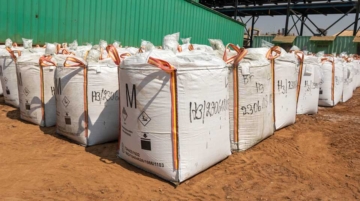
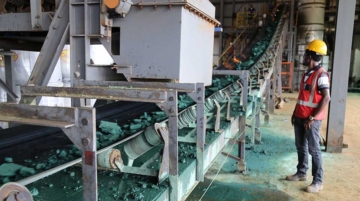
Following major Chinese investment, the Simandou project was formally commissioned in November 2025, and the first shipment of ore arrived in China this January. Already the world’s top iron ore importer, China is expected to be the project’s primary export market.
The two northern blocks are controlled by Winning Consortium Simandou, in which China Baowu has been a key investor since June 2024 and now holds a 51% stake. The two southern blocks are being developed by a Rio Tinto–Chinalco joint venture, with Baowu also involved through its partnership with Chinalco.
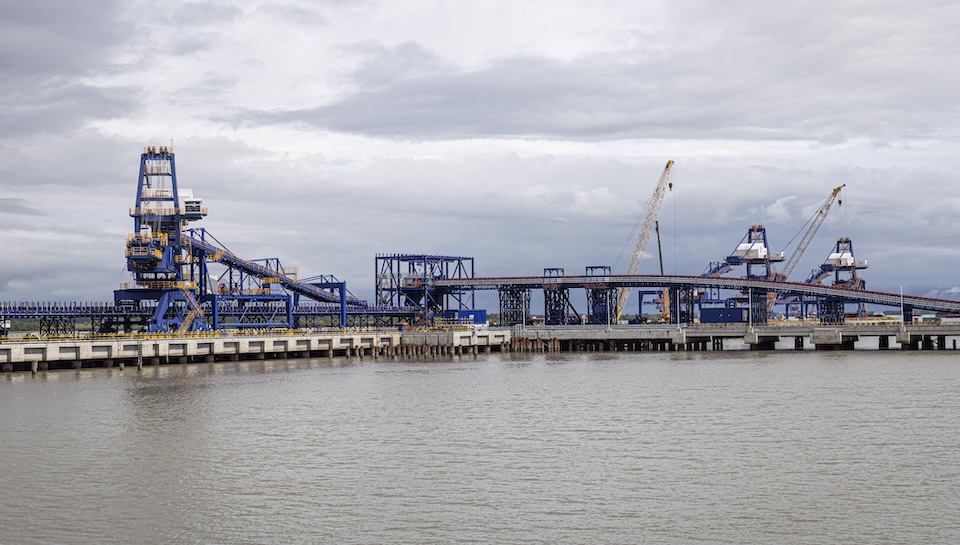
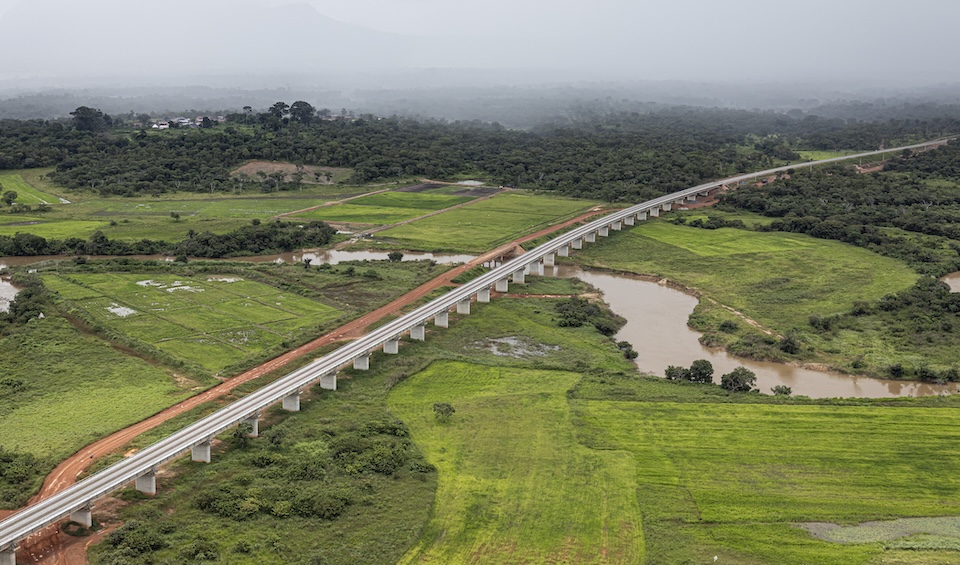
With total investment estimated at around $24 billion, Simandou includes a 670 km heavy-haul railway and a new Atlantic port, making it one of the largest mining-linked infrastructure projects in Africa in recent years.
Environmental Fault Lines
The connection between the bond—known as 24 Baowu K1—and such a large mining project may challenge its credibility as a low-carbon transition mechanism. In China’s steel sector, this type of bond is typically used to finance plant upgrades or specific decarbonization technologies within steel production.
There has been some precedent for incorporating iron ore mining into sustainable finance frameworks. Australia’s latest Sustainable Finance Taxonomy, developed with technical support from the Climate Bonds Initiative, includes iron ore mining as a potentially green activity, Xu said.
The key criterion is that the ore grade must be compatible with hydrogen-based direct reduction or other low-emissions production routes. The taxonomy also requires mining activities to meet emissions intensity targets.
Simandou has drawn scrutiny from civil society groups over its environmental footprint. In 2022, Human Rights Watch raised concerns that the project could affect local land, water resources, and ecosystems, citing risks such as deforestation and land acquisition.
The organization stated that construction of the railway could occupy more than 100 square kilometers of land and affect habitats of endangered species such as the West African chimpanzee, based on an impact assessment by Winning Consortium Simandou.
The assessment also estimated that forest clearance and related activities could result in more than 19 million tons of CO₂ emissions over the mine’s 22-year lifespan. Other experts argue the emissions impact of deforestation may be even greater.
In July 2025, community organizations raised concerns over potential water and soil contamination. Winning said it remains committed to advancing the project in accordance with Guinean law and international standards.
Under the latest Shanghai Stock Exchange guidelines, issuers of transition bonds are encouraged to have independent third-party verification of environmental benefits and to provide ongoing assessments during the bond’s lifetime.
As Xu noted, the credibility of bonds like 24 Baowu K1 depends on whether proceeds are used as stated and whether disclosures are transparent—ideally clarified through future reporting.
As of this writing, no such report has been identified. A June 2025 bond management report states that the port and railway components will conduct environmental and social impact assessments in line with International Finance Corporation standards.
Beyond Ore Exports
Simandou is closely tied to Guinea’s industrial ambitions. The government has positioned the project as the cornerstone of its national development strategy, Simandou 2040, aimed at moving beyond raw ore exports toward long-term industrial growth and economic transformation.
“Guinea, like many resource-rich countries, hopes to use projects such as Simandou to move up the value chain and support structural transformation,” said Yunnan Chen, a research fellow at ODI.
With rising global demand for critical resources, she noted that governments may have an opportunity to negotiate greater technology transfer and higher-value investment from external partners.
Guinea’s presidential chief of staff, Djiba Diakité, said in November 2025 that project partners must complete feasibility studies for downstream processing facilities—either a steel mill or pellet plant—within two years of production.
Simandou and its infrastructure are also viewed as long-term national assets. The Guinean government holds a 15% stake in both mining blocks and in La Compagnie du TransGuinéen (CTG), the joint venture responsible for developing the railway and port.
The government has proposed industrial zones along the rail corridor to support broader development, including agriculture, alongside a sovereign wealth fund to manage future revenues for long-term investment.
Translating resource wealth into a competitive downstream industry remains challenging, said Xinyi Shen of CREA. It requires “supporting infrastructure, skilled labor, and stable demand.” In many African countries, these conditions are still evolving, and green steel markets are in their early stages.
The bond prospectus states that Simandou will provide essential feedstock for Baowu and the global steel industry’s decarbonization efforts and references potential downstream processing in the Middle East and West Africa. However, it does not outline specific plans for steelmaking facilities in Guinea.
Guinea’s ambitions also reflect a broader shift in how Chinese companies support overseas resource and infrastructure projects. Rather than relying solely on loan-financed construction models, companies and investors are increasingly taking on financing and risk-sharing roles, including through domestic bond issuance such as 24 Baowu K1.
Whether Baowu’s bond ultimately supports Guinea’s industrial ambitions remains uncertain. However, by linking domestic transition finance to an upstream mining project abroad, it suggests one possible pathway for securing the raw materials needed for low-carbon industrial transitions.
At the same time, it raises questions about how China’s sustainable finance instruments should be defined, verified, governed, and held accountable when applied to projects far from the industries they are meant to decarbonize.
Deng Yaowen is an ESG practitioner working on responsible mineral supply chains, social performance in the extractive industries, and China’s evolving global footprint. This article was originally published on Dialogue Earth under the Creative Commons BY NC ND licence.