
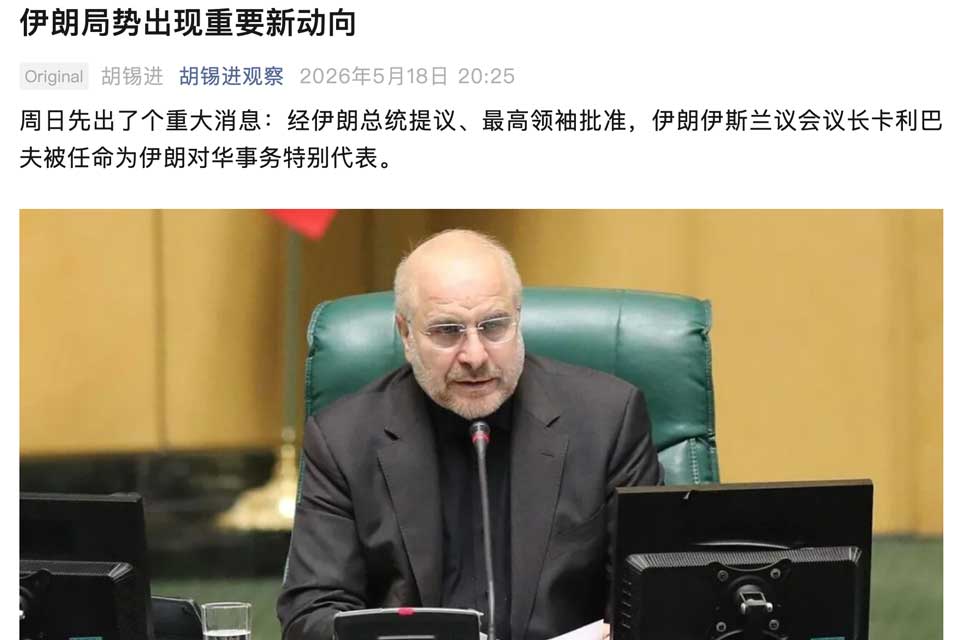
A day after U.S. President Donald Trump wrapped up his Beijing summit with Chinese President Xi Jinping with few actual breakthroughs on Iran, Tehran named parliamentary speaker Mohammad Bagher Ghalibaf as its special representative for China affairs, a move Chinese analysts say signals Iran is betting on Beijing to exert greater influence over negotiations to end the war.
According to Tasnim, an Iranian news agency affiliated with the IRGC, he was appointed at the proposal of President Masoud Pezeshkian and with the approval of Supreme Leader Ayatollah Mojtaba Khamenei, and will “coordinate various sectors of relations between Iran and China.”
Ghalibaf is one of Iran’s most prominent conservative political figures who led the country’s delegation in April peace talks with the U.S. He is also a former commander in the Islamic Revolutionary Guard Corps (IRGC) and the former mayor of Tehran.
Niu Xinchun, executive director of the China-Arab Research Institute at Ningxia University, told the South China Morning Post that the appointment showed Iran was placing “unprecedented” importance on ties with China. Ghalibaf, he said, is likely a figure who can represent Iran and is acceptable to different domestic factions.
Hu Xijin, the former editor-in-chief of the nationalist state tabloid Global Times, read the appointment through Ghalibaf’s overlapping roles in U.S. and China diplomacy.
“Because he is also the person in charge of negotiations with the United States, the overlap between his two roles sends a signal: Iran not only wants to negotiate with the United States, but also wants to strengthen contact and communication with China,” Hu wrote. “Iran hopes China can exert greater influence in ending the war. This is the strongest signal almost everyone reads from this information.”
Hu argued that the appointment would help Iran connect with China’s efforts to “promote peace and stop the war,” creating what a “deep binding” between Ghalibaf’s U.S. and China missions at a moment of crisis.
He also noted that the announcement came right after Trump left China and shortly before Vladimir Putin’s visit to Beijing. While Putin’s trip would mainly focus on China-Russia relations, it could also provide an opportunity for Beijing and Moscow to discuss joint efforts to push for de-escalation over Iran.
Xin Caimi, a popular WeChat current affairs commentary account, also emphasized Ghalibaf’s rank and political influence.
Compared with previous Chinese envoys, Ghalibaf holds a higher authority and carries greater domestic influence. His appointment means Iran is “greatly raising the level of political coordination on China affairs,” moving communication with Beijing from the diplomatic and embassy system to a higher national coordination framework.
The account added that Ghalibaf “knows the battlefield and the negotiating table,” understands how to show toughness toward the United States, and knows how to seek a practical way out at critical moments.
Zhanhu Zhiku, a nationalist WeChat account focused on military and geopolitical analysis, said the appointment is evidence that Tehran is making a long-term strategic bet on China’s future role in the Middle East.
“Special representatives for another country’s affairs are usually mid-level diplomats,” the account wrote. “But this time, Iran directly appointed its parliament speaker, effectively the country’s No. 3 figure, as special representative for China affairs, highlighting the importance it places on relations with China.”
“Some analysts believe Iran’s move is an institutional bet,” it continued. “Iran is betting that China will lead the future Middle East order.
For Iran, this is a chance to seize a development opportunity, and also a way for a great power to provide a ‘backstop’ for a weaker country. Because once China-Iran relations develop to a certain level, the United States will have to think twice before acting against Iran again.”