
In a rare blunt assessment, an analysis from China’s prominent state-backed think tank, The Institute for International Affairs in Qianhai, a district of Shenzhen in southern China, denounced Myanmar’s general election under military rule last month, saying the process lacked legitimacy and would do nothing to improve the country’s external environment.
However, the analysis said the junta’s continued grip on power could allow China to sustain its infrastructure footprint in the conflict-ravaged country and preserve Myanmar’s rare-earth supplies to China, a key leverage point in U.S.-China rivalry.
“A Fake Election”
Li Zheng, an assistant researcher at the institute affiliated to the Chinese University of Hong Kong, wrote that the election amounted to a “well-designed political transition to cloak military rule in civilian garb”.
He added that the outcome would further damage Naypyidaw’s international image, as the vote had been condemned by the United Nations, the European Union and Association of Southeast Asian Nations (ASEAN).
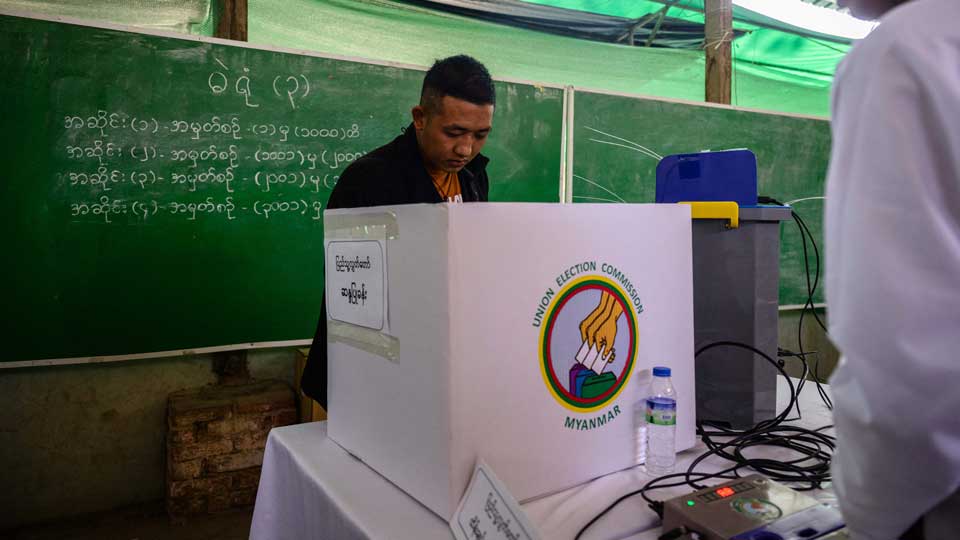
In December, Myanmar’s junta held a month-long general election in an attempt to bolster its legitimacy. The vote delivered a landslide victory to pro-military parties, with no pro-democracy groups securing any seats.
Min Aung Hlaing, the military chief, is widely expected to assume the presidency next month. Meanwhile, Aung San Suu Kyi, the well-known dissident and the country’s former elected leader, remains in prison, with her National League for Democracy removed from power and formally dissolved.
Li’s assessment stands in sharp contrast to Beijing’s position, which has voiced strong support for the election result.
“Myanmar’s future, following what many described as a ‘fake election’, remains shrouded by the clouds of internal civil war and international isolation – developments that are likely to have far-reaching implications for regional stability,” Li wrote.
Stabilizing Rare Earths Supply Chains
But there is an upside for China, according to Li. A moderately stable junta-controlled government will provide China with a reliable supply of critical minerals, namely, rare earths that are abundant in Myanmar.
Myanmar accounts for more than half of China’s rare earth imports from abroad, ranking among the top of China’s rare earths exporters, according to the official Myanmar think tank Institute for Strategy and Policy – Myanmar
Li said China’s investments and rare-earth supply chains are largely concentrated in areas controlled by local armed groups. As a result, he argued that if the junta could repackage military rule in a more civilian form, it would be “conducive to China–Myanmar cooperation” and help safeguard the security and stability of related rare-earth supply chains.
WHY IS THIS IMPORTANT? China has long backed Naypyidaw’s rulers without attaching moral judgment, a stance that has made it almost the only major power on the international stage to openly support Myanmar’s military government. An article like this, published by a well-known Chinese research institute, sheds light on the rationale behind this position. Beyond China’s long-standing principle of “non-interference”, Beijing’s extensive infrastructure investments in Myanmar and its growing demand for the country’s rare-earth supplies mean that China requires a stable political environment, particularly at the local level, where armed groups hold significant sway.