
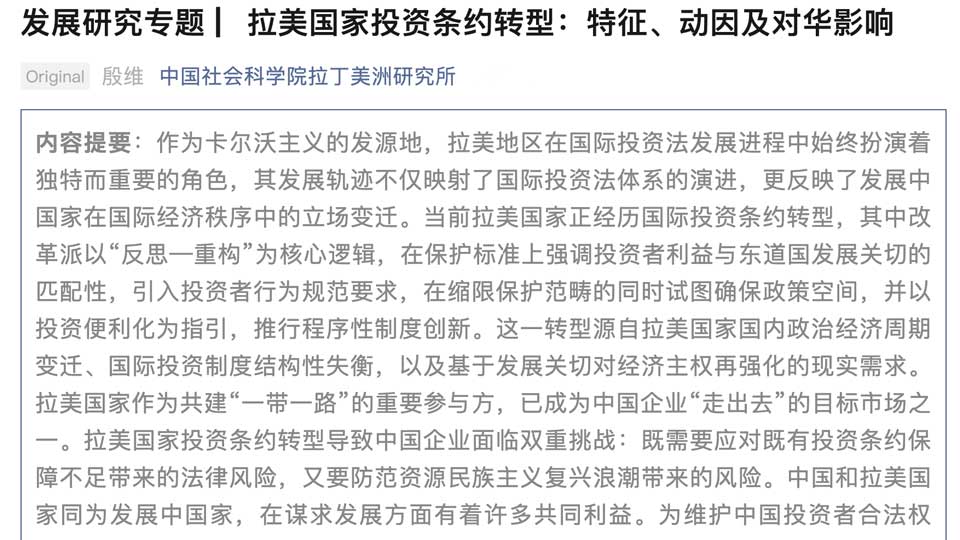
An analysis from China’s most influential public policy think tank, the Chinese Academy of Social Sciences, warned of Latin America’s trend of drifting back towards what it called “resource nationalism” and urged Chinese companies to strengthen risk safeguards measures.
“Resource Nationalism”
“Some Latin American countries are seeing a renewed surge of resource nationalism, with governments expanding their intervention in the economy. The resulting uncertainty is reshaping Chinese firms’ investment decisions and raising legal risks and compliance costs,” the article, issued in the Institute of Latin American Studies journal at CASS, wrote.
The author, Yin Wei, director of the China–Latin American Law Research Center at China’s Southeast University of Political Science and Law, one of the country’s leading institutions for legal studies.
In her article, she examined the starkly different attitudes of Latin America history’s left- and right-leaning governments, arguing that the “pendulum-swing” politics is a key factor causing shocks to Chinese capital, and it will still be the case in the future.
Now, China needs to immediately act by building stronger legal defenses, tightening compliance practices, and supporting local social governance in Latin American countries to reduce its exposure to future risks, she said.
Chinese companies have already filed appeals in Chile, Mexico, and Bolivia in response to their efforts to nationalize certain critical minerals. In Chile, the supreme court rejected China’s appeal.
Environment, Labor Responsibility Check
The author also urged Chinese companies to take a closer look at Latin America’s stringent protections on labor, the environment, and broader social issues, and to follow through on their corporate social responsibility commitments.
“Many Latin American countries grant unions collective bargaining rights, and their labor laws impose strict conditions on worker welfare and the termination of employment contracts. Without careful compliance with labor regulations, Chinese-invested projects may face significant and unpredictable risks,” she wrote.
For labor rights, a high-profile example emerged last year when Brazilian prosecutors sued BYD, alleging the company bore responsibility for human trafficking and working conditions “analogous to slavery” at a factory construction site in the country.
WHY IS THIS IMPORTANT? For Chinese scholars and investors, the rapid expansion into Latin America’s resource sectors and the broader “going-out” push, which concentrated largely in Brazil, has begun to draw more cautions. Much of the concern centers on how a growing number of Latin American countries have become significantly more politicized, not just as it relates to U.S.-China competition but also on domestic issues, including mineral nationalization, labor rights, and environmental protection.
For a country that seeks to position itself as a leader of the Global South, China now faces a subtle tension. While objections to resource protection measures in Latin America may be commercially rational, in some instances, framing these moves as “nationalism” carries political and diplomatic sensitivities, especially given how the term has often been used to frame China itself.
How Chinese scholars read Latin America’s pushback, and how the inevitable business frictions, rooted in anti-hegemony narratives and demands for resource sovereignty, feed into Beijing’s policymaking—will be worth watching as China tries to distinguish its global posture from that of the United States.


