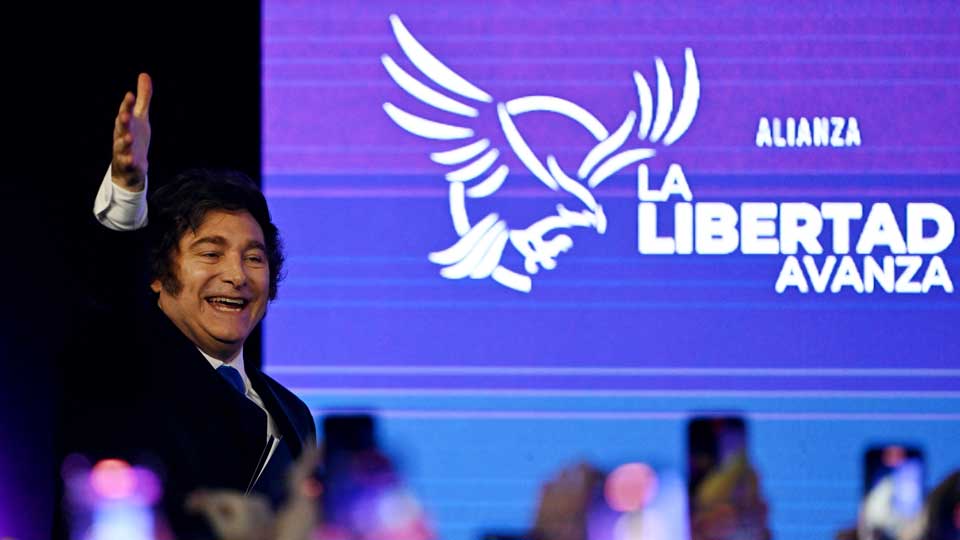
Chinese observers interpret Javier Milei’s triumph not simply as a domestic win for libertarian reform but as a struggle that places Argentina squarely under the shadow of Washington and Wall Street.
In an analysis published by The Paper.cn, Yuan Mengqi, Assistant Research Fellow at the Institute of International and Area Studies, Tsinghua University, said that Milei’s midterm victory consolidates U.S., especially Trump’s, and Wall Street’s endorsement of his reform agenda.

Yuan said that Argentina will likely strengthen its ties with Washington. While its bulk trade and financial cooperation with China will continue, the country is expected to align more closely with the U.S., Europe, and Israel in areas such as security, technology standards, and diplomatic discourse.
Guillaume Long, former Foreign Minister of Ecuador and a researcher at the Center for Economic and Policy Research (CEPR), told The Paper that Trump’s direct support for Milei amounted to foreign interference in Argentina’s domestic politics.“It is a kind of coercion that told voters, ‘You must vote for this man, or the U.S. will abandon you.’”
Long lamented that Argentina is becoming “a more ‘typical’ Latin American country,” as Milei’s economic agenda pushes it toward a mono-export model dominated by raw materials, minerals, and soybeans, its main exports to the U.S., China, and Europe. In his view, Argentina’s economy is regressing from a complex, diversified system to one increasingly resembling Brazil’s commodity-dependent structure.
As Argentina’s economy remains unstable, the Trump administration’s pre-election delivery of financial support drew attention. On October 9, the U.S. Treasury announced a historic move: directly purchasing Argentine pesos and signing a $20 billion currency-swap framework with the Argentine central bank, aimed at stabilizing the peso and economy. Yuan said that while the aid was smaller than markets had hoped, it carried major political weight: “This purchase mainly stems from Milei and Trump’s personal friendship and shared policy orientation. Even though it’s not direct debt, it still implies political binding and potential risk,” she said.
Long emphasized Argentina’s deep-rooted sense of independence and pride, which he said Trump failed to understand. While some voters may have felt pressured to back Milei out of fear that things could worsen, “anyone who knows Argentina knows its people have a strong sense of national dignity,” he said.
Yuan added that debates over how to manage relations with the U.S. have long existed inside Argentina. If ties worsen, even the leftist camp would criticize the government. In general, however, most Argentines still favor maintaining close relations with the U.S., given its role as a major source of foreign investment and a key trade partner.
On Chinese social media, Milei’s economic policies and the elections have drawn intense interest over the past months, often with a critical tone.
A WeChat account called “Argentina New Continent” (阿根廷新大陆), a key information hub for the Chinese community in Argentina, has published a series by writer Wu Jun, explaining how Argentina has been captured by Wall Street financial giants.

Wu’s essays trace Argentina’s recurring debt crises since the 1970s – borrowing, collapsing, then tightening belts – as part of a global phenomenon he calls “national financialization.”
He argues that instruments such as sovereign bonds, debt swaps, and derivatives have become tools for global financial players to shape national policies. In Argentina, these forces appear through investment funds, international banks, and consulting firms that determine access to credit and fiscal sustainability.
Under former President Mauricio Macri (2015–2019), Argentina’s public debt surged by over $100 billion in four years, a phenomenon Wu attributes not only to fiscal deficits but also to the structural logic of financial markets, which transfer adjustment burdens to the public and restrict policy autonomy.
In Wu’s view, debt is not only an economic pressure but a mechanism of political and social control, forcing countries to prioritize debt repayment over public services and social investment.
Why Is This Important? For Chinese audiences, Argentina’s economic experiment resonates on multiple levels. It reinforces a sense of confidence in China’s own financial resilience, which is largely insulated from Western monetary dominance. It also sharpens concern that Buenos Aires’s closer embrace of Washington could complicate China’s trade and investment interests in one of its key agricultural partners.