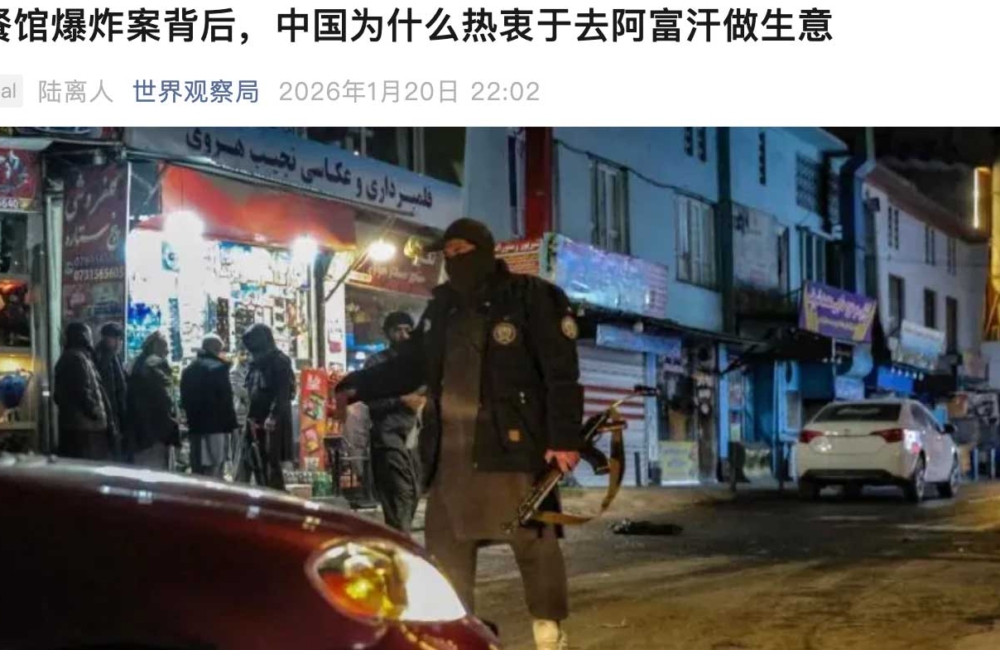
The bombing of a Chinese restaurant in Kabul, which killed at least seven people, prompted a rare but serious wave of discussion on Chinese social media. The attack was claimed by ISIS-K, Afghanistan’s Islamic State affiliate, which said it targeted Chinese citizens in retaliation for China’s Xinjiang policies and criticized Beijing’s engagement with the Afghan authorities.
On Chinese social media, current-affairs commentary accounts quickly compiled records of past attacks. They listed at least five armed incidents in recent years in Afghanistan or nearby border regions that targeted Chinese citizens, causing injuries and deaths.
One post argued that the January 19 attack underscored a worrying shift: violence against Chinese nationals is increasingly driven by political and ideological motives rather than kidnappings for profit, making future targeted attacks more likely.
The commentary then stressed that Xinjiang’s long-term stability cannot rely solely on domestic counterterrorism. Since the U.S. withdrawal from Afghanistan, terrorism in Central and South Asia has intensified, with ISIS-K and affiliated groups becoming more active. Security deterioration in Afghanistan and parts of Central Asia was framed as a direct external pressure on China’s western frontier.
The author also highlighted the return of militants from the Middle East, estimating that hundreds to thousands of fighters previously active in Syria had moved into Central Asia and Afghanistan, reinforcing ISIS-linked networks. These groups concentrated in mountainous regions that overlap with key Belt and Road corridors, exposing Chinese projects and personnel to heightened risk.
The author points out that while some netizens expressed discomfort with China’s engagement with the Taliban, the Taliban and ISIS are irreconcilable enemies. Because key militant bases are located in northern Afghanistan, the author argued that only the authorities in Kabul have the capacity to suppress them on the ground.
China cannot carry out cross-border military operations and must rely on intelligence cooperation, regional coordination, and economic leverage. Increased investment would strengthen incentives for the Afghan authorities to confront ISIS-K and protect Chinese interest, the author argued.
WHY IS THIS IMPORTANT? The commentary to the Kabul attack shows that some Chinese view Afghanistan less through an ideological lens than through a security one. Engagement with the Taliban is treated as an unavoidable reality imposed by terrorism risks to Chinese citizens, Xinjiang, and Belt and Road projects.