
The Cambodian government is leading a massive, unprecedented crackdown on the scamming business that once accounted for an estimated one-third of the country’s GDP. For the past six months, heavily armed security forces have raided scam centers across the country and arrested more than 6,000 in the first couple months of the year.
The campaign began last fall when the United States issued a criminal indictment against Chen Zhi, a multi-billionaire Chinese national who built a vast empire in Cambodia that included a huge network of scam compounds that generated a staggering $30 million a day.
Huang Yan, a Chinese journalist based in Southeast Asia, is among a small group of international journalists covering every detail of the ongoing crackdown against scam centers. Huang joins Eric from Bangkok to discuss why the fall of Chen Zhi was so important and what it reveals about the outsized role that Chinese actors are playing in this saga.
📌 Topics Covered in this Episode
- Cambodia’s scam crackdown: reality vs. narrative
- Chinese kingpins behind the networks
- Life inside scam compounds
- The Chen Zhi case and global pressure
- Why the industry persists
- Where the scams are moving next
Show Notes:
- Cambodia: Rain and Dust: The Rise and Fall of Chen Zhi by Huang Yan
- The New York Times: Why Cambodia Handed Over a Man Accused of Stealing Billions in Crypto Scam by Sui-Lee Wee
- U.S. Department of Justice: Chairman of Prince Group Indicted for Operating Cambodian Forced Labor Scam Compounds Engaged in Cryptocurrency Fraud Schemes
About Huang Yan:

Huang Yan is a journalist based in Phnom Penh and Bangkok, specializing in Southeast Asia. For over seven years, he has reported on online gambling and scam compounds and cross-border criminal networks, drawing on interviews with survivors, insiders, and law enforcement. He publishes the Substack newsletter, Cambodia: Rain and Dust, exploring the political and economic forces behind scam operations in the region. He is the Chief Editor of Phnom Penh On the Ground, a Chinese-language news outlet in Cambodia. Huang has contributed to Nikkei Asia and has worked with the BBC, The New York Times, and Bloomberg.
Transcript:
ERIC OLANDER: Hello, and welcome to another edition of The China Global South podcast, a proud member of the Sinica Podcast Network. I’m Eric Olander. You know those emails that we get saying there’s a recruiter who really thinks our background is perfect for a big job?
Or your friend who hasn’t been on a date in years suddenly out of the blue gets one of those WhatsApp messages from someone who says they’re interested in getting to know them. And of course, there are those classic get-rich-quick schemes that a lot of us have become desensitized about, but maybe it’s our parents or a relative we know who got suckered in and now somehow is sending $1,000 in Amazon gift cards to someone on the other side of the world they don’t even know. Dealing with this and protecting our friends and relatives from these scammers is now a part of modern life.
But many people don’t know where or how these scammers operate. And if you haven’t been following what’s been going on here in Southeast Asia, something remarkable is happening in Cambodia. For the past six months or so, the Cambodian government has launched a massive crackdown against the scam industry.
And to give you some context about how big this is, enormous it is, it’s believed that scammers were once generating between $12 and $20 billion a year, which is somewhere between 40 and 65% of the country’s total GDP. Prime Minister Juan Manet has launched a full-scale campaign against the industry. Let’s take a look at some of the stats from the past six months.
Over the past, let’s say again, six months or so, 11,000 workers have been deported, approximately 5,000 have been detained, 173 key figures have been arrested following increased pressure from both China, the US, and now Singapore is weighing in. Many, many governments are now putting pressure on the Cambodian government. Authorities have reported sealing off about 200 scam compounds across the country, especially in hubs in Sihanoukville and Phnom Penh.
Now, the campaign began in earnest last October, when the US Justice Department released an indictment against a Chinese national named Chen Zhi, who the US claimed was generating as much as $30 million a day from scam center operations. What made Chen such a fascinating character, though, is that he didn’t hide in the shadows. In fact, his company, Prince Holding Group, was highly visible in Cambodia, with large real estate holdings, shopping centers, banks, and other businesses that lent him an air of legitimacy.
He was also a big philanthropist and very close to the ruling family in Cambodia. He, in fact, did have Cambodian citizenship. And for a long time, the Cambodian government protected him from the criticisms he had been getting for years, claiming he was actually a big scammer.
But the US, UK, Chinese, Singaporean, and numerous other governments all said those businesses were merely a front for what was a massive scamming operation that built billions of dollars from people all over the world. Well, let’s get a perspective on what’s going on in Cambodia, more details on Chen Zhi, and just this huge crackdown that’s intrinsically involving China in many different ways. Huang Yan is a journalist based in Phnom Penh and Bangkok who covers Southeast Asia.
For over seven years, he has reported on online gambling and scam compounds and cross-border criminal networks, drawing on interviews with survivors, insiders, and law enforcement. He also publishes the absolutely essential Substack newsletter, Cambodia, Rain and Dust, that explores the political and economic forces behind scam operations, not only in Cambodia, but elsewhere as well. He’s also the chief editor of Phnom Penh On The Ground, a Chinese-language news outlet in Cambodia.
Huang Yan, thank you so much for taking the time to join us today. Really appreciate it.
HUANG YAN: Thank you, Eric. Nice to meet you.
ERIC OLANDER: It’s wonderful to have you and to give us a sense of the magnitude of what’s been going on. You’ve been covering this quite closely.
Tell us a little bit about, again, I gave a broad overview of it, but tell us a little bit about what the past six months have been like in Cambodia.
HUANG YAN: I’ve followed the online gambling and scam industry for like seven years. And over the last few months, they’ve been doing a lot of crackdowns. They arrest some people and then go on raids.
So, like, there seems to be a change in that industry because Cambodia has had a lot of, like, online scams and criminal activity for many years. But we still need to wait and see what happens. Because, like, one thing is, like, the police don’t really go inside a lot of the scam compounds we know.
Like the scam compound, they have several buildings in a closed area, but they go to some, like, condos or apartments in Phnom Penh. So, like, the police don’t really go inside a scam compound to arrest, like, 100 people, not like that. So they go to the condos or apartments. Like, if these people don’t have protection, they will arrest them.
And for the scam compound, it’s like they move themselves. Like the scam compound, they open their gates, and people move in. But not really, the police go inside the compound to arrest people.
Like, it’s a little different.
ERIC OLANDER: So this raises the question. Sorry to interrupt you. This raises the question: How serious is this crackdown?
We’re talking about potentially 150,000 or more people who are involved in or are basically enslaved in this business. 11,000 have been arrested, according to, or deported, and 5,000 arrested. So the numbers are still out of whack in terms of how many people are involved in this and how many people have been detained.
The images we are getting, though, on social media and through the Cambodian press, are that this is a very big crackdown. But what you’re telling us is that there may be more than meets the eye here, and the perception may be different than the reality. What’s your sense of how seriously the Cambodian government is taking to crack down on this?
HUANG YAN: Yeah, like, we don’t know how serious they are. Like, we don’t see that they are very serious. Like, the numbers are very strange.
Like, the Cambodian government, they deport a lot of people, right? But deportees, like, before they were arrested, like, half a year. But they didn’t crack down before.
So why do you have the number, like, a long time before? So maybe this shows how many foreigners leave Cambodia. Like me, if I go to Cambodia and I leave, I may have one of them, the numbers.
So it’s like, you don’t know numbers. And, for example, like the Cambodian government, they please go to one apartment, they arrest, like, 100 people. They will say, like, 15 Chinese, like, or five Indonesians or something like that.
But if you add the number, the number is wrong. So the total number and the details cannot match. So it’s like, we don’t know.
And the government never tells us, like, what kind of scam they do, right? What kind of scam? Do they scam US people, or do they scam the Chinese?
We don’t know. Like, did you arrest any of them, both? We don’t know.
And where do they go? Do they go to the prison or go where? Like, normally we don’t know.
And a lot of time, like, we don’t have a picture. Like, so, like, normally if you do a crackdown, you, like, have police go to some place, and you have a picture, and you know what kind of scam you do, right? And how do you do the scam?
And you have, like, how they do the money laundering, how they receive the money from the victims, right? It’s like a lot of things. This is an industry.
They have scammers; they have people to do the money laundering for them. They have the people to get the phone numbers, everything. Like, normally, like, police can get all the evidence, right?
Why do you say there is a scammer? But we don’t see any of this.
ERIC OLANDER: We don’t know. Yeah. So it really, at this point right now, from your vantage point, we can’t tell how serious a crackdown this is.
And if it’s really something that we should believe, the Cambodian government says that they, by, you know, in the next few months, they want all of the scammers out of the country. You have some doubts about that claim.
HUANG YAN: Yeah, it’s like, I think it’s very, very easy to, like, doubt that thing because, like, they didn’t go to the scam compound raid. Just the scam compound said to scammers, you can go. So they go.
Maybe they will leave Cambodia. Maybe they stay in Cambodia. They’re still hiding in some hotels and apartments.
They wait to see what happens. So, they have not really left Cambodia yet. And if they leave, it’s like they leave of their own will, not by the police around them.
ERIC OLANDER: So it’s quite different. Yeah. Well, Cambodia is one country that we’ve been focusing on.
But the scam issue is really widespread across Southeast Asia. So there are big scam centers in Myanmar and in Laos. This has been a problem in the Philippines and Indonesia.
Interestingly, not a big issue in Vietnam. There’s one area the scammers haven’t entered. And the Vietnamese have been very effective in keeping them out.
But one of the things that we hear, and I’d be interested to get your take on this, is that certainly in Myanmar and Laos, which are close to the Chinese border, Chinese organized crime syndicates are heavily involved in those, working in collaboration with local governments. In Cambodia, what is the role of Chinese organized crime? Certainly, Chandra, as you detailed in your fascinating report on Chan, was very much a part of this.
But the understanding that I have is that of those 150,000 people, the digitally enslaved people that people call, they’re from all over the world, from Southeast Asia, from Africa. But the bosses often are from China. Can you help us understand the role that Chinese entities are playing in these whole scam centers?
HUANG YAN: Generally, at the beginning, when I came to Cambodia in 2019, it was called online gambling at that time. So it’s like online gambling and a scam. You cannot tell the difference very clearly.
It’s like the same thing. Sometimes, the online gambling platform can scam you. And yeah, some online scams use the online gambling platform.
ERIC OLANDER: Now, sorry, were these online gambling for China, directed towards China, or anywhere in the world?
HUANG YAN: I think before, it’s already been targeted at Chinese people, the Chinese mainland. But after 2019, the Cambodian government issued an online gambling ban. So it’s like online gambling is illegal after that in Cambodia.
So they turned to scam more. And another thing is that the Chinese government is really cracking down on money laundering. So it’s very hard to get money from the scam thing.
So they tried to scam more foreign people, like non-Chinese people. So right now, they have the scammers, they have Chinese, they have all over the world, from the Philippines, Indonesia, and then also the scam of the world, the US and UK. But still, there are a lot of people who are Chinese, and a lot of them are Chinese from China.
ERIC OLANDER: Well, let’s talk about Chen. He is reported to be one of the two or three major kingpins who were involved in organizing massive scam operations. Again, the indictment claims $30 million a day was generated through these illicit activities.
All of this came to light back in October when the US and UK issued their indictments, but the US Justice Department issued its very detailed indictment against Chen. He had been living, though, pretty openly in Cambodia, under the protection of the Cambodian government. There had been a lot of suspicion over the years that he was involved in this type of scam.
You could tell us more about Chen and why he’s so important in this whole story.
HUANG YAN: Why Chen is very important in this story is that he plays a very big role in that industry. He’s the big scammer, the biggest one in the world. First, he’s been doing online gambling for many years, and then also, he has some compounds.
The compound has a lot of scam things, and he earns a lot of money. They have a group called the Prince Group. The Prince Group has a bank, Prince Bank, and a real estate company, Prince Real Estate.
They are very public in Cambodia. They pretend to be a legal company. Also, Chen is an advisor to PM Hongsheng before, and now he’s an advisor to PM Ho Manai.
He is like a public figure, but he doesn’t go to a lot of places. He has a bank, he has real estate, and he has more than 100 companies. He has a company in Singapore, a company in Taiwan, and a lot of real estate in the UK.
He buys a Cuban cigarette company.
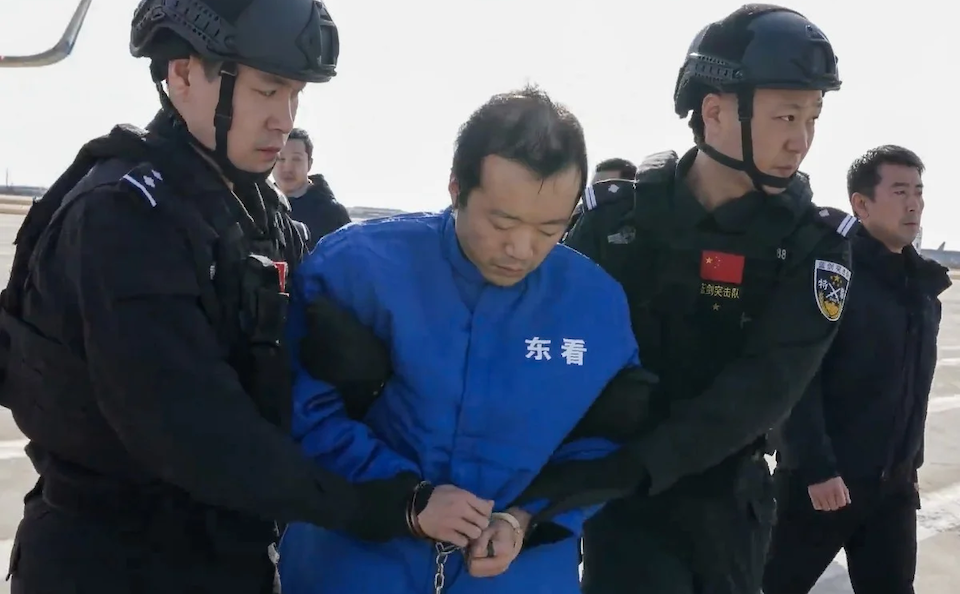
ERIC OLANDER: He’s super rich. The US reportedly seized $15 billion in Bitcoin, which was only a fraction of his wealth. The story then turned again about Chen earlier this year, when, suddenly, out of nowhere, the Cambodian government extradited him to China.
In a very public way, the Chinese government put him in a blue jumpsuit and with shackles and displayed him when he arrived at Beijing’s international airport. Why do you think the Chinese wanted Chen when, in fact, the US, the British, and others wanted Chen? For a long time, China had been negotiating with Cambodia over the extradition of Chen.
In fact, I heard that Xi Jinping himself wanted Chen to return and be extradited. Tell us about the extradition and what you understand happened, and why the Cambodians chose to make that move when they did.
HUANG YAN: The Chinese government wanted Chen for many years. He’s a big mafia, and he’s very important in that thing. So the Chinese police had wanted him for many years, but it had not been successful before.
Last October, the US sanctioned Prince and Chen. The Chinese government also faced more pressure: if you don’t get Chen, maybe the US will get him. The Chinese government put a lot of pressure on the Cambodian government.
But the Cambodian government faced pressure from the Chinese, US, and Korean governments. A Korean college student was killed in a broken mountain in Cambodia last year. And they have a lot of pressure from Thailand.
But Thailand started a war with Cambodia. They fight with each other. And Thailand said, ” We want to see the scam compounds.
So the Cambodian government is in a very bad situation.
ERIC OLANDER: Yeah. One of the things that I heard, and again, I’d love to get your take on this, is that after the US indictment came down. The Cambodians came under pressure from the United States to extradite Chen Jue; there was concern that if he appeared in a US court, many of his relationships with Cambodian officials would become public. So better to ship him off to China, where you’re not going to hear anything more out of Chen Jue ever again.
And the secrets that Chen Jue may have had about his relationships with various leaderships and elites and various, you know, the insiders in Cambodia would stay quiet. What do you think of that theory that I heard? There’s some guess that’s possible.
HUANG YAN: That’s not possible.
ERIC OLANDER: Sure. Nobody really knows for sure, right?
HUANG YAN: Yeah. Chen Jue is close to some big guys. So the big guys don’t want him.
Maybe they have some secrets. We don’t know, right? So if the US gets him, it could be bad for them.
So this is possible. But if you put him in China, China will also know something about the change. Yeah.
But then maybe the Cambodian government will not have any choice now. Yeah.
ERIC OLANDER: And Chen Jue is by no means alone. There was a company called Huiwan as well, which was also reportedly part of a scam network. Tell us about some of the other major actors in this, and some of the other key Chinese figures involved in this controversy.
HUANG YAN: Yeah, there are a lot of big guys in the things. Huiwan has a platform called Huiwan Guarantee. They do the guarantee for the money laundering guys and the scam companies.
So it’s very popular now. All the scam companies use Huiwan to launder money with them. So it’s very useful for scammers to use that thing to pull off the scam successfully.
And right after some crackdown in Myanmar last year, in Myanmar now, or in Mawadi, a lot of scammers go to Cambodia. So the thing changed a lot. Things changed very rapidly.
At that time, every province in Cambodia had a scam center. A lot of scammers never go. Because I visited many scam compounds, we know where this one is.
But at that time, a lot of big companies suddenly appeared in the middle of nowhere. And maybe after two months, there is a compound. Yeah.
ERIC OLANDER: So what’s it like at these compounds? And weren’t you afraid that you were going to be kidnapped yourself and taken into these compounds as an enslaved person? Because they don’t seem to discriminate against anybody.
They even grabbed a very famous Chinese actor. Were you not afraid of being sucked into this system? And also tell us a little bit about what it was like at these compounds.
HUANG YAN: The compound is very close, and inside is a small society. They can be very brutal. But I think there’s one thing about the kidnapping.
I think outside, they don’t understand very clearly. They don’t kidnap other people. Like me, if I walk in the street, they will not kidnap me.
Sometimes they treat you and say, “Come here, I’ll get you a very high-paying job.” And then you come to some place, and they will arrest you, like kidnap you to the compound. But it’s like targeting some people.
It’s not randomly in the street. It’s different.
ERIC OLANDER: Yeah. What we’ve heard is that they’ve, in fact, been targeting quite a few Chinese as well who can’t find jobs in rural communities. They say there’s a job at a hotel.
They say there’s a good tourism job and lure them in, and then confiscate their passports and say they can’t leave. And then they had to reach these incredibly high quotas every day to scam people out of money, or else they could suffer violence or beating. And then they would be threatened if their relatives were kidnapped and brought there.
What was it like when you were on the compound grounds? Did it feel like a prison? Did it feel like a tech startup?
What did it feel like and look like? Give us a brief description.
HUANG YAN: The compound is a different kind of compound. It’s not the same, not all the same. But generally, the compound, you can think of it as a prison.
Also, before, it’s barbed wire, it’s everything. It’s very dark. So, before, we were very careful.
We cannot go inside the compound, right? We cannot go inside, but we can go outside. But we can go outside very carefully beforehand.
We can see what’s happening. So we want to understand what the compound is. But after that, after the Cambodian government says the scam is illegal and publicly says that, we are better off.
If we go to some compound, we go outside. It’s okay. You take some pictures or videos, but you go very quickly.
It’s okay. It’s not a… Because, out of the compound and inside the compound, they can do everything.
They can beat people, cheat people, torture people, and nobody knows, right? And they can pretend it’s not happening. You cannot get the evidence that it’s happened, right?
Because nobody thinks you do not have evidence, but outside the compound, they cannot do anything.
ERIC OLANDER: Why do you think this is a problem across Southeast Asia, and why do you think Southeast Asian governments have just not been able to bring it under control? And not even the weakest governments, like Myanmar and Laos, which many people would expect to be so weak in governance that they can’t do it, are struggling with this. Even bigger governments like Indonesia are struggling with this. What is it about this issue that makes it so difficult for governments and law enforcement to bring it under control and to get rid of it?
HUANG YAN: One thing is that the industry really has a lot of money, can get it very quickly, and has a lot of it. And another thing is that some local governments in Southeast Asia are very corrupt. So they are very easy to bribe the police, the local police, or the high-level government officials, so that they can stay there.
Like in Cambodia, they bribe the police; they can bribe the governor or something like that. So they get protection. I stayed in Cambodia for many years. The thing is, it’s a legal business.
Like in the border town of Bavaria, the town is all scum buildings. So if you go to that town, without scum, it’s nothing. But it has many buildings like that.
If the police are hiding in the street, you will see many buildings. You cannot ignore it, right? So everybody knows, so it’s like legal.
Not really, but it seems legal.
ERIC OLANDER: Semi-legal, right. Yeah. And we’re now seeing more and more that, as the Cambodians crack down, reports indicate that scam centers are relocating to other countries.
And Sri Lanka is now one of the places where it’s reported to be coming up. And in fact, the Sri Lankan government just last week arrested 130, 435 people, including several Chinese nationals, engaged in scam centers. So this is not something, again, that’s going to be confined to Southeast Asia.
It tends to go in places where there is weak governance, as you talked about, a lot of corruption, access to power, because you need a lot of electricity, and again, this ability to move money in and out via the internet. And so I heard they were using Starlink connections in the middle of the Cambodian jungle as their internet provider. So, where do you see this going next if Southeast Asia is, in fact, getting serious about cracking down on scam centers?
HUANG YAN: They are really going to Sri Lanka now. Like, 10,000 to 20,000 people from Cambodia are going to Sri Lanka. That many?
That’s incredible. That’s a big number. I didn’t realize it was that big.
Yeah. We don’t know exactly, but what we heard is similar. But the Sri Lankan government is now trying to crack down.
And I heard the Chinese embassy in Sri Lanka also issued a statement, saying, ” We will crack down on that thing. I heard some restaurant owners in Siamoville moved to Sri Lanka and followed the grey industry. So it’s really happening.
But also, most of them still stay in Cambodia; they’re not moving out. Most people. And some people moved to Malaysia, and some people moved to Vietnam. And before, Vietnam was very clean, like, they did not have a lot of scams.
But now they’re trying to move to Vietnam because it’s near Cambodia, and it’s very easy to cross the border. So it’s really a lot of scammers going to Vietnam now. We don’t know what’s going on; we don’t know if the Vietnamese government will crack down on it.
And right now, Southeast Asia is still a good place for scams. They have all the inspectors; you can find some people to do money laundering for you and do everything for you. Yeah, some people go to Africa or Europe, like Georgia or Turkey, but that’s not a big number.
Yeah.
ERIC OLANDER: Yeah, we’ve seen reports of Bitcoin mining and scam centers popping up in Ethiopia and Angola. This is a global problem. But Southeast Asia, from what we’re hearing from you, who covers this so closely, is still going to be a major center of this, even though there is a crackdown underway in Cambodia.
Huang Yan, thank you so much for taking the time to join us today. I recommend Hongyan’s incredible sub stack. It is essential to read Cambodia, rain or dust.
If you want to understand what’s happening with this issue, go, and I’ll put a link to that in the show notes. Also, Hongyan is the chief editor of Phnom Penh on the ground, a Chinese-language news outlet that operates in Cambodia. Hongyan, thank you again for your time and your insights.
I really appreciate it. Thank you very much, Eric. Great talk.
That’ll do it for this edition of the China Global South podcast. We’ll be back again next week with another edition. Of course, if you want to follow our work at CGSP, go to ChinaGlobalSouth.com.
Thank you so much for listening and for watching.