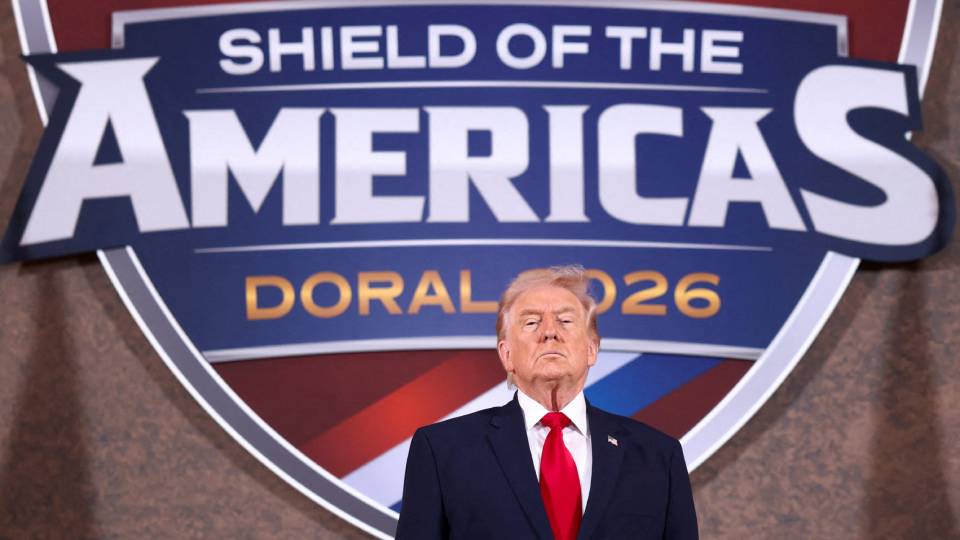
In early March, U.S. President Donald Trump hosted 12 Latin American leaders for the “Shield of the Americas” Summit. There was much speculation around the summit’s objectives: some viewed it simply as an opportunity to gather Latin American leaders aligned with Trump for a photo-op. Others thought it was an effort to establish a counter-narcotics initiative, while a smaller group sought to discuss immigration issues.
Taken at face value, it may seem like China was missing from the agenda. But reading between the lines, it’s clear that countering China is still top-of-mind in Washington’s approach to the region. Certainly, in the months preceding the summit, the U.S. has made its position clear: Beijing has no place in the Western Hemisphere.
Prior to the summit, the U.S. hosted the Americas Counter Cartel Conference, which was followed by a joint declaration promising expanded security partnerships in the Western Hemisphere, signed by seventeen regional governments, including the U.S.
Trump’s remarks at the Shield of the Americas summit mostly deal with this development, even equating this coalition to the one established more than a decade ago to combat the Islamic State. While China was not mentioned explicitly, it was not difficult to fill in the blanks. Towards the end of his speech, he said that “we will not allow hostile foreign influence to gain a foothold in this hemisphere. That includes the Panama Canal, which we talked about. We’re not going to allow it. And together, we’ll protect our sovereignty, our security, and our cherished freedom and independence.”
While the summit publicly launched a counter-cartel coalition, it may also mark an early step toward a regional alignment aimed at limiting China’s strategic influence.
After the speech, President Trump issued a proclamation stating four objectives for the Americas Counter Cartel Coalition. The fourth objective was another thinly-veiled shot at Beijing, confirming its place on the American threat radar: “[t]he United States and its allies should keep external threats at bay, including malign foreign influences from outside the Western Hemisphere.”
According to some outlets, all leaders attending the Summit signed the Doral Charter, a document that has not been officially published and supposedly affirms the “right of the peoples of our hemisphere to shape their own destiny free from interference.”
This would suggest some sort of consensus on the subject matter and a discursive alignment with Washington’s 2026 National Defense Strategy. However, Panama and Costa Rica – both demilitarized States – have publicly declared that their heads of State did not sign any documents. Notably, they also avoided any reference to Beijing.
One important thing is that the China angle appears to go beyond the rhetorical exercise and appears to be directly connected with the other topic that has been left out of public discussions: infrastructure and investment in key sectors.
These sectors could be defined as the “key terrain” referred to in Washington’s 2026 National Defense Strategy. The past year of the Trump presidency has made it clear: the U.S. is ready to take action to deny China in this region. For proof, look no further than what’s going on with Panama’s ports deal or with Chile’s submarine cables scandal.
Caught in the middle of this are the countries that hoped to navigate the U.S.-China rivalry without getting sucked into it. While the summit publicly launched a counter-cartel coalition, it may also mark an early step toward a regional alignment aimed at limiting China’s strategic influence. That may be what the Shield of the Americas really stands for.
Alonso Illueca is CGSP’s Non-Resident Fellow for Latin America and the Caribbean.