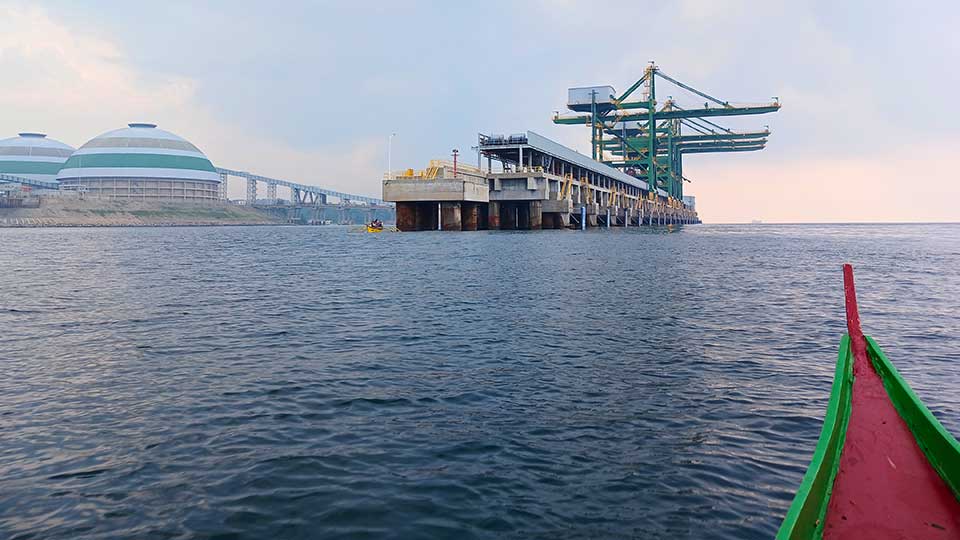
Canopies of old trees, a port, and a solar farm came into view as the air-conditioned bus approached Mariveles town in Bataan province.
Within minutes, after traversing a tree-lined, well-paved road, the bus reached its destination: the freeport area of Bataan, a sprawling special economic zone (SEZ) located on the other side of Manila Bay from the capital and has brought industrialization to northern Luzon region.
With the SEZ, Bataan’s provincial government boasts of hosting the country’s biggest coal plant, the 1200-megawatt GNPower Dinginin, that’s done a lot to power new industry but also caused significant environmental damage to the local marine ecosystem.

“We have to go farther and spend more since we’re no longer allowed in our common fishing ground where the [coal terminal] now stands,” said Henry Bunag, whose fishing village in Sitio Dinginin in Barangay Alas-asin is dwarfed by the massive power plant.
Fishermen like Bunag have to spend more on fuel, from P200 ($4) to P2,000 ($35.72) depending on boat size, as well as on ice because they have to spend a day or two at sea, exposing them to rough weather.
The GNPower Dinginin facility became the country’s largest coal power plant after authorities borrowed tens of millions of dollars from China to upgrade an existing plant that eventually doubled its output. That first plant that GNPower built was notable because it was the Philippines’ first fully privately funded power project with no sovereign guarantee, despite being the largest recipient of dollar funding from China, with $687 million, at the end of former president Gloria Macapagal Arroyo’s term in 2010.
This mixed funding approach shows how China doesn’t operate as a “unitary actor,” as U.S.-based development research institute AidData revealed in its 2024 report about Beijing’s two decades of development funding in the Philippines, from 2000 to 2022. “China, as one of the world’s largest funders of foreign development projects,” relies on a vast network of international suppliers “with varying reputations for transparency, follow-through, and outcomes.”
According to the same report, the national government, as a willing local counterpart, is subject to common funding features such as lax reporting requirements. AidData warns that it raises the stakes because it can encourage inaction “to mitigate negative spillover effects for communities” and thus requires equal attention as the Asia-Pacific region looks to Beijing for funding for such projects.
Barred From Fishing
A migrant from the nearby province of Pangasinan, Bunag recalled that fishing was a reliable income source until around 2013 when the first coal plant’s pier wasn’t fully operational yet.
His neighbor, who identified only as Poly, said they opposed the GNPower Dinginin because they knew it would take up more of their fishing ground, which is precisely what happened. Those who fish by nets spend P2,000 ($35) more to beef up their 100-meter fishing.
Poly relies on fishing because his monthly income of P5,000 ($85) as a village watchman is spent on rice, which hit record-high prices under the Marcos administration. He also allots fish catch for meals and fuel, with the net P200 to P300 ($4-5) going to his three children’s school transportation.
Another resident, Vicente de la Rosa, swore that before sunrise, they used to haul in squid weighing as much as six kilograms from the fishing ground.
Hazardous pollutants—foamy discharge and coal dust—also irritate their skin and eyes. Every time the ship transfers coal, they must wear a bonnet or avoid the thick dust altogether.

Even green “arosep” seaweed and shellfish that served as a lifeline during lean seasons have also dwindled since the plants started humming into operation.
“Those days, you could just pick them up from the shore. What a fruitful time,” wife to a migrant fisher from Visayas Island Rosario Nievales said.
“Now, they’re gone, what a pity,’’ added her migrant neighbor, Lorena Sumagdon, whose brother-in-law used to earn as much as P5,000 ($89.30) a day from hawking seaweed in the market.
Bunag claims that during a public consultation, they were assured that the seaweed would grow back after mountain quarries used for building a dry dock were dumped into the sea, covering the rocks where the seaweed used to thrive.
Wilfred Santiañez of the University of the Philippines Marine Science Institute explained that “any materials that can block light can affect the health of photosynthesizers and lead to their death.”
While GNPower complies with government requirements like making an Environmental Guarantee Fund available to address environmental damage and rehabilitation and forming a community-based Multi-partite Monitoring Team (MMT) to ensure that such funds are used for their intended purpose, among other things, residents of Sitio Dinginin haven’t heard of either. They have also not been informed about GNPower’s regular air and water testing results.
The Mariveles’ municipal environment office, whose staff is the chairperson of the MMT, refused to grant this reporter’s request for an interview when she visited in January.
Power of Timing

AidData’s tracking of Beijing’s funding revealed that next to Metro Manila, “Central Luzon received the largest share of financing overall,” followed by Davao region on the southern island of Mindanao. All are politically and economically important regions, with the last two the home regions of former presidents Arroyo and Duterte, with whom China maintains warm diplomatic relations.
But while China funded the GNPower as part of Arroyo’s priority project, AidData found that its “interests appear to lie in boosting local electricity consumption to unlock increased productivity and follow-on projects for Chinese firms.”
Provincial-based grassroots network the Nuclear/Coal-Free Bataan Movement said the government labels private-funded projects “nationally significant” to expedite their permits. This allows companies to enjoy government incentives when trading in special economic zones without actual assurance on how to mitigate their potential impacts.
As expected, fishers suffer the most.

“They can’t sail out to open sea with their small boats and, at times, can’t even break even due to high fuel costs. They can’t command competitive prices when commercial operators can lower the price with their huge catch,” fish consignor Jonathan delos Reyes said.
Furthermore, Bunag’s boat was hit by a commercial vessel while in municipal waters, and the operator paid him for the damages.
“We can put up with the coal dust and smoke, but the ban, combined with encroachment by commercial fishers and the loss of seaweed, made it difficult to recover,” Bunag lamented.
Mavic Conde is a Filipino environmental reporter who focuses on the link between agriculture, livelihood, and the environment.