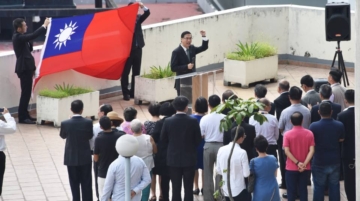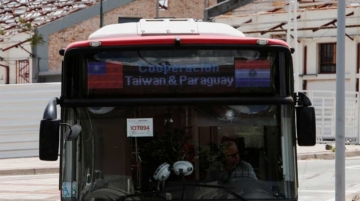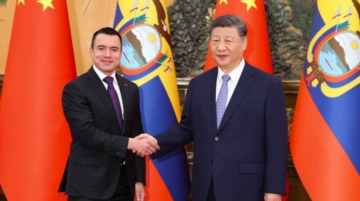
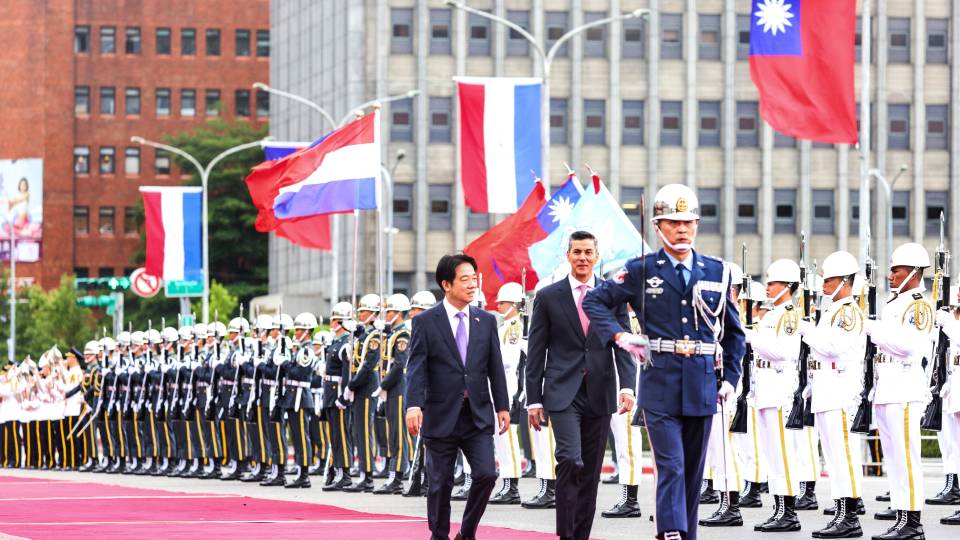
With the media flurry around the Trump-Xi and Xi-Putin summits, global attention has been focused on high-level diplomacy in Asia. Yet another diplomatic visit – far quieter but strategically significant in its own right – also took place this month: on May 10, Paraguayan president Santiago Peña concluded his first official visit to Taiwan as Head of State. The visit reinforced strategic and commercial ties between Asunción and Taipei while dispelling assumptions that Paraguay was preparing a diplomatic shift toward Beijing.
Yet Peña’s visit was not merely an act of diplomatic symbolism. The visit saw the signing of three memorandums of understanding, reflecting a new strategic posture in the bilateral relationship. Focused on artificial intelligence, cybersecurity, and judicial and criminal cooperation, the agreements deepened ties between Paraguay and Taiwan in a moment when China was actively trying to alter the partnership. More broadly, the visit reflected Taiwan’s growing efforts to transform its remaining diplomatic alliances into technology partnerships centered on artificial intelligence, cybersecurity, and semiconductor development.
China’s Expanding Outreach in Paraguay
Taiwan and Paraguay’s relationship dates back to 1957, but these long-lasting ties have not insulated Paraguay from China’s efforts to change the status quo. Over the last year, Beijing expanded its parliamentary outreach in Paraguay, particularly among opposition legislators, as debate over diplomatic recognition resurfaced in the country. In November 2025, a congressional delegation of 8 deputies, all from opposition parties, visited Beijing. There are reports that the Chinese consulate in São Paulo, Brazil, was in charge of arranging the visit.
Officially framed as an interparliamentary and educational exchange, the visit nevertheless drew renewed attention in Paraguay to relations with Taiwan and China. The head of the Paraguayan delegation, Carlos Pereira Rieve of the Liberal Party, even stressed, on the record, that Paraguay should reconsider its diplomatic alliance with Taipei.
While the visit appeared largely symbolic, the absence of deputies from the ruling Colorado Party signaled skepticism on their part. Its caucus publicly declined to take part in the trip and reiterated its unwavering support for Taiwan. Nonetheless, there was some form of dissent within the party, which was made public prior to the congressional visit.
In June 2025, Colorado Party deputy Carlos Núñez, serving as Paraguay’s representative to the Latin American Parliament, met with the Chinese ambassador to Panama during a visit to the regional parliament’s headquarters in Panama City. There, he advocated for Paraguayan commercial ties with China, citing the potential for increased investment, particularly in infrastructure.
In October 2025, another deputy from the Colorado Party, Hugo Meza, called for a serious debate on diplomatic and commercial ties with China amid a congressional delegation visit to Taipei that same month. Núñez ultimately resigned from the party, while Meza was expelled.
Between Taipei and Beijing
Any significant shift in Paraguay’s diplomatic ties with Taiwan would require the support of the Colorado Party. The party has governed Paraguay for most of the last 70 years, with the only exception being from 2008-2012, making any major departure from the status quo appear unlikely. Yet debate over the Taiwan question in Paraguay has not been confined to Congress alone.
At times, the Paraguayan government appeared to signal interest in some form of rapprochement with Beijing. In April 2025, Paraguayan Minister for Economy and Finance Carlos Fernandez Valdovinos stressed in CNN en Español that Paraguay would be willing to sign a free trade agreement with China, provided that Beijing was also willing to negotiate one with the South American trade bloc Mercosur, made up of Argentina, Brazil, Paraguay, and Uruguay, along with 7 more associated states.
His ambiguity towards the Taiwan question forced him to later clarify that any such deal could not have a precondition of breaking diplomatic ties with Taipei. This was later reiterated by Paraguay’s Foreign Minister, Rubén Ramírez Lezcano, saying that Paraguay was open to establishing diplomatic, consular, and commercial relations with mainland China, but it would not sever ties with Taiwan to do so.
This left many puzzled. Was Paraguay signaling an opening to China, or was it implicitly challenging Beijing’s interpretation of the One China Principle? Following the congressional visit to Beijing, Chinese officials appeared to interpret the signals as the former.
But this perceived ambiguity ended with President Peña’s state visit to Taiwan. Peña reaffirmed Paraguay’s strategic partnership and alliance with Taiwan.
Taiwan’s Technology Comes Into Focus
Amid mounting pressure from opposition parties and business elites to integrate Paraguay more deeply into the Chinese market, President Peña’s visit was a consequential one. The visit reaffirmed Paraguay’s commitment to Taiwan, but it also had another important dimension: it helped clarify what Paraguay gains from its relationship with Taiwan.
The Paraguay-Taiwan partnership is increasingly being framed around strategic technology. The visit’s agreements promise closer cooperation on AI computing and cybersecurity, paving the way for Paraguay’s ambitions to play a bigger role in Latin America’s digital and industrial future. If Peña hopes to position Paraguay as a regional node in an eventual Latin American semiconductor ecosystem, then access to Taiwan’s expertise and technology transfer will be a major advantage.
Paraguay will be a key case study in the future of Taiwanese diplomacy. Faced with China’s overwhelming economic advantages, Taiwan is unlikely to compete on equal footing through trade volume, exports, or financial assistance alone. Paraguay may ultimately reveal that Taiwan’s alliances can be sustained not through checkbook diplomacy but through access to technologies shaping economic and strategic power in the twenty-first century.
In doing so, Paraguay may also point toward a new model of engagement within the Global South: one centered less on financial leverage and more on technological cooperation and strategic reciprocity.
Alonso Illueca is CGSP’s Non-Resident Fellow for Latin America and the Caribbean.