
It’s a busy time for politics in Latin America. In the next year, many countries will go to the polls to elect new presidents.
Within this context, a clear trend is taking shape: across the region, candidates’ positions on China are becoming a central battleground in upcoming elections. In Honduras, Bolivia, Chile, Costa Rica, Peru, Colombia, and Brazil—countries all facing votes in the coming year—presidential hopefuls are trying to leverage Beijing’s presence for political gain by building up their anti-China stances.
But that’s easier said than done. As Argentina’s president Javier Milei demonstrates, it’s one thing to tout an anti-China rhetoric during a campaign, and another entirely to live up to it once in office.
Early Signs from Bolivia and Honduras
Bolivia’s elections in October will serve as a testing ground for the China factor. The two candidates, Rodrigo Paz and Jorge Quiroga, have both pledged to revisit a major lithium deal involving a Chinese company, with the lower-polling Quiroga adopting a more anti-China rhetoric to boost his numbers. Although his performance depends on many other factors, many will be watching to see how his anti-China approach plays out.
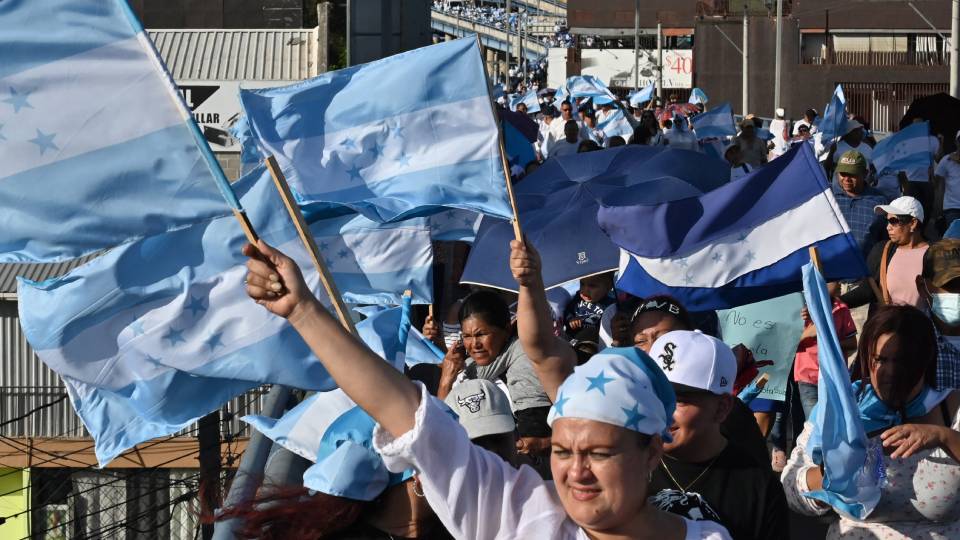
The same can be said about Honduras, where opposition candidates have expressed intentions to undo diplomatic ties with China. Honduras established formal relations with Beijing in 2023, switching recognition from Taiwan after decades of official ties with Taipei.
The frontrunners, Salvador Nasralla, a former vice-president and member of the centrist Liberal Party, and Nasry Asfura, the nominee of the National Party, have positioned themselves in the Taiwan camp.
As these developments unfold in Central America, both China and the United States are actively positioning themselves. Earlier this month, the United States announced visa restrictions on Central American nationals who were, in its words, “working with the Chinese Communist Party to undermine the rule of law in the region.”
A few days later, a delegation of Honduran parliamentarians from across the political spectrum visited China for diplomatic exchanges. The timing of both actions underscores the high stakes of China’s influence in the region and the U.S.’s efforts to counter it.
Ideological Nexus or Electoral Tool?
While anti-China sentiment is generally associated with the right-wing candidates throughout the region, the turn against China among centrist parties like the Liberal Party in Honduras and the Christian Democratic Party in Bolivia demonstrates that no political orientation has a monopoly over the trend.
Chile illustrates this uncertainty. The country, which will elect a new president in November, is one of the region’s most mature democracies, alternating between left- and right-wing leaders while maintaining close commercial ties with China, including a free trade agreement and partnerships in critical minerals such as lithium and copper.
Given this history, it is difficult to predict how presidential candidates will approach China: right-wing frontrunner José Kast has long promoted pragmatic economic engagement, but the broader anti-China trend in the region could still influence the campaign in unpredictable ways.
If there is one country where this trend is not likely to surface, it is Costa Rica—but not for the reasons China would like. Under Rodrigo Chaves, San Jose has significantly reduced its ties with Beijing, even issuing a presidential decree blocking the deployment of Chinese 5G tech.
Because the government has maintained a generally unfriendly stance toward China, most candidates are largely aligned on the issue, and the debate is unlikely to become a major point of contention in the February 2026 election.
A more favorable scenario is found in Peru, where the Chancay Port—the flagship project of China’s Belt and Road Initiative (BRI) in Latin America—and the planned Central Bi-Oceanic Corridor promise significant economic and trade benefits. Buzz around these projects will secure a space for the China trend in the April 2026 elections, albeit on more favorable terms for Beijing.
In contrast, Colombia provides a clear example of a right-wing, ideologically driven stance against China. Many right-wing candidates and establishment figures have criticized President Petro’s decisions to join the BRI, adhere to the BRICS’ New Development Bank, and forge a strategic partnership of some kind with Beijing. Given Colombia’s historical ties with the United States and its partnership with NATO, this criticism is likely to reemerge during the May 2026 presidential elections.
Finally, we have Brazil. Lula Da Silva’s current rift with Donald Trump and the warming up of ties with Xi Jinping position China as a major topic in the October 2026 elections. A reelection seems to be likely for Lula, with his popularity boosted due to his confrontation with Trump.
Meanwhile, former President Bolsonaro’s political heir may seek to stake out a position diametrically opposed to Lula’s, particularly on China-related issues as well as BRICS membership and U.S. tariffs.
Rhetoric and Reality
As China continues to feature prominently in election campaigns across the region, it remains to be seen how much of the rhetoric will hold once politicians take office. While many use anti-China stances to gain an edge now, these positions often give way to a more pragmatic approach in governance, as seen with Milei in Argentina and Bolsonaro in Brazil.
Viewing the China question through an electoral lens, especially at such a consequential moment in the international order, helps explain why Latin America has struggled to move beyond the current U.S.-China binary. Instead of focusing on strategic autonomy and guarding against overdependence on either power, policy debates are dominated by empty rhetoric.
In a world defined by great-power rivalry and the reemergence of spheres of influence, the real challenge for Latin America—and the Global South more broadly—is maintaining strategic autonomy. That is where discussions in a mature democracy should ultimately be focused.
Alonso Illueca is CGSP’s Non-Resident Fellow for Latin America and the Caribbean.


