Japan in recent months has become increasingly concerned about the twin crises of China’s growing military threats and rising uncertainty about U.S. security commitments during President Donald Trump’s tenure. Since taking office last fall, Prime Minister Sanae Takaichi has responded by dramatically elevating Japan’s geostrategic position across the Asia-Pacific, not only aimed at countering Beijing, but also preparing for less American involvement in the region for the foreseeable future.
Against this backdrop, Japanese words and deeds over the last three weeks have been inarguably historic.
Starting on April 21, Takaichi took the fateful step to authorize the biggest relaxation of arms export rules since World War II. For over 80 years, the post-war legal status quo limited Japan’s defense equipment and technology exports to five non-lethal categories: Rescue and relief, transport, early warning systems, surveillance and reconnaissance, and mine clearance. Under the new legislation, however, Takaichi and her defense minister Shinjirō Koizumi have abolished the five-category restriction.
In its place, defense exports will now be split into two categories: “weapons,” meaning lethal systems, such as fighter jets warships, and missiles, and “non-weapons,” meaning nonlethal equipment, such as radars. Lethal weapons exports will be subject to case-by-case approval by the National Security Council, which includes the Prime Minister, Defense Minister, and other relevant Ministers. Japan will only export lethal weapons to likeminded partners, under Koizumi’s concept of “arms sale diplomacy.” These include core allies like the U.S., Australia, and Philippines, as well as ever closer regional partners like Vietnam, Indonesia, and Singapore.
Takaichi then hit the road for visits to Vietnam and Australia. In Hanoi, she met Vietnamese leader To Lam and gave a landmark speech updating the security challenges to Tokyo’s longstanding “Free and Open Indo-Pacific” (FOIP) vision. She argued that the regional environment has changed dramatically since FOIP was first introduced by her predecessor and mentor Shinzo Abe about a decade ago.
The prime minister cited intensifying geopolitical competition, rapid technological change, supply-chain vulnerabilities, and the rise of the Global South. Takaichi laid out concrete plans to ensure FOIP, including the establishment and maintenance of resilient supply chains and AI/data infrastructure, public-private economic cooperation and rule-making, and stronger maritime security cooperation.
Moreover, Takaichi focused on her host, Vietnam, which she clearly believes is a critical geostrategic partner for Tokyo. She highlighted Hanoi’s value in cooperating on the above-mentioned issues and added the need for more bilateral cooperation in areas like critical minerals, space technology, and satellites. Although Takaichi never mentioned China directly, the strategic logic underpinning these initiatives was clearly tied to concerns about Beijing’s growing influence.
Another country she neglected to mention was the U.S., but Takaichi’s tone was different than past Japanese leadership speeches, implying concerns about Washington as well. A decade ago, Japanese FOIP messaging often positioned Tokyo as supporting U.S. regional leadership. In Hanoi, however, Takaichi presented Japan itself as an independent strategic architect, a regional coordinator, and a provider of public goods and security partnerships.
The shift reflects growing Japanese confidence, but is also a recognition that America may not always provide stable leadership, especially amid domestic polarization and transactional foreign policy approaches. Of course, Tokyo is not rethinking the treaty alliance or anything that extreme, but there is now a tacit recognition in Japanese leadership circles that the time has come to think and act more independently.
What is now taking shape is a Japan prepared to project power, export arms, build regional coalitions, and shape Asia’s strategic future more directly than ever before.
Defense minister Koizumi set the stage for Takaichi’s next and final stop, which was to Australia. On April 19, and in anticipation of Japan’s lifting of the lethal ban on assistance, Koizumi, alongside his Australian counterpart Richard Marles, signed contracts worth $7 billion for warships. From 2029, the Japanese Mitsubishi Heavy Industries will supply the Royal Australian Navy with eleven upgraded Mogami-class frigates, with three to be built in Japan, the rest in Australia.
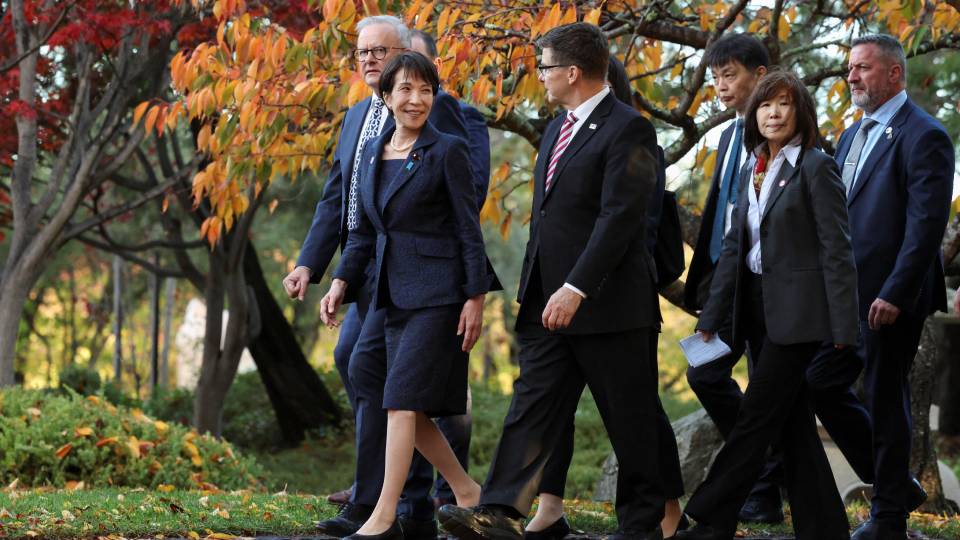
While on the ground, Takaichi and Prime Minister Anthony Albanese inked multiple agreements, with echoes from when she was Vietnam, including on critical minerals, supply-chain resilience, economic-security coordination, and energy security. On the latter point, Japan and Australia pledged to work more closely together to deal with the global energy crisis caused by America and Israel’s war against Iran. Takaichi remarked, “The effective closure of the Strait of Hormuz had been inflicting enormous impact on the Indo-Pacific. We affirmed that Japan and Australia will closely communicate with each other in responding with a sense of urgency.”
Meanwhile, Koizumi visited both Indonesia and the Philippines to secure arms deals under Japan’s new authorization. While in Jakarta, he and Indonesian Defense Minister Sjafrie Sjamsoeddin signed agreements pertaining to defense-industry cooperation, personnel exchanges, joint exercises, and future collaboration on defense technology and equipment.
But the more significant move happened in Manila. There, Koizumi met with Philippine officials and agreed to begin formal negotiations on a weapons-transfer agreement amid mounting regional tensions. In a joint press conference, Koizumi and Philippine Defense Secretary Gilberto Teodoro “reaffirmed [their] strong opposition to any unilateral attempts to change the status quo by force or coercion in the East China Sea and the South China Sea.”
The most important potential transfers discussed were Abukuma-class destroyers, and TC-90 surveillance aircraft. Koizumi explicitly said Japan was seeking the “early transfer” of the destroyers to the Philippines. And for the first time ever, while participating in the annual U.S.-Philippines Balikatan military drills, Japanese forces conducted a live-fire missile drill facing the South China Sea—in a clear signal of deterrence toward Beijing.
The context for all of these recent moves has been heightened tensions between Japan and China in the East China Sea and Taiwan Strait. Beijing’s closer ties to Russia and North Korea have only complicated the matter.
Although it is true that Japan also harbors deepening concerns about U.S. reliability, the reality is that the two are not equal: China remains the primary catalyst behind Tokyo’s strategic transformation. Japanese leaders increasingly believe that the old postwar model—economic power backed by American hard power—is no longer adequate for the Asia-Pacific’s emerging dangers. What is now taking shape is a Japan prepared to project power, export arms, build regional coalitions, and shape Asia’s strategic future more directly than ever before.
In many respects, Tokyo is attempting to not only serve as the connective strategic tissue linking America’s alliance system with emerging middle powers, but to become a truly indispensable strategic power in its own right. The implications for the regional balance of power could be profound.
Derek Grossman is CGSP’s Non-Resident Fellow for the Asia-Pacific.