
Indonesia is once again attempting to thread a very narrow geopolitical needle—deepening ties with the United States without rupturing its indispensable relationship with China. The recently signed Agreement on Reciprocal Trade (ART) underscores just how delicate and consequential this balancing act has become. While the deal promises economic opportunity and strategic diversification, it also raises harder questions about how far Indonesia can stretch its long-standing hedging strategy in an increasingly polarized Indo-Pacific.
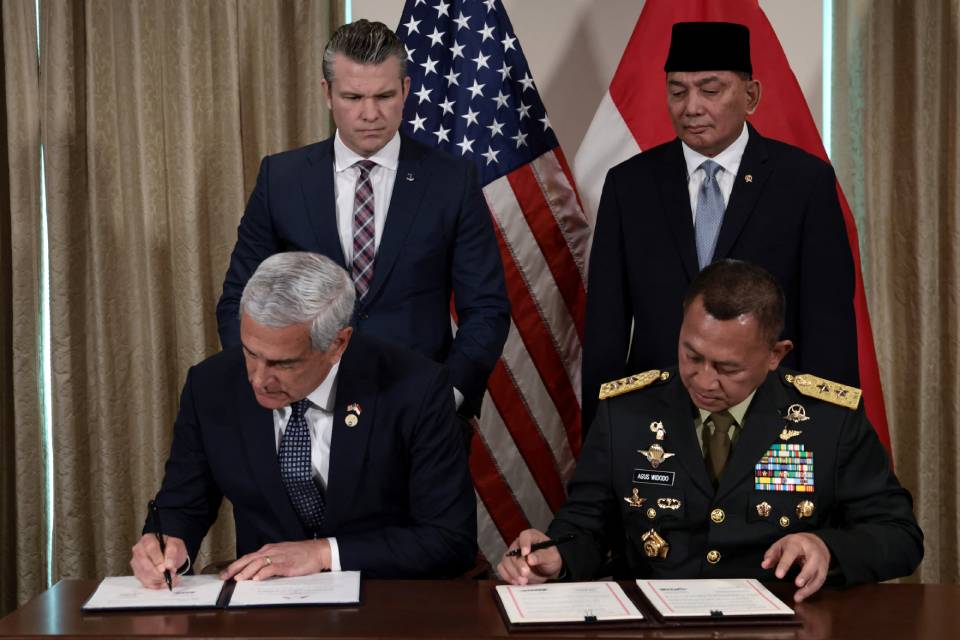
On February 19th, Indonesia and the United States signed the ART, a sweeping, cross-sectoral accord poised to reshape Indonesia’s economy and recalibrate its strategic relationships with both the United States and China for years to come.
The two countries followed up on April 13th with a defense deal expanding joint military exercises, enhancing maritime domain awareness, and facilitating defense technology transfers—in a further sign that Indonesia-United States relations are becoming increasingly strategic.
Similarly, on the economic side, the ART is not only strategic but a reflection of the evolving bilateral trade dynamics and the domestic economic pressures shaping Jakarta’s policy decisions. Jakarta’s decision to ink the pact raises new stakes on whether the ART, on balance, advances or constrains Indonesia’s economic development.
The ART will be further significant in how it reshapes Jakarta’s relationship with China. On a structural level, the agreement does little to displace China’s central role in Indonesia’s economy. Beijing remains Jakarta’s largest trading partner and a dominant investor in key sectors, including nickel processing, electric vehicles, batteries, and green technology.
These ties are not easily unwound. They are embedded in supply chains, infrastructure, and long-term capital commitments that reflect commercial logic as much as geopolitics. Even in emerging areas such as rare earths, where Indonesia holds some potential, significant barriers remain. Processing is environmentally costly and energy-intensive, and China’s entrenched dominance in refining capacity is unlikely to be challenged in the near term.
In this context, the U.S. trade deal does not offer Indonesia a viable substitute for China, but rather an additional layer of engagement alongside it.
From Beijing’s perspective, the agreement is likely a source of quiet concern, but not immediate alarm. Chinese policymakers appear to have responded cautiously to the ART, avoiding overt criticism that could alienate Jakarta. This restraint reflects a recognition of Indonesia’s importance—not only as a major economy, but as a pivotal actor in Southeast Asia.
Major Chinese-backed projects in Indonesia, from industrial parks to high-speed rail, underscore the strategic weight Beijing places on the bilateral relationship. At the same time, China understands that Indonesia’s outreach to the United States is not necessarily a rejection of Chinese partnership, but part of a broader hedging strategy.
Indeed, one of the agreement’s potential advantages for Indonesia is that it strengthens Jakarta’s bargaining position with China. By signaling that it has alternative economic partners, Indonesia may gain leverage in negotiations over investment terms, technology transfer, and market access.
The mere possibility of deeper U.S. involvement can serve as a counterweight, encouraging Beijing to remain competitive. In this sense, the deal functions as a geopolitical signal as much as an economic instrument.
DEREK GROSSMAN, CGSP NON-RESIDENT FELLOW FOR ASIA-PACIFIC AFFAIRS
Yet this signaling effect cuts both ways. If the agreement is perceived—either in Beijing or elsewhere—as evidence that Indonesia is tilting toward Washington, it could complicate relations with China. This risk is particularly acute if Jakarta appears inconsistent or reactive, rather than strategically deliberate. Efforts to use the U.S. relationship as leverage could backfire if China interprets them as opportunistic or unreliable. Over time, this could erode Indonesia’s credibility as a negotiating partner, weakening rather than strengthening its position.
There is also a more subtle constraint embedded in the agreement itself. Certain provisions—particularly those related to supply chains and security-sensitive sectors—may limit Indonesia’s flexibility in engaging with China. For example, rules governing inputs from countries deemed strategic risks could affect industries that rely heavily on Chinese components.
While such restrictions may be unevenly enforced, they nonetheless introduce friction into Indonesia’s ability to seamlessly integrate Chinese and Western economic partnerships. This creates a tension at the heart of Jakarta’s strategy: the desire to diversify without being forced to choose.
In practice, however, these constraints may prove more manageable than they appear. Global trade is highly adaptable, for example, and Indonesian firms can—and often do—route goods through third countries such as Singapore or Vietnam to navigate regulatory barriers. Given the scale and complexity of international supply chains, enforcement is inherently imperfect. This provides Indonesia with a degree of flexibility, allowing it to comply with formal commitments while maintaining substantive economic ties with China.
Meanwhile, China has moved to reinforce its own position by emphasizing reliability and stability. Beijing has sought to contrast its approach with what it portrays as Washington’s unpredictability, particularly in trade policy. This narrative resonates in Indonesia, where there is longstanding skepticism about overdependence on any single partner. Observers often point to the treatment of U.S. allies such as Japan and South Korea as cautionary examples, reinforcing the appeal of a diversified, non-aligned approach.
Indonesia’s relationships with the world’s two largest economies remain largely complementary: China dominates Indonesia’s infrastructure and industrial inbound investment, while the United States plays a key role in Indonesia’s export markets, finance, and advanced technology. This division reduces direct conflict and allows Indonesia to compartmentalize its partnerships.
China understands that Indonesia’s outreach to the United States is not necessarily a rejection of Chinese partnership, but part of a broader hedging strategy.
Still, the balancing act is becoming more complex. Diplomatic signaling—such as the sequencing of high-level visits or participation in competing initiatives—carries increasing weight in a polarized geopolitical environment.
Ultimately, the ART does not fundamentally alter Jakarta’s trajectory vis-à-vis China. Instead, it reinforces an existing pattern of pragmatic engagement, economic diversification, and cautious hedging. The deal provides Indonesia with additional options and modest leverage, but also introduces new risks. If mismanaged, it could expose the limits of its balancing strategy in an increasingly contested regional order.
The bottom line is straightforward but uncomfortable: Indonesia is not choosing between the United States and China—but the margin for avoiding that choice is narrowing. The ART buys Jakarta time, space, and leverage. Whether it also locks Indonesia into new constraints will depend less on the agreement itself than on how skillfully Indonesian policymakers navigate the next phase of great power competition.
Derek Grossman is CGSP’s Non-Resident Fellow for the Asia-Pacific.