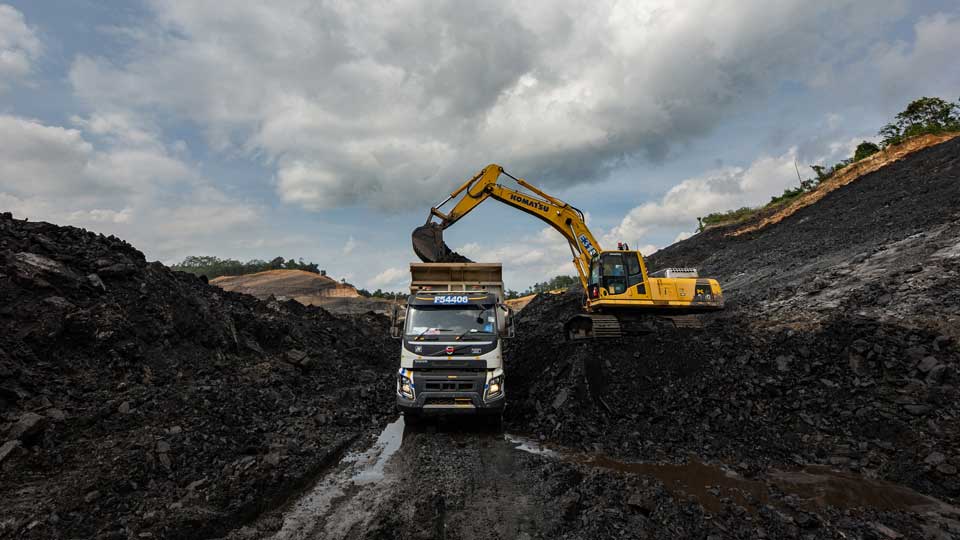
Indonesia sits on a geological treasure trove of rare earth minerals, and the government is eager to tap into the wealth they could bring.
While it knows how to find, mine, and sell the highly sought-after critical materials, it confronts a geopolitical dilemma: The only timely, viable path to processing its own rare earths leads straight to China, the exact partner other potential geopolitical partners, such as the United States and Japan, want Indonesia to avoid.
Rare earth elements, despite their name, are relatively abundant in the earth’s crust. The “rare” refers instead to the difficulty of finding them in concentrated, mineable forms and the extreme challenge of transforming them into usable materials—a complex, technically demanding process.
The vast archipelago nation has significant deposits of rare earth elements, the essential metallic ingredients for everything from electric vehicle motors to missile guidance systems and medical devices.
These materials have become a source of friction between countries vying to control supply chains. While China remains the dominant power, the U.S., Australia, France, Japan, and others are scrambling to secure their own access.
Now, Indonesia wants in.
President Prabowo Subianto’s government has accelerated plans to develop the sector, with officials identifying eight mining blocks with significant potential.
To manage these strategic assets, the state has established a new enterprise, Perminas, tasking it with extraction and processing. Brian Yuliarto, head of Indonesia’s Mineral Industry Agency, told parliament the reserves are promising enough to compete internationally.
The push extends Indonesia’s resource nationalism playbook. The government saw its bet on nickel pay off handsomely under former President Joko Widodo after it banned raw ore exports, forcing companies to build domestic smelters.
That policy turned Indonesia into a global stainless-steel powerhouse.
But the nickel play also revealed limits. While stainless steel, which uses nickel, boomed, Indonesia’s ambitions to leap into the more lucrative electric vehicle battery industry stumbled. The country lacked high-pressure acid-leach facilities needed to produce battery-grade nickel sulfate, creating what researchers call a “hollow middle” in its supply chain.
Rare earths present an even steeper climb, with high capital costs and difficult technology.
“It’s challenging without China,” says Bhima Yudhistira Adhinegara, executive director of the Center of Economic and Law Studies, an Indonesia-based economic think tank. “China’s control of the supply chain, technology, and workforce has long been proven. With France or Australia, perhaps as diversification partners, but at a very limited scale. If Indonesia wants to go fast, China will be the viable option.”
Adhinegara also highlights that processing is also often environmentally destructive, causing severe soil acidification, radioactive waste, and contaminated waterways. The industry will also be energy-intensive, relying on coal and gas.
“It will emit not only carbon emissions but also hazardous particles such as NOX and PM2.5,” he says. “Health costs will be challenging for communities, workers, and local government.”
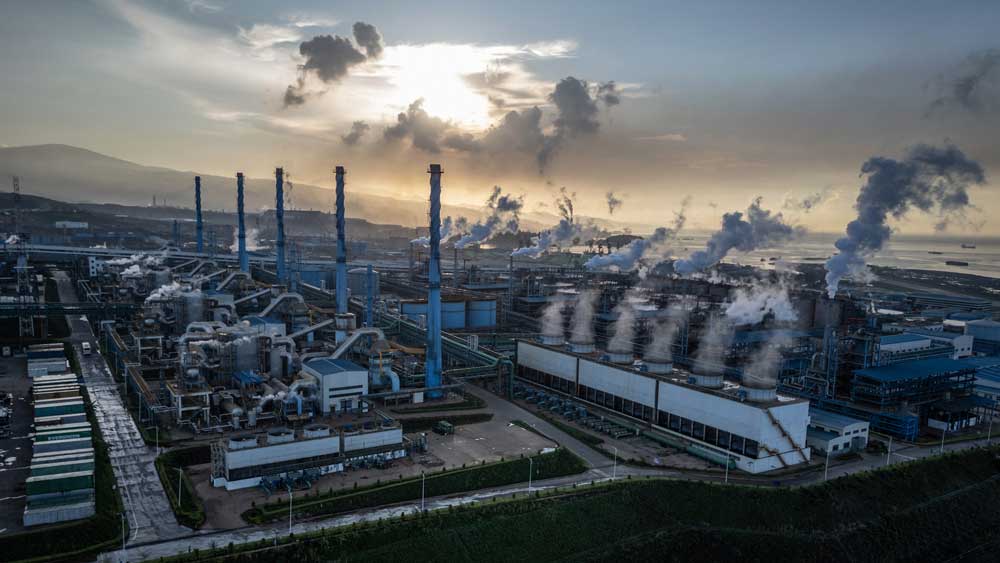
Indonesia currently remains at an early exploration stage, lacking sufficient refining capacity and reliant on imports of processed rare earths like lanthanum and neodymium to meet its own domestic needs.
This is where the United States enters the picture. Washington has spent years trying to build “China-free” critical mineral supply chains, viewing dependence on Beijing as a national security vulnerability.
In February, the U.S. and Indonesia signed a trade deal to strengthen economic ties and align Indonesia with U.S. interests. It included critical minerals and rare earths, committing Indonesia to partner with American companies to secure supply chains, hopefully luring Indonesia away from China.
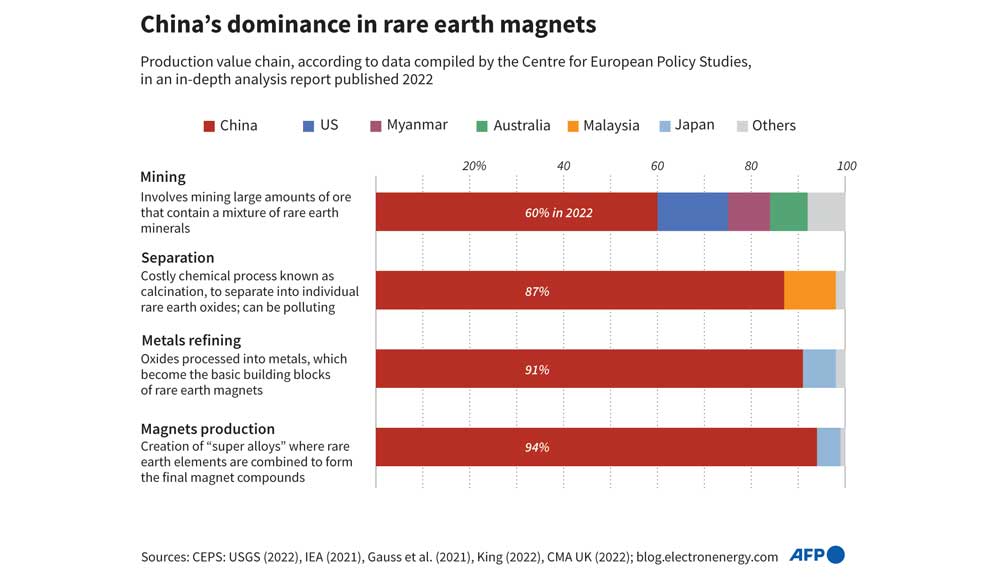
But the United States is decades behind China in rare-earth processing power. By 2030, China will control 51% of rare-earth production and 76% of refining, according to the International Energy Agency. Beijing’s current share is even higher.
This dominance results from “a coordinated, decades-long scheme to control different critical minerals and bend the global market to their will,” according to a recent U.S. congressional report. China’s basic strategy, the report states, is to subsidize production and keep prices low enough to discourage competition.
For Indonesia, this creates a squeeze. While Washington is its preferred security partner and a key source of investment, Beijing still holds the keys to building processing facilities on a reasonable timeline.
“The agreement with the United States may also function as a ‘poison pill,’ in the sense that it could constrain Indonesia’s ability to pursue future cooperation with China in the processing and downstream development of critical minerals,” said Adhinegara.
The dilemma echoes a broader tension: developing nations rich in green economy resources want to process them at home to capture more value and create jobs. But they must often choose between an incumbent China offering infrastructure today and a United States offering promises of a different system tomorrow.
As Indonesia launches its first research projects, the clock is ticking.
The government hopes to develop its own processing technology, but that is a long-term gamble. For now, Jakarta must navigate between the world’s two largest economies, trying to secure its place in the critical minerals competition without becoming a pawn in a bigger game.
Naomi Srisuk is an independent journalist based in Jakarta, Indonesia