
By Felix Brender 王哲謙
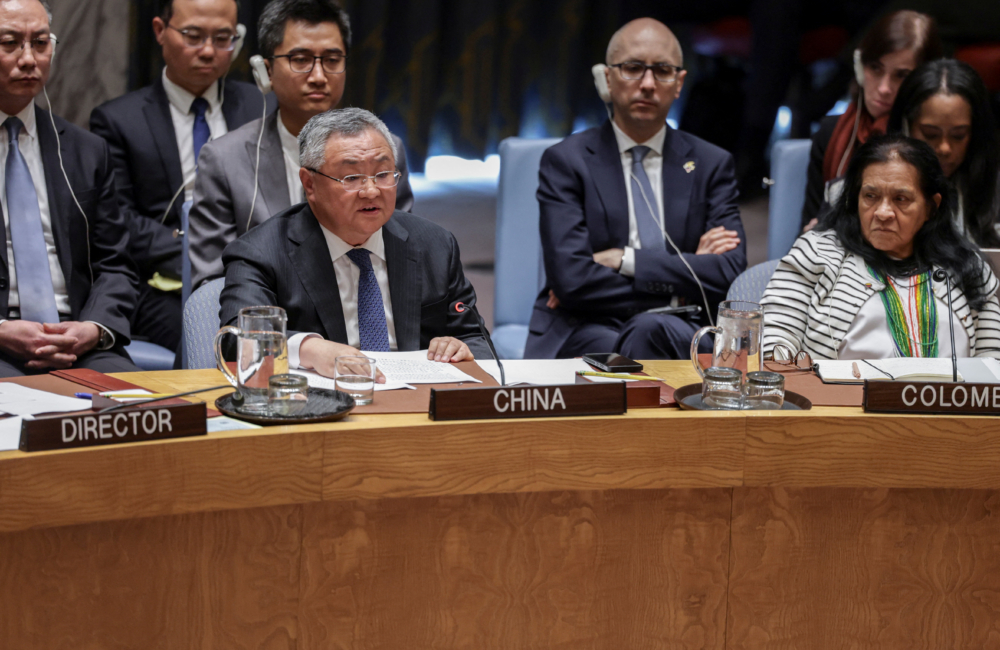
When China and Russia vetoed the UN Security Council’s Strait of Hormuz resolution on 7 April, after weeks of increasingly plaintive calls for Beijing to “do more” over Iran, a familiar argument resurfaced: if China wants the status of a great power, surely this is the moment to act like one.
Yet the Chinese debate suggests something rather different. While a somewhat bizarrely triumphant special issue of Contemporary International Relations (现代国际关系), produced to describe the official line, presents Iran as the heroic defender of the Global South and China, somehow, as the room’s sole moral adult, the broader debate is framed rather differently: by a delicate balancing act (微妙平衡) between Iran and the Gulf, and strategic opportunity (战略机遇) created by yet another bout of American overreach.
That is why so much elite commentary goes in circles. It identifies the tensions, but stops there, because balance is a safe position to diagnose and an even safer one to inhabit. China, we are told, must oppose force, defend sovereignty, avoid alienating partners on either side, and preserve regional stability.
All true enough. But what follows is, as in so many other cases, less a strategy of engagement than one of inaction: condemn escalation, call for a ceasefire and an end to the fighting, offer a “constructive role”, and above all, avoid taking responsibility as an alliance-based power.
Wang Yi’s March formulation was entirely in keeping with this approach: respect sovereignty, oppose the abuse of force, and seek political solutions. Admirable language, certainly. But language nonetheless.
That is why the recurrent claim that China is the obvious solution to the crisis deserves caution. Beijing offers moral vocabulary rather than operational leverage. Sovereignty, non-interference, political settlement: these are not meaningless principles, but they are strikingly inexpensive ones. They flatter China’s self-image as a responsible power while requiring rather little in practice.
Officially, this restraint is presented as proof that the Party’s security doctrine is correct. One might say the doctrine has the convenient habit of vindicating whatever China was going to do anyway.
If elite commentary expresses this in cautious official language, the more candid nationalist discourse makes the point more plainly: America’s talent for creating its own Middle Eastern messes can work to China’s advantage, provided Beijing is sensible enough not to jump in after it. That is the logic Zhongnanhai has often preferred: let Washington absorb the costs of disorder while China preserves optionality.
Calls for China to become a more active mediator thus miss the point. Beijing is resisting them not because it lacks awareness of the crisis, but because deeper involvement would cut against the very strategic habits that have served it reasonably well. Even those commentators urging China to rethink its non-intervention stance generally do so not in the name of international order, but in defense of Chinese assets and interests.
There is, finally, a more structural reason for this caution. China does not want to alienate Iran, but nor does it want to alienate Saudi Arabia and the Gulf. That, ironically, is part of being a global power: making difficult choices and disappointing partners.
It is also part of the longer-standing problem with China’s international position. It has influence, certainly, but few durable alliances, by choice or limitation, and many of its relationships rest more on economic convenience than on deeper strategic trust.
Against this backdrop, upbeat commentary suggesting that Iran is especially accommodating of Chinese interests feels rather too pleased with itself. It overstates affinity and understates the tensions that Chinese analysts themselves have already identified.
What follows is not just a story about China, but about those who imagine themselves aligned with it. Beijing does not do alliances in the traditional sense, and it shows little inclination to acquire the burdens that come with them. Partners may benefit from Chinese trade, investment, and occasional diplomatic cover, but they should not expect rescue.
Iran is learning this in real time. Russia has long had to understand it. Others, from Venezuela onwards, have discovered that China’s support rarely extends to underwriting risk when it matters most.
In that sense, China’s posture is entirely coherent. It is present in the rhetoric, careful in practice, and determined to benefit from instability without ever quite taking ownership of it. The real question is not whether China will step in, but why others still assume that it will.
Felix Brender is a project associate at LSE IDEAS.
