While the dust from the U.S. military operation in Caracas to oust Nicolás Maduro has yet to settle, early Chinese reactions already offer useful food for thought. The views expressed across Latin America, largely absent from both Chinese and Western commentary, also help contextualize how China’s relationship with Venezuela, and with the region more broadly, may evolve in the coming months.
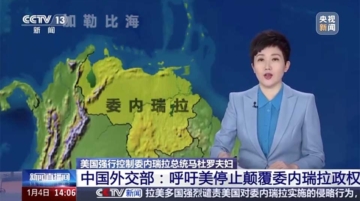
Let’s begin with China’s response. Official messaging moved fast, and predictably, into classic Chinese rhetorical mode: moral adjudication, a legalist UN Charter–centered argument, and sovereignty absolutism.
Yet the intensity is notable. This was not merely boilerplate disapproval. The rebuke sits on the high end of China’s standard repertoire of “U.S. intervention” condemnations—closer to its strongest post–Cold War denunciations than to routine, formulaic objections.
Rhetorical Escalation
The vocabulary alone signals escalation: “悍然” (brazenly), “肆意践踏” (wantonly trample), “霸凌” (bullying), “掳走” (abduct/kidnap), “侵略” (aggression/invasion). These are not casual descriptors; they are verdict words, rarely clustered so densely in a single official statement.
At the same time, China limiting itself to diplomacy was entirely expected. To understand why, it helps to look beyond the rhetoric and toward the reality of today’s Sino-Venezuelan relationship, which is only a shadow of what it once was.
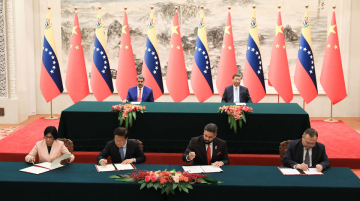
In 2023, the two governments announced an “all-weather strategic partnership,” but the headline obscures the trajectory. The oil-for-loans era effectively ended in 2016. Venezuela has also never been a major destination for Chinese foreign direct investment, just $5 billion over the last two decades, despite years of Venezuelan delegations traveling to Beijing in search of deeper economic support.

The one area in which China has remained economically beneficial is sanctions evasion. It is estimated that approximately 4% of China’s imported oil comes from Venezuela, largely via intermediaries (Chinese customs data still record zero direct Venezuelan imports).
Even then, it remains unclear how much of that oil is used for debt repayment versus cash transactions.
Strategic Limits
It is important to understand that Beijing has deliberately chosen to limit its engagement with Caracas, based on its experience dealing with Chavismo, the political movement and governing project built around Hugo Chávez and sustained under Nicolás Maduro, over the past 25 years.
This has little to do with China’s capabilities and far more to do with what China learned from the relationship. The squandering of approximately $65 billion in loans, and the experience of dealing with an immensely corrupt—but, more importantly, inefficient and incapable—political elite left a lasting mark.
Western coverage, meanwhile, often reduces Latin America to a background chorus reacting to Washington, when in reality the region’s fractured responses will shape how far China can translate moral condemnation into durable leverage.
None of this is to say that Venezuela is not important to China. It is.
Venezuela remains a petrostate with a uniquely consequential geography: it sits on South America’s northern rim with nearly 2,800 kilometers of Caribbean–Atlantic coastline—roughly the distance from Paris to Moscow, giving it direct maritime reach into the Caribbean basin and into the U.S. strategic neighborhood.
Venezuela once had outsized political and economic clout across Latin America, one of the reasons China became interested in the country in the first place. But that Venezuela is long gone.
Regional Fragmentation
What remains is a strategically positioned state with vast energy resources whose most enduring asset is its geographic leverage and its antagonist posture vis-à-vis the United States.
Yet focusing solely on Beijing’s denunciation misses the more consequential story: how Latin America is interpreting the intervention and what that means for China. Across the region, reactions have splintered sharply. Some governments framed the raid as an intolerable breach of sovereignty and a dangerous precedent for the hemisphere.
Others welcomed Maduro’s removal as long-delayed justice against an authoritarian project. A third set of governments avoided taking sides altogether, responding through consular measures or simply remaining silent as the situation evolved.
Regional positions, at a glance:
- Sovereignty/precedent camp (condemnation): Chile, Colombia, Mexico, Brazil, and Uruguay rejecting unilateral force.
- Welcome/endorsement camp (open approval): Argentina, El Salvador, and Chile’s president-elect José Antonio Kast openly endorsed the U.S. operation to remove Maduro.
- Tacit support (endorsing the outcome without naming the U.S.):
- Ecuador: backed Venezuela’s “restoration of democratic institutions and the rule of law” and restricted entry and asylum for officials linked to the Maduro regime.
- Bolivia: expressed firm support for the Venezuelan people in a process to restore democracy, reestablish constitutional order, and fully guarantee human rights.
- Caribbean enabling role: Trinidad & Tobago’s cooperation—reported as providing key operational support—positioned it as a pivotal facilitator in the Caribbean basin, even as the government publicly denied being a direct participant.
- Silent or non-committal states: Many governments simply abstained from taking a clear public position for or against the operation in the immediate aftermath, either to avoid domestic backlash, preserve diplomatic flexibility, or wait for the situation to clarify.
The wide array of positions matters for Beijing because China’s influence in the hemisphere does not operate in a vacuum; it is filtered through Latin American domestic politics, regional alignments, and—crucially—Venezuelans’ own reading of what just happened.
Here, too, the picture is more complicated than either Chinese or Western framings allow.
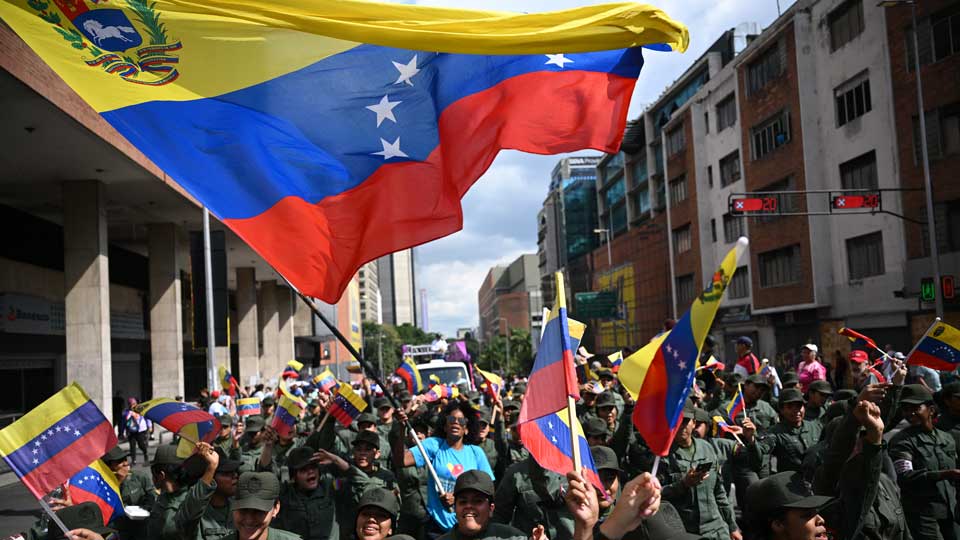
Chinese official messaging presumes a ready-made “Global South” consensus in which sovereignty talk automatically carries the day. But Venezuelans themselves, especially abroad, have been far more interested in outcomes than in doctrinal arguments: hundreds rallied in central Madrid for days to support the U.S. detention of Maduro, while large crowds gathered in downtown Buenos Aires to celebrate what they saw as a historic break with authoritarian rule.
Western coverage, meanwhile, often reduces Latin America to a background chorus reacting to Washington, when in reality the region’s fractured responses will shape how far China can translate moral condemnation into durable leverage.
In the post-Maduro scramble, Venezuela’s future remains uncertain: it is still unclear whether Washington can effect regime change, whether the intervention collapses into an uncontrollable quagmire, or whether the system simply reconstitutes itself under new management.
Regardless, Beijing can condemn the operation all it wants, but Latin America’s political landscape will decide whether China’s story travels—or stalls.
Parsifal D’Sola Alvarado is the Founder and Executive Director of the Fundación Andrés Bello