
In China’s engagement with the Global South, climate diplomacy is one area where Latin American and Caribbean (LAC) countries play a particularly decisive role. The Global South is set to be disproportionately affected by climate change, yet its governments must negotiate solutions with the world’s largest emitters—China among them—in order to advance their development plans and secure financing for the energy transition.
Smaller countries and economies, such as many in the LAC region, are often sidelined in global policy debates. But climate negotiations and agreements create one of the rare spaces where these states, individually and collectively, hold real leverage and emerge as consequential actors.
For its part, China presents itself as a leader in addressing climate change, playing key roles in renewable (particularly solar) energy generation, and the broader energy transition process, through the processing of critical minerals and the production of batteries for electric vehicles.
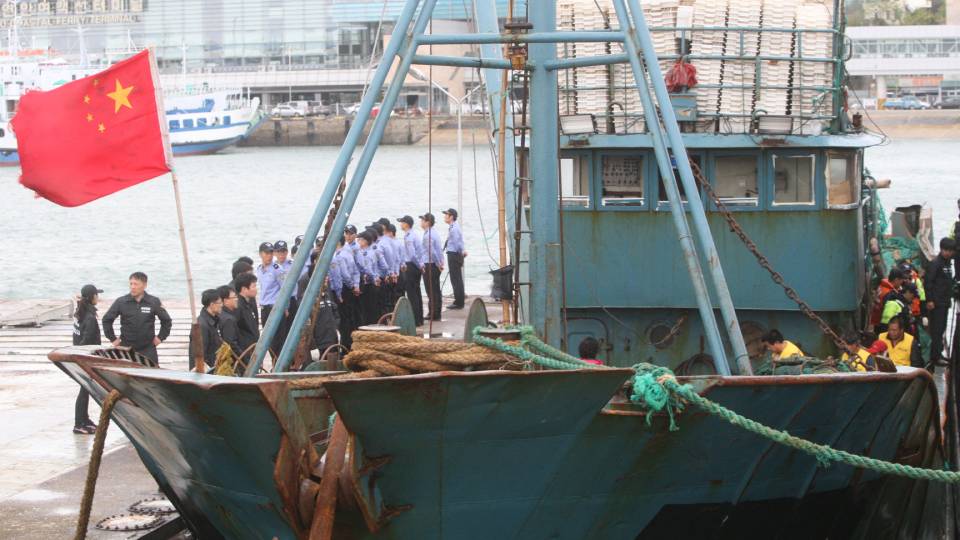
But there is a contentious, sometimes-forgotten side of China-LAC relations: blue diplomacy. In maritime cooperation and the management of fisheries and aquaculture, Beijing and certain LAC countries find themselves at odds, mostly because of Illegal, Unreported, and Unregulated (IUU) fishing engaged in by Chinese actors.
In the last decade, the presence of Chinese fishing fleets in the Pacific waters of South American nations such as Colombia, Ecuador, Perú, and Chile has become a structural phenomenon affecting geopolitical dynamics, the livelihood of lawful fishers, and the diversity of the region’s marine ecosystem. Some of these states are acting against IUU fishing while others are trying to navigate the issue without letting it affect their broader relationship with Beijing.
Earlier this year, Argentina deployed its navy to prevent China’s distant-water fishing fleet from depleting its marine resources. Colombia, which recently warmed up ties with Beijing through the China-CELAC Forum and the Belt and Road Initiative, enacted a law against Chinese IUU fishing.
The recent opening of Perú’s Chancay Port in alliance with China’s state-owned COSCO coincided with a multiyear increase of Chinese vessels engaging in IUU fishing in their exclusive economic zone since 2018. Lima has incrementally tightened regulations, particularly on tracking mechanisms, which has led to a complete cessation of port stops by Chinese vessels at Peruvian harbors in 2025. This contrasts with the 155 and 205 vessels recorded in 2023 and 2024, respectively.
China’s distant-water fishing fleet is mostly composed of Panamanian-flagged vessels. Panama has the largest merchant vessel fleet by flag in the world. Due in large part to the use of its flag for IUU fishing, the European Union has given Panama a yellow card since 2021. Although the country is taking corrective actions, a decision to issue a green card may not be reached until 2026.
In addition, a 2022 decision by the Eastern Tropical Pacific Marine Corridor (CMAR) countries (Panama, Costa Rica, Colombia, and Ecuador) to join forces with the United States in combating IUU fishing has significantly affected China’s distant-water fishing fleet.
Nonetheless, the Chinese fleet has found two new bases to reorganize its operations. Arica and Iquique, two northern Chilean ports, have seen a massive influx of vessels since mid-2024, with logistical support provided by Chilean authorities since the end of the year. The users include vessels sanctioned by the U.S. These crews also engage in unequal competition with local fishers who comply with local regulations.
For now, Chilean authorities are turning a blind eye, but in the not-so-distant future, things may change. As demonstrated by Colombia and Perú, not even a close partnership with Beijing induced them to allow devastation of their fisheries and aquifers.
Beijing is dealing with a growing tension between its climate leadership and its maritime practices.
With its fleet moving deeper into the South, China is finding itself in a difficult position. Overall, Beijing is dealing with a growing tension between its climate leadership and its maritime practices. This has put China at odds with the underlying discourse in the broader Global South, which favors sovereignty, sustainability, and conservation of resources. This particularly applies to LAC States for whom protecting maritime resources and sovereignty is of utmost importance.
The actions undertaken by Argentina, Colombia, Peru, Panama, and the countries involved in regional marine conservation efforts show that even states seeking closer commercial ties with Beijing are unwilling to compromise on this priority. On the contrary, they are inclined to draw clear lines and to protect their natural resources, individually and collectively.
Should Chile decide to follow its neighbors, China may soon face a regional consensus against IUU fishing, forcing Beijing to choose between the practices of its distant-water fleet and preserving its carefully cultivated image as a responsible actor in the Global South.
Alonso Illueca is CGSP’s Non-Resident Fellow for Latin America and the Caribbean.