In 2025, China remained a top-three source of Foreign Direct Investment (FDI) in Southeast Asia, following only the U.S. and intra-Southeast Asian flows. While much of the investment falls under the umbrella of the Belt and Road Initiative (BRI), it is important to distinguish between broad private investment and state-led funding.
Understanding how State-Owned Enterprises (SOEs), Private-Owned Enterprises (POEs), and Multinational Enterprises (MNEs) coordinate their distinct roles is essential to grasping the China-SE Asian economic partnership evolution.
The following table illustrates how these three entities differ in their funding, focus, and current strategic direction:
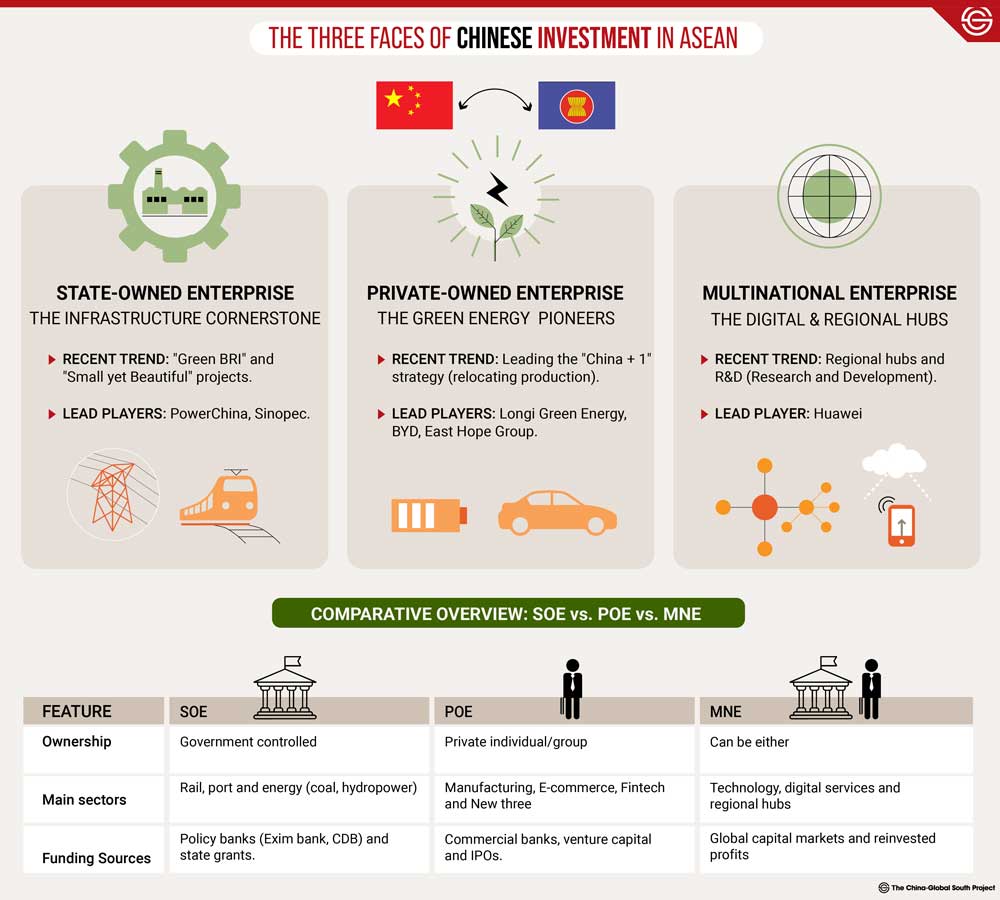
SOE: The cornerstone of China’s investment in ASEAN
Chinese state-owned enterprises (SOEs) play a critical role in both domestic and overseas economic activities. Funded and controlled by the government, they serve both economic and diplomatic functions in China-Southeast Asia relations. There are two levels of SOEs: central SOEs, directly controlled by Beijing, and local(sub-national) SOEs, which are spread across Chinese provinces. Some local SOEs maintain direct partnerships with ASEAN governments.
For example, Beibu Gulf International Port Group (北部湾港集团), a Guangxi provincial SOE,has a direct partnership with the Malaysian government. It shares ownership of Kuantan Port and its associated industrial park. This cooperation is described as “two countries, two parks,” referring to the industrial park in Qinzhou, Guangxi, and the industrial zone in Kuantan, a strategically important Malaysian port area.
Initially, SOE investments in SE Asia, particularly under the BRI, concentrated on large-scale infrastructure and economic zones. In recent years, especially after 2022, when the concept of “Xiao er Mei” (small yet beautiful) gained prominence, the project has expanded into smaller, more targeted initiatives with reduced financial risk.
While SOEs remain leading players in overseas BRI investment and continue to be involved in legacy mega-projects in Southeast Asia, such as oil and gas pipelines in Myanmar and hydropower dams in Vietnam, newer investments increasingly focus on projects with clearer local benefits and lower risk.
POE: Leading with the “New Three”
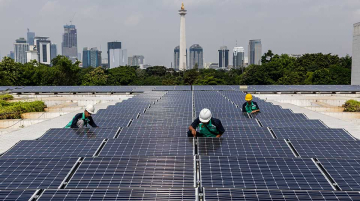
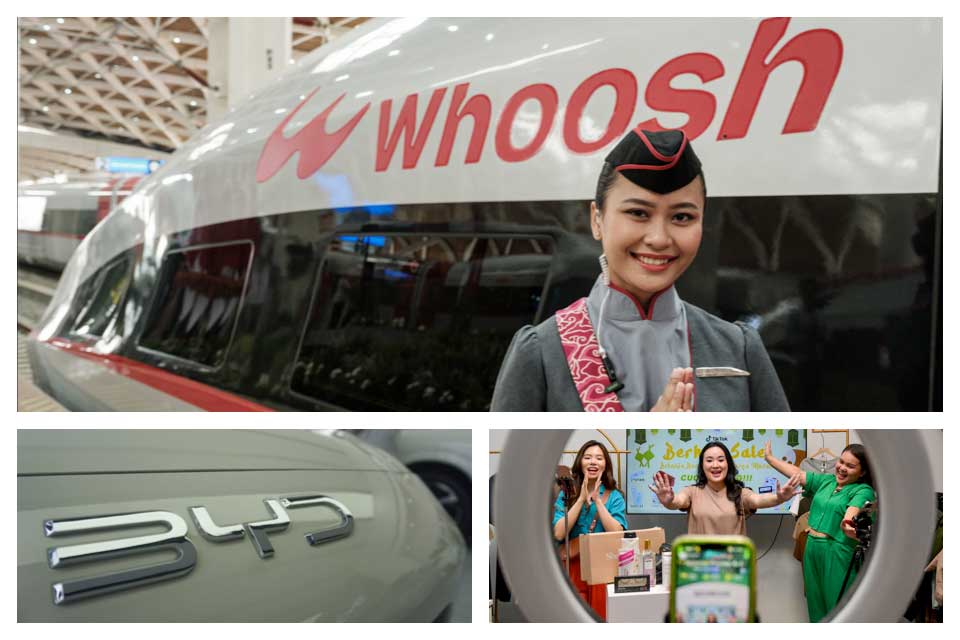
Chinese SOEs and POEs often support one another’s overseas development. As described in Chinese media, SOEs “set the stage,” while private companies later “put on the show” (“国企搭台,私企唱戏”). Building on the infrastructure and institutional groundwork established by SOEs, POEs are now leading the expansion of the “new three” (新三样) industries: solar, electric vehicles (EVs), and batteries.
These export-driven green industries are no longer supplied solely from China. Instead, Chinese POEs are increasingly relocating production to ASEAN for both geopolitical and economic reasons, integrating the region into manufacturing networks rather than treating it merely as an end market.
A primary example to demonstrate the integrated supply chain is Indonesia’s nickel to battery ecosystem. Leveraging vast nickel reserves – a critical input for lithium-ion batteries – the country has become a focal point for upstream-to-downstream industrial development led by Chinese firms.
The Morowali and Weda Bay industrial parks together form a full industrial system developed with significant Chinese investments. While nickel is mined at the Indonesia Morowali Industrial Park (IMIP), processed materials are shipped to downstream facilities at the Weda Bay Industrial Park, where companies like Huayou produce materials for lithium-ion batteries. Battery production in West Java managed by CATL is expected to begin in 2026, further extending the value chain.
MNE: Regional hubs supporting research and development
Multinational enterprises (MNEs) operate across multiple countries, with a home base in one country and substantial business activities in many host economies. In Southeast Asia, Chinese MNEs often act as lead firms, coordinating regional operations, supply chains, and technology deployment.
Huawei, often mistaken for a state-owned enterprise due to its strong patriotic branding, is in fact a privately owned MNE. While its home country is China, it operates in more than 170 host countries worldwide. Huawei’s presence in ASEAN is not only about hardware exports, but the company also aligns its corporate development plans with regional digital plans. In 2025, Huawei is recognized as a lead partner for the ASEAN Digital Master Plan 2025.
A concrete example is Huawei’s partnership with Thailand’s major telecom operators to deploy 5G networks nationwide. Huawei has worked closely with companies such as AIS to build core network infrastructure, base stations, and enterprise 5G applications, particularly in the Eastern Economic Corridor (EEC), Thailand’s flagship industrial zone.
Chen Heyi is an independent China-Southeast Asian relations analyst.