As 2026 begins, the China-ASEAN relationship is evolving across several fronts, including trade, Artificial Intelligence, infrastructure development, and South China Sea. With the ASEAN’s chairmanship held by the Philippines, the year opens with distinct political and institutional dynamics for the region.
Several developments are expected to shape the directions of China-ASEAN collaboration this year, from high-level trade and investment events to expected policy and political announcements. Three pillars stand out as key areas to watch.
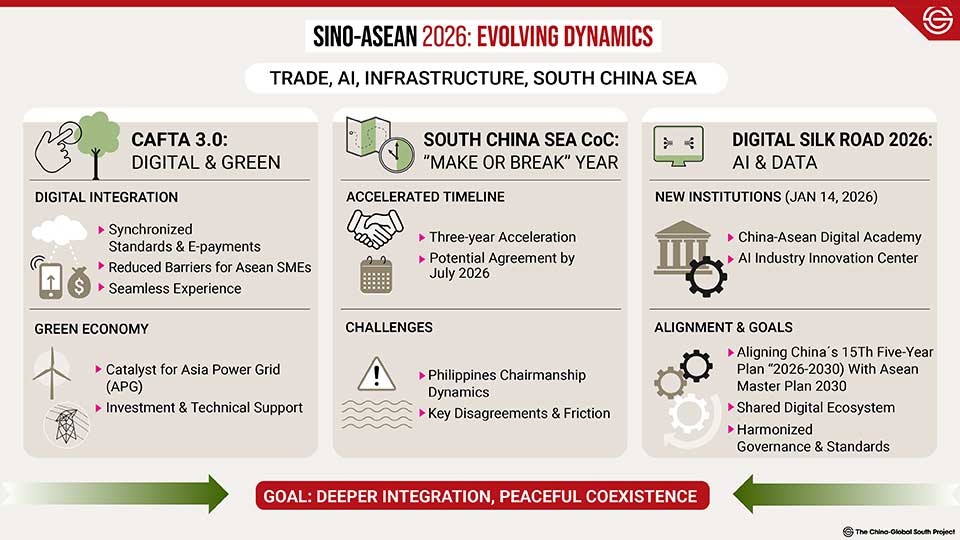
China-ASEAN Free Trade Area (CAFTA 3.0): The Digital and Green Trade Era
2026 marks the critical first year of implementing the China-ASEAN Free Trade Area (CAFTA) 3.0 Upgrade Protocol, which was signed last year in October. The updated agreement moved beyond simple tariff reductions towards deeper integration across nine areas, with the digital economy taking the central stage.
Specifically, ASEAN and China agreed to work together to synchronize technological standards, notably in e-payment systems. This would significantly reduce the barrier to entry for small businesses from the region, allowing SMEs in ASEAN to plug into China’s consumer market while offering Chinese investors and consumers the seamless experience within Southeast Asia.
The green economy was another focused area under CAFTA 3.0. Among all the potential investments in the horizon, ASEAN Power Grid (APG), a project aiming to build up an interconnected power grid system in ASEAN , deserves special attention. The new CAFTA framework could act as a catalyst to fill the current investment gap with Chinese capital and provide technical support for the project to turn the vision into a reality.
The South China Sea Code of Conduct: The 2026 deadline
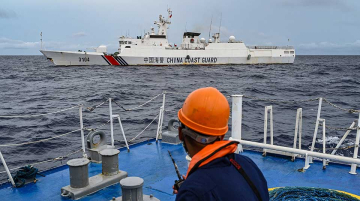
2026 would be the “make or break” year of the South China Sea Code of Conduct (CoC) negotiation. Since 2002, the CoC has been on the agenda for ASEAN and China’s discussion, with the purpose of finding a peaceful and durable solution in the controversial area, where China’s “nine-dash line” maritime claim clashes with those of four ASEAN member states: The Philippines, Vietnam, Malaysia and Brunei.
Although formal negotiation opened in 2018, the progress had been slow due to the constant maritime friction between China and the Philippines. In 2023, ASEAN and China agreed to accelerate conclusions on CoC within three years. ASEAN Secret-General HE Kao Kim Hourn has been optimistic about this negotiation and has predicted a final agreement by July 2026.
At the same time, analysts in the region remain cautious. Ongoing disagreements over key provisions and intensified geopolitical sensitivities under the Philippines’ ASEAN chairmanship could possibly delay progress. The uncertainty matters, deeper regional economic integration, including CAFTA3.0, ultimately depend on a stable security environment.
Digital Silk Road 2026: Data Governance and Artificial Intelligence
The Digital Silk Road (DSR) is a key component of the Belt and Road Initiative, which has mostly focused on Chinese overseas investments in technological developments. In recent years the investment expanded from infrastructure construction to digital systems. 5G was the primary focus of the DSR in ASEAN, with Huawei’s strong presence in Indonesia and Malaysia.
Entering 2026, the DSR framework has evolved to prioritize Artificial Intelligence. On January 14, China and ASEAN announced the opening of the China-ASEAN Digital Academy and the China-ASEAN AI Industry Innovation Center. The goal is to better align the digital strategy part of China’s 15th Five-Year Plan (2026 – 2030) with ASEAN’s Digital Master Plan 2030. The aim of the initiative is to build a shared digital ecosystem, with harmonised data governance and interoperability and aligned standards.
Chen Heyi is an independent China-Southeast Asian relations analyst.