In response to Iran’s partial closure of the Strait of Hormuz, the United States has begun implementing a counter-blockade—leveraging naval patrols, sanctions enforcement, and selective interdictions to constrain Iranian oil exports and raise the costs of Tehran’s strategy. Rather than restoring stability, however, this tit-for-tat dynamic is accelerating fragmentation in global energy markets, dividing oil flows into politically controlled channels. The result is a sustained crisis that has led to the emergence of a new, access-driven energy order across the Asia-Pacific, elevating India as a central redistribution hub, preserving China’s coercive leverage, and forcing vulnerable states like the Philippines into a new era of transactional energy diplomacy.
At the Sharp End of the Oil Shock
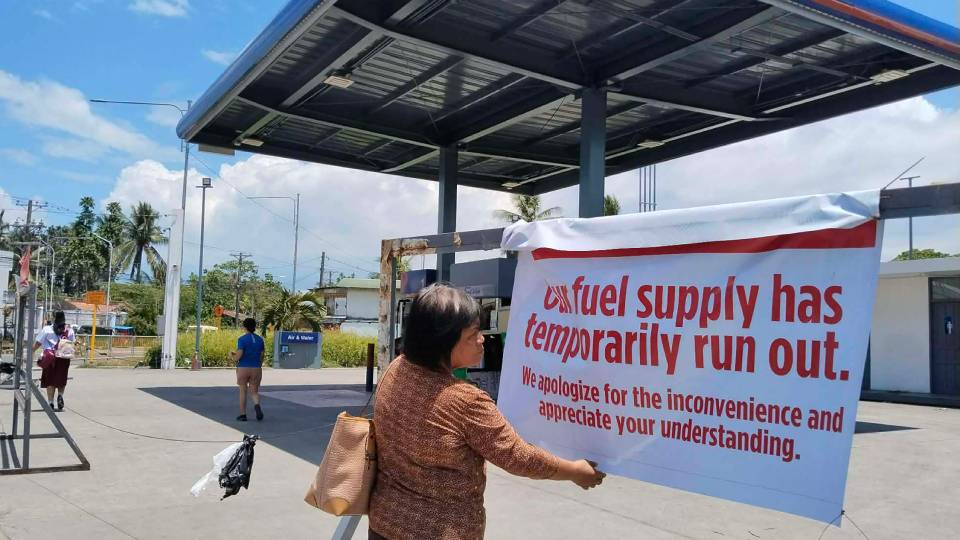
Indeed, the Philippines recently became the first country worldwide to declare a national energy emergency. Roughly 95 to 98 percent of the Philippines’ oil must navigate the Strait of Hormuz—making it extremely and alarmingly dependent on safe passage. On March 24, the Philippine energy secretary estimated that Manila’s petroleum supply would only last the next 45 days.
President Ferdinand “Bongbong” Marcos isn’t taking any chances. He declared that his nation would reduce its work week to four days to ration fuel. In the meantime, the Philippines is actively seeking both crude and refined oil supplies. The reality is that crude, while less expensive, would then have to be refined at Manila’s one and only refinery, Petron Bataan, and this facility can only process roughly 180,000 barrels a day or 30-40 percent of national fuel demand. Refined oil is more expensive and thus more difficult to secure in the current environment.
To dampen the blow, the Philippines is requesting that the Trump administration grant a temporary sanctions exemption or waiver so that it can secure Russian oil for the first time in five years, and Manila is negotiating with a range of other countries, such as Indonesia, Malaysia, and Middle Eastern countries, through third-party intermediaries, to ensure continuity of its supplies. Urging his people not to panic, Marcos said: “We are exploring other sources not affected by the war…things are beginning to open up…we can be confident that after the 45 days we will have a flow of oil.” Marcos seems to be hinting at a new model for oil redistribution in the Asia-Pacific that he hopes will help the Philippines in a severe time of need.
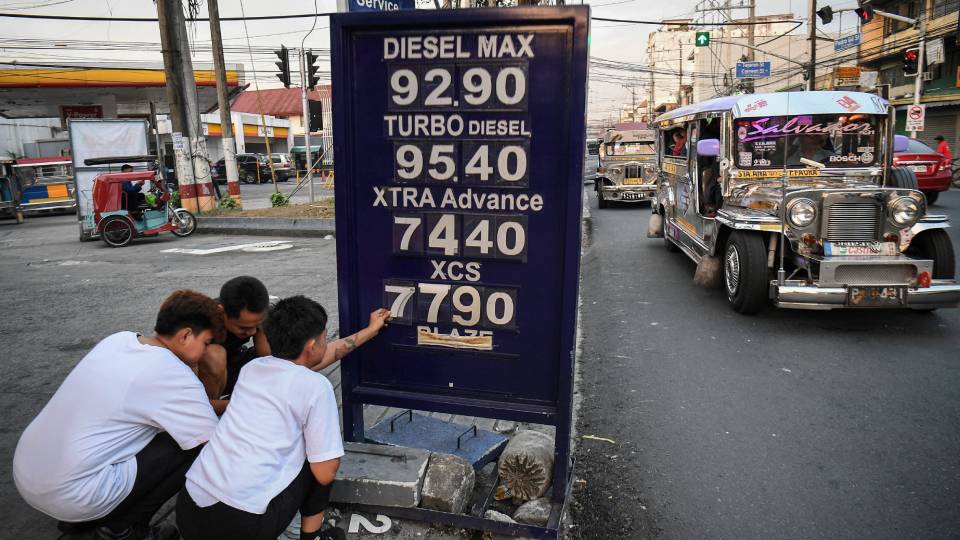
Workers change the price label of fuel at a petrol station in Manila on March 17, 2026. Photo by TED ALJIBE / AFP
A Selective Strait
Amid the blockade battle in the Strait of Hormuz, the bottom line is that any ships coming out of or into Iran may be intercepted by the U.S. Navy. However, ships transiting through the strategic channel to and from other locations may still receive both Iranian and American authorization, meaning that certain flagged ships are getting through, while others are not.
China, for example, appears to have gotten at least one of its tankers through since Washington’s implementation of a counter-blockade, probably because that ship, Rich Starry, originated from the UAE, not Iran. Generally, only nations that Tehran believes remain friendly or neutral, such as China, India, Malaysia, and Pakistan, have received clearance (others, like Japan, may follow, but this remains to be seen), and Washington has not opposed these transits.
Regardless, the blockades have severely warped the oil shipping network, empowering some countries to build their stockpiles and sell off excess supply at a higher price while less fortunate ones must negotiate deals to ensure their energy security. To be sure, the oil trading ecosystem has always been complex: even if a nation did not receive its supply through the Strait of Hormuz, which provides 20 percent of the world’s oil, it could purchase from neighboring markets and receive shipments via overland pipeline, truck, or ship. Simply put, oil resources are highly fungible—even if there might be some added cost and time for supplies to reach their destination.
A good example is how oil distribution networks naturally adapted following Russia’s invasion of Ukraine in 2022—the most substantial rewiring of global oil distribution since the 1970s. European nations, which had mostly depended on Russia for their oil prior to the war, redirected their purchases to the Middle East, Africa, and the United States after the war began. Moscow, in turn, focused more on selling to Asian nations, like China and India, and on finding ways to evade Western sanctions, such as using ship-to-ship oil transfers to mask the original supplier.
The same will eventually happen in the current conflict against Iran. All nations that are overly dependent on the Strait of Hormuz will inevitably discover new and creative ways to purchase their oil products. Trump’s recent suggestion that he might exit the conflict without forcing Iran to reopen the strategic channel adds further urgency to the need for diversification.
Indeed, Iran could establish a permanent toll at the narrowest point of the Strait of Hormuz—just 21 miles—that would fund the rebuilding of post-war Iran while causing a surge in costs for oil coming out of the strait. Therefore, redirections in oil flows are entirely necessary.
China and the Hub-and-Spokes Energy System
But until these new oil flows are established, any nation that was highly dependent on the strait and did not possess much of a strategic reserve is now scrambling for options. In the Asia-Pacific, countries like the Philippines have essentially become oil-deficient and must strenuously procure new supplies in an already stressed market. Vietnam is in a similar situation. Japan and South Korea, however, maintain healthy strategic reserves and can likely weather the storm for most of 2026, if required.
Meanwhile, China and India are getting many or most of their flagged ships through the strategic channel. This new paradigm of “haves” and “have-nots” is creating a new, albeit temporary, “hub-and-spokes” model of oil redistribution across the Asia-Pacific. Hubs are centers of either crude or refined oil supply, whereas spokes are destinations for excess supply, and though the market will eventually adjust, this emerging dynamic may result in major shifts in geopolitics not only this year, but for many years to come.
Iran’s selective blockade, and the U.S. counter-blockade, is not simply constraining supply—it is reorganizing the Asia-Pacific energy system around access, empowering a small number of intermediary states while deepening dependence among the rest.
One of the major hubs is China. For now, China has decided to constrain oil exports, further concentrating supply in the hands of a smaller number of active hubs. If China wanted to change its strategy, however, then it could easily leverage its access to the Strait of Hormuz and purchases of 90 percent of Iran’s oil supplies to great effect. Indeed, China has the structural capacity, especially in refinement, to play the role of a major hub in the future, even if it has so far prioritized domestic supply over regional redistribution. For now, its crude oil sales throughout the region are negligible, but changing its approach could pay huge strategic dividends throughout the region by making countries like the Philippines and Vietnam more dependent on China.
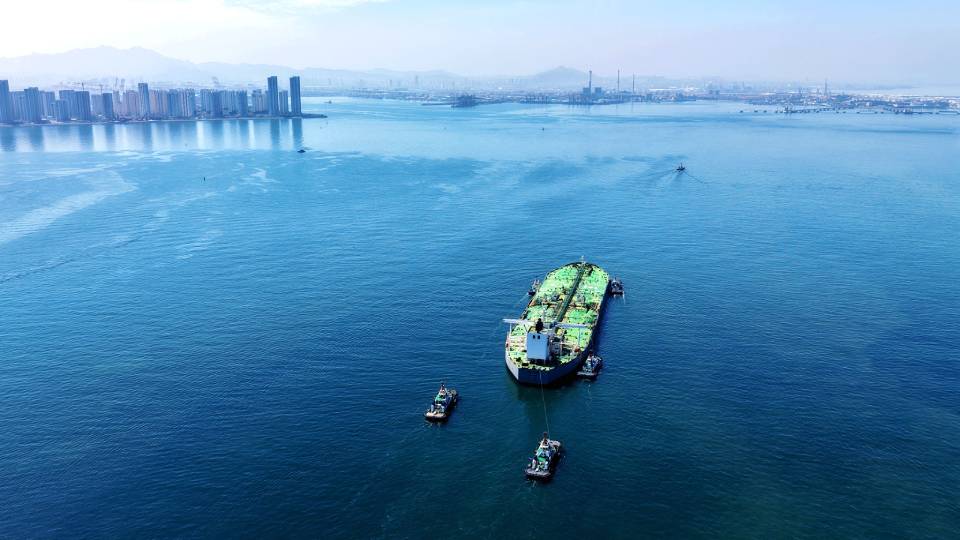
A tanker loaded with imported crude oil sailed towards the crude oil terminal of Qingdao Port along Jiaozhou Bay in Qingdao, Shandong, China on April 13, 2026. (Photo by YFP / CFoto / CFOTO via AFP)
In this context, the Philippines is clearly a spoke in search of a hub. Concerns are rising in Manila that as part of the reset in Philippines-China relations, Manila might once again pursue joint exploration with Beijing of natural resources, to include oil, in the South China Sea. Doing so might make the Philippines more amenable to Chinese sovereignty demands.
As a fellow spoke that imports up to 90 percent of its crude oil through the Strait of Hormuz, Vietnam has reportedly turned to Japan, South Korea, and Thailand as potential hubs or intermediaries for energy support. Hanoi’s challenge is that none of these nations themselves have secured Iran’s express authorization to receive unimpeded access through the Strait of Hormuz.
Japan, however, might be the furthest along in this regard, as Tehran’s foreign minister, Abbas Araghchi, agreed in principle to the idea so long as its ships are “non-hostile” and coordinate with Iranian authorities. A redirection of oil supplies from Japan to Vietnam would further strengthen their “comprehensive strategic partnership”—considered the highest level of partnership. Vietnamese leader To Lam is also currently in Beijing, where his meeting with Chinese president Xi Jinping will likely involve discussions of energy collaboration.
Another example of an emerging hub-and-spokes model for oil redistribution is unfolding in South Asia. Bangladesh recently reached out to India for access to fuel supplies that can no longer be shipped directly under Iran’s restrictions, and New Delhi has approved Dhaka’s request. Nepal and Sri Lanka are also in discussions with India on energy cooperation. Indeed, it is a good move for New Delhi to approve of these deals, mainly because providing excess supplies to Bangladesh—and to other countries in the region—would align closely with India’s “Neighborhood First” policy in which it seeks to focus first and foremost on South Asia, with a particular eye toward countering Chinese inroads in the region. Not doing so would allow Beijing to use its own strategic advantages, as a fellow hub, to elevate its influence with spokes within India’s backyard.
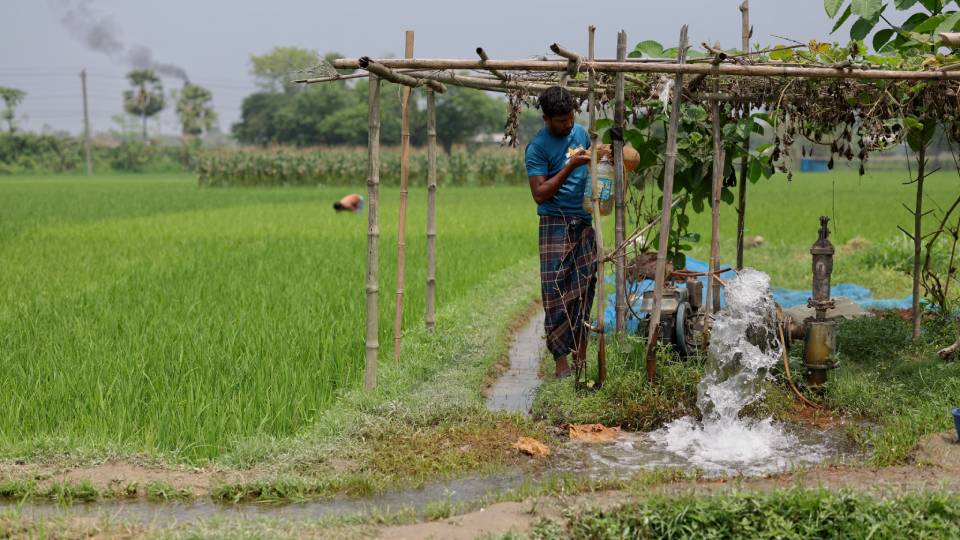
Mohammad Yusuf, a farmer, pours diesel into a bottle used as a makeshift tank while irrigating his paddy field amid a fuel crisis, in Manikganj, Bangladesh, April 8, 2026. REUTERS/Mohammad Ponir Hossain
Adjusting to the New Energy Order
Russia, meanwhile, is less a hub than a critical upstream enabler of the system. The Trump administration’s temporary waiver allowing India to continue importing Russian oil has had cascading effects, effectively sustaining the supply base that underpins New Delhi’s redistribution role. At the same time, Moscow is expanding the use of shadow fleets and ship-to-ship transfers to move crude outside formal channels, increasing the volume of oil available to intermediary states.
As the crisis deepens, it is becoming increasingly plausible that more countries will engage with Russian energy indirectly, if not openly. In this sense, Russia is functioning as a pressure valve for the global market—injecting supply into a constrained system and enabling Asia-Pacific hubs to maintain outward flows. This dynamic, however, runs counter to long-standing U.S. efforts to isolate Moscow economically.
In the end, oil flows will naturally realign. But for now, oil redistribution through hub-and-spokes will likely come at a higher cost for the consumers and a windfall for the sellers. Taken together, these workarounds show that Iran’s selective blockade, and the U.S. counter-blockade, is not simply constraining supply—it is reorganizing the Asia-Pacific energy system around access, empowering a small number of intermediary states while deepening dependence among the rest.
Derek Grossman is CGSP’s Non-Resident Fellow for the Asia-Pacific.