
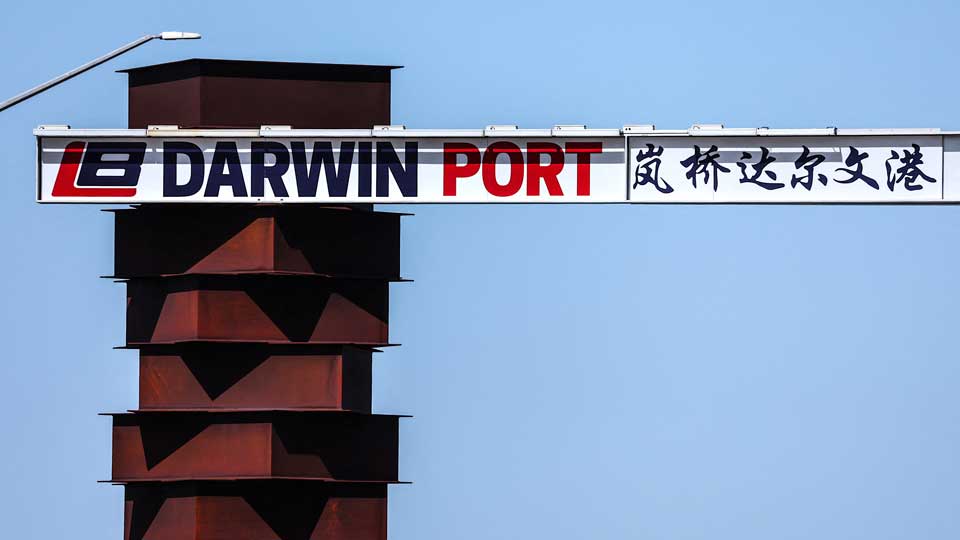
Two prominent Chinese media outlets, often seen as occupying opposite ends of the political spectrum, voiced similar concerns over Australia’s call for China to give up Darwin Port – although from different perspectives.
Caixin, a business news publication widely seen as among China’s most liberal outlets, highlighted the move’s noncompliance from a commercial standpoint, warning that Canberra’s behavior could undermine legal procedures and market confidence.
In an article published last week, Caixin said the Darwin lease is a “commercial contract involving private enterprise property rights,” once being forcibly terminated, Canberra would face more “complex legal procedures, compensation issues, and market efficiency concerns.”
For guancha.cn, a nationalist online news portal that is closely aligned with the state, the agreement is framed as a purely political decision.
The site detailed a 2023 investigation review by the Australian government that permitted a Chinese company to operate the port, and then, just two years later, the issue resurfaced by both the Conservative and Labor parties in the 2025 election.
Guancha’s title for its story, “Playing the Chinese card,” reflects the prevailing sense among policymakers in Beijing that the campaign to annul the Chinese company’s contract to manage the Port of Darwin is purely political given that it already passed a security review.

U.S. Behind the Scenes
While both media outlets expressed different concerns, they pointed to the same obvious factor behind Canberra – the United States.
Darwin, in the northern part of Australia, is seen as crucial for Asia-Pacific security. Since 2012, the U.S. Marine Corps has deployed rotational forces to Darwin for training.
These rotational forces are primarily based at Robertson Barracks, approximately 15 kilometers from Darwin Port, and the nearby Royal Australian Air Force Base Darwin.
Former U.S. President Barack Obama expressed its concerns almost immediately after the port acquisition was reached in 2015.
And, the scale of these rotations has gradually expanded over time. By 2025, the annual rotation of U.S. forces at Darwin could reach approximately 2,500 personnel, establishing Darwin as a key strategic hub for U.S.-Australia military cooperation.
In May, the American company – Cerberus Capital Management – was reported to discuss a deal with Australia’s Northern Territory government, and the New York-based entity is linked with President Donald Trump.
China: “Obligation to Take Measures”
Both Caixin and Guancha.cn quoted Xiao Qian, the Chinese ambassador to Australia, saying Beijing “has the obligation to take measures” to protect Chinese enterprises’ interests.
“Should any situation arise, such as the port being forcibly reclaimed or coercive measures being taken, we are obligated to take action to protect the interests of Chinese enterprises. This is our position.”
The Shandong-based, privately owned Landbridge Group signed a 99-year lease with the Northern Territory ten years ago. The group has no corporate affiliation with state-owned enterprises (SOEs), CGSP has found, but it has public cooperation with China National Petroleum Corporation (CNPC).
Australian Strategic Policy Institute, or ASPI, a Canberra-established think tank, said in 2015 that the Landbridge Group is allegedly linked with the People’s Liberation Army.
Xiao, the ambassador, added that Canberra’s decision was precisely at this juncture that Darwin Port turned profit last year. “This raises questions for me about [Australia’s] business ethical value,” he stated.
According to the Australian Securities and Investments Commission (ASIC), Port Darwin turned a profit in the 2024-25 fiscal year, recording a net profit of approximately $6.7 million, compared to a loss of approximately $26 million in the 2023-24 fiscal year.
In the recently concluded fiscal year 2025, the port handled approximately 25,500 twenty-foot equivalent units (TEUs) of container cargo, while its overall annual cargo throughput remained at around 4 million metric tons a year.
WHY IS THIS IMPORTANT? China’s global port acquisitions have been a defining feature of its trade expansion over the past two decades. The resistance these projects now face reflects Beijing’s broader challenges as globalisation encounters mounting headwinds. If Darwin Port is returned to Australian control, it would mark the second such reversal after the Panama Canal episode.
At the same time, as Beijing has hosted a steady stream of Western leaders in recent months amid the turbulence of Donald Trump’s policies, Canberra’s move appears out of step with this tentative diplomatic thaw. How this will affect the “Western honeymoon” with China remains to be seen.