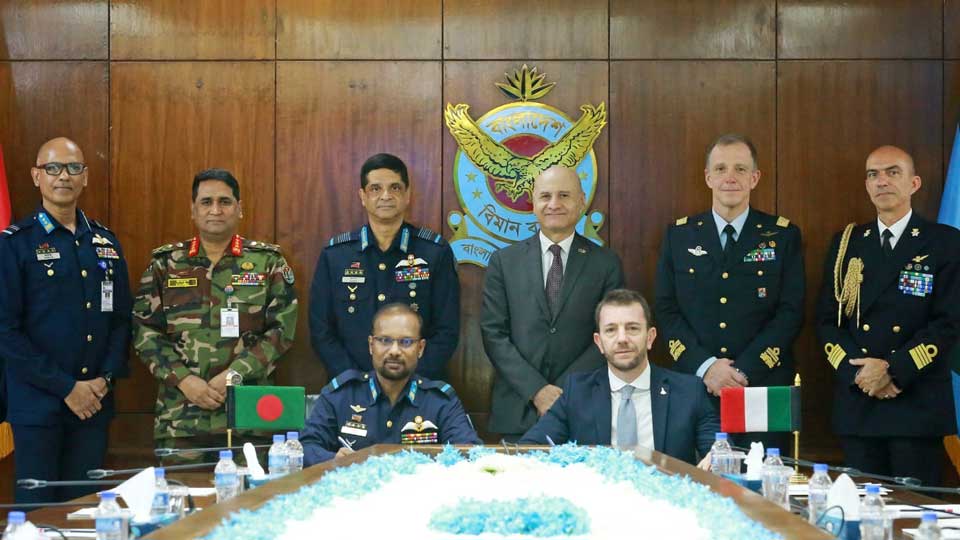
Bangladesh’s air force has quietly moved closer to acquiring one of Europe’s most advanced fighter jets. In recent days, Bangladesh and Italy’s Leonardo signed a letter of intent in Dhaka for the purchase of Eurofighter Typhoon aircraft. While neither side disclosed numbers or pricing, outside estimates based on earlier official signals suggest a potential deal worth around $2.5 billion for 12 aircraft, a striking figure for a lower-income South Asian country.
Why would Bangladesh commit such resources to an expensive European fighter, and does this signal an abandonment of earlier plans to buy Chinese jets? According to an in-depth analysis published by The Paper (澎湃新闻), a Shanghai-based media outlet known for its geopolitical reporting, the answer lies less in procurement details than in Bangladesh’s long-standing strategic anxiety over India, its dominant neighbor.
The analysis argues that Bangladesh’s geography – bordered by India on three sides and historically shaped by India’s role in its 1971 independence – has left Dhaka economically interdependent with New Delhi yet deeply wary of political and military pressure. As India modernizes its air force around France’s Rafale fighter and expands its influence in the Bay of Bengal, Bangladesh faces mounting incentives to strengthen its own deterrence capabilities. In this context, the Eurofighter Typhoon is framed as a calculated attempt to counter India’s Rafale fleet.
At the same time, the article notes that Bangladesh’s fighter decision remains far from settled. Severe budget constraints, logistical challenges associated with NATO-standard aircraft, and the availability of lower-cost Chinese options such as the J-10CE and the Pakistan-produced JF-17 Block III mean that Dhaka is likely keeping multiple doors open. Rather than choosing between Europe and China, the analysis suggests Bangladesh may ultimately seek a mixed fleet to balance military effectiveness, political alignment, and financial reality.