
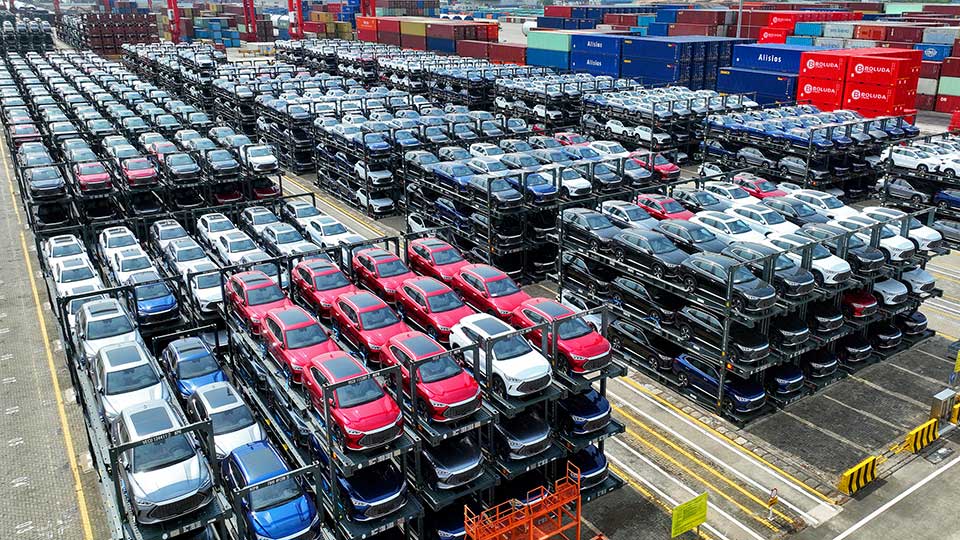
Most media coverage of Mexico’s new tariffs on Chinese goods has zeroed in on the obvious visible targets: automakers and auto parts, where duties climb as high as 50 percent. These sectors are capital-intensive, politically sensitive, and easy to frame as symbols of shifting trade policy.
A commentary circulating on a Chinese WeChat account focused on global trade argues that the real damage lies elsewhere.
The analysis points to small and mid-sized exporters of everyday consumer goods such as clothing, shoes, furniture, toys, and household items, whose business models depend heavily on U.S. consumers. Unlike automakers or equipment manufacturers, these firms lack the ability to reroute exports to Southeast Asia or the Middle East, absorb higher costs, or quickly redesign supply chains.
China’s fastest-growing export segment, new energy vehicles, has already been shut out of the U.S. by a 100 percent tariff, forcing its expansion to occur outside North America. High-value equipment manufacturing similarly relies on demand from emerging markets. Large multinational brands such as Haier, Lenovo, and TCL, meanwhile, have long diversified globally and can adjust logistics without abandoning markets.
Small exporters do not have that option. For them, losing access to the U.S. market means collapse.
The author also illustrates his points with some data. While overall Chinese exports to the U.S. have declined from 19.2% of total exports in 2018 to 14.7% in 2024, cross-border e-commerce tells a different story. More than 70% of revenue for many Amazon and independent-site sellers still comes from North America. These exports, though only a fraction of total U.S.-bound trade, sustains hundreds of thousands of small businesses and millions of Chinese households.
As a result, the commentary argues, Mexico’s tariff hike is unlikely to trigger a mass exit. Instead, these businesses are passing higher costs on through price increases, even as sales soften. The most significant impact, in this view, will not be factory closures or dramatic relocations, but a sustained squeeze on small exporters and higher prices for American consumers.
WHY IS THIS IMPORTANT? For small commodity exporters, shifting to markets in Southeast Asia, India, or Africa is not a simple solution. Local producers there are already highly competitive on price, making it difficult for Chinese exporters of clothing, shoes, and other low- to mid-end goods to maintain margins. Meanwhile, the domestic Chinese market offers little relief: small exporters are often squeezed by large platforms such as Taobao and Pinduoduo, forcing them to sell at a loss. For these firms, the U.S. market is not just profitable. It is survival.