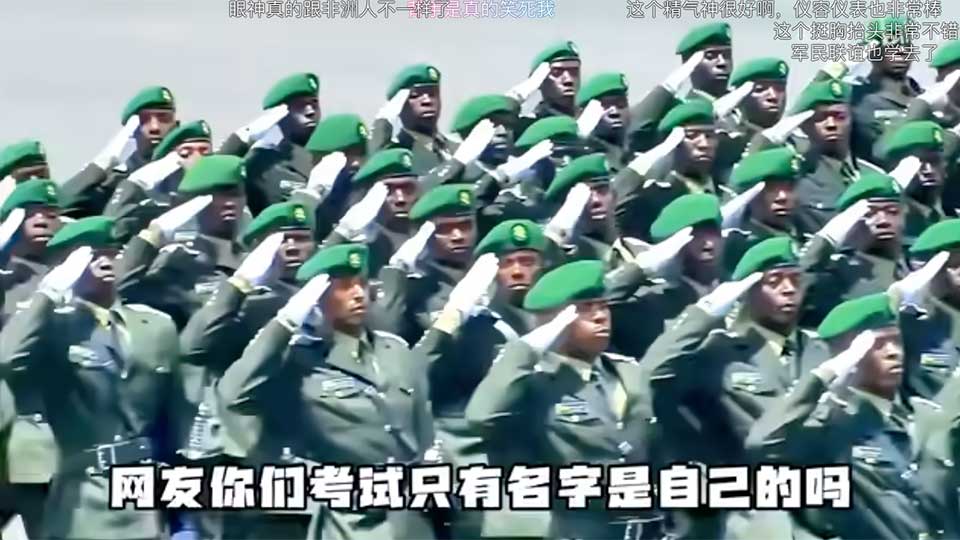
On Chinese social media, a Bilibili video has left netizens marveling at how much Rwanda’s army has come to resemble the People’s Liberation Army (PLA). The edit splices together clips of Rwandan infantry drills, martial art practices, parades, and even the hand gestures of their instructors. Every detail is modeled on the style of China’s National Defense University in Shijiazhuang.
Ahead of Rwanda’s 25th independence anniversary parade in 2019, the government invited a team of Chinese instructors four months in advance to retrain its soldiers. The marching formations, parade discipline, and choreography were designed to replicate Beijing’s standards. The video’s creator went so far as to joke that Rwandan troops, shouting commands in Chinese, even look like tanned Chinese brothers.
Fast-forward to 2025, when Rwandan-backed forces captured Goma, a strategic mining hub in the Democratic Republic of Congo. The offensive was executed with striking efficiency: supply lines cut cleanly, tactical maneuvers carried out by the book, and battlefield discipline that mirrored PLA drills. “If not for their skin color,” the blogger said, “you might mistake them for a Chinese unit conducting exercises abroad.”
Rwanda hasn’t only adopted PLA training methods and battlefield tactics. It has also absorbed the cultural side of China’s military doctrine, the blogger said. Troops run joint sports events with civilians, officers sweep streets to show solidarity with the people, and even daily routines reflect PLA traditions.
Other African armies trained by China have followed suit: in Tanzania, soldiers sing before meals, recite Mao-era “Three Rules of Discipline and Eight Points of Attention” during downtime, and fold their bedding each morning into perfect cubes—what Chinese soldiers call “tofu blocks.”
Chinese commentators note that for resource-strapped African governments, the PLA offers an attractive model. Unlike the U.S. or NATO forces, China built a world-class land army on modest budgets, a reputation cemented during the Korean War. Since 1957, the Shijiazhuang Army Command College has trained scores of African officers, producing five presidents, eight defense ministers, and hundreds of senior commanders. Many of them describe the experience as transformative, a “rebirth” under PLA tutelage.
Why is this important?: What’s unfolding in Rwanda and elsewhere is not only a story of tactics and training but of cultural export. China is embedding its military ethos across Africa. For Beijing, this amounts to soft power by way of hard power: a slow-motion remolding of African armies in the PLA’s own image, with long-term implications for how military influence and loyalty are cultivated on the continent.