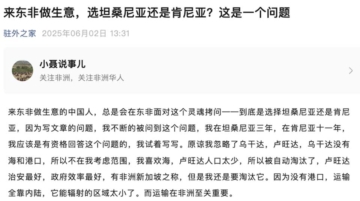

The popular East Africa-based Chinese online commentator Xiao Nie “小聂说事儿,” who chronicles daily life of Chinese immigrants on the continent, recently published an article addressing common biases about Africa’s consumer market. The piece was written in response to a flood of comments on a previous post of his about the high sales of Chinese electronic motorcycles in Africa. Many readers argued that Chinese goods are only popular on the continent because they’re cheap and of low quality, and that African consumers simply can’t afford anything better.

In the new article, the author refutes this narrow view and urges readers to look at the African market through a more nuanced and developmental lens.
While he acknowledges that affordability is the entry point for Chinese goods in places like Kenya—where many still earn modest incomes—he emphasizes that “cheap” does not mean “bad,” nor is price the only factor driving demand. In fact, a rising middle class across African countries is already seeking better-designed, more durable, and brand-recognized products, the author points out.
Key Highlights From Xiao Nie’s Post on Why African Consumers Like Chinese Products:
- Chinese products are adapting to local needs: From phones with extra-large batteries for rural users to multi-SIM options, Swahili-language systems, and toughened hardware, manufacturers are innovating for utility and reliability, not just low price.
- Market competition is real: Chinese entrepreneurs in Africa face strong competition from Indian, Middle Eastern, and Western businesses. Many are small-scale, self-funded pioneers who have to start from ground level—low price is a strategy for survival and entry, not an indication of inferior quality.
- The future is moving upmarket: As African middle classes grow, so will demand for better products. Chinese brands like Huawei, BYD, and Xiaomi are already positioning themselves for this next phase, shifting from basic trade to local manufacturing and brand-building.