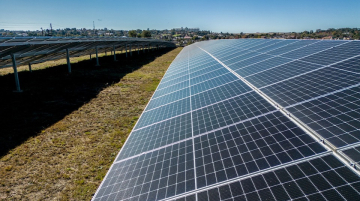

The China Energy Engineering Corp. has propositioned the Zimbabwean government for the construction of a 1,000-megawatt (MW) floating solar plant on the Kariba dam along the Zambezi River.
At nearly $1 billion, the project will be on the world’s largest man-made lake.
If the Zimbabwean government grants the proposal, China Energy Engineering Corp will install more than 1.8 million photovoltaic panels over 146 modular floating units.
Bloomberg reports that CDF Trust Ltd., Energy China Ltd., and the Intensive Energy Users Group prepared the Kariba report for Zimbabwe Power Co.
The Intensive Energy Users Group comprises big electricity consumers including mining companies. The plan for the floating solar project envisions mining operations also tapping power from the project once completed. This move to solar is targeted at helping Zimbabwe reduce its carbon emissions and crippling blackouts that have been rolling over for several hours.
Currently, Zimbabwe is producing less than half of its 1,700MW power demand. Aging coal-fired plants are underperforming while low water levels have affected hydropower generation. Due to droughts and the low inflows from tributaries feeding the Zambezi River, Kariba’s water levels have been decreasing getting to 2.68 percent of usable water in December last year.
Built in the 1950s as a joint venture between Zambia and Zimbabwe, the Kariba dam has a generation capacity of 1,050MW for Zimbabwe while it generates an estimated 1,080MW for Zambia.
Floating solar power stations are becoming increasingly attractive due to the small spaces they require.
The proposal by the Chinese company comes after Zimbabwe announced the implementation of an agreement with independent power producers for 27 solar installations. The arrangement would see the generation of a total of 1GW from the independent producers ranging from 5MW to 100MW.
The government is incentivizing investors to accelerate $1 billion 1,000MW solar projects. Independent power producers are seeking to increase renewable power generation as the freezing of funding for coal-fired power projects continues around the world as the shift from fossil fuel gains momentum.
Just recently, China Energy completed two floating solar projects in China’s Shandong Province and Thailand, according to Reuters.
WHY IS THIS IMPORTANT? More than 8 million Zimbabweans do not have access to power. Demand for electricity has surged in recent years driven by higher agricultural and mining activity.
To plug the deficit, Zimbabwe has to import power from its regional neighbors Zambia and Mozambique. The power is costly with the IMF saying that electricity shortages are among the main factors slowing down Zimbabwe’s growth.
SUGGESTED READING:
- China Dialogue: Zimbabwe’s energy policy still favoring coal over renewables by Tonderayi Mukeredzi
- World Resources Institute: What’s After Coal? Accelerating China’s Overseas Investment in Renewables by Ziyi Ma and Yu Ma