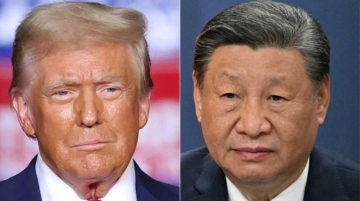
The increasingly acrimonious U.S.-China relationship is the defining trend of this era, upending global politics, economics, and security, especially across the Global South. Countries that have worked hard to avoid having to pick sides in this new competition may no longer have that luxury as this rivalry intensifies.
Jane Perlez, a Pulitzer Prize-winning journalist and a former longtime China correspondent for The New York Times, has been covering this story since the 1980s. Now, together with acclaimed Harvard University China scholar Rana Mitter, she’s launched season 3 of her award-winning podcast, Face Off: The U.S. vs. China, in which they explore the key trends reshaping ties between these two powers.
Jane joins Eric from Sydney to discuss the forces driving this rivalry: leadership personality, domestic pressure, technological competition, and the tightening link between geopolitics and economic strategy.
📌 Key topics explored:
- How China defines and uses foreign aid
- Aid vs development finance in China’s system
- The role of Chinese development banks
- Myths around “free” Western and Chinese aid
- Aid as diplomatic influence
- China’s engagement with regional blocs (AU, ASEAN)
- What China’s aid strategy means for the West
Show Notes:
- Time: In Trump-Xi Face-Off, a Clash of Personalities by Jane Perlez
- Podcasting News: Face-Off podcast returns to explore rising tensions between China and US
- Council on Foreign Relations: Reporting from China, With Jane Perlez
About Jane Perlez:

Jane Perlez is a former longtime foreign correspondent for The New York Times. She was the Beijing bureau chief and correspondent for The New York Times from 2012 to 2019. Before that, she served in Pakistan, Indonesia, Poland, Austria, and East Africa. She was part of the reporting team that won the 2009 Pulitzer Prize for its coverage of Afghanistan and Pakistan. From 1998 to 2001, she was Chief Diplomatic Correspondent based in Washington, DC. Perlez is now producing and hosting the award-winning podcast Face-Off: US vs China. She is a fellow at Harvard Kennedy School, where the podcast is based. Her colleague, Rana Mitter, a distinguished historian of modern China, joins Ms Perlez in every episode. Now in its third season, the podcast aims to deliver informative and engaging discussions for a non-specialist audience. She has made two other podcasts on China and the U.S. Perlez graduated from Sydney University with a BA (Hons). She first visited China in 1967 during the Cultural Revolution on a trip organized by the National Union of Australian University Students.
Transcript:
ERIC OLANDER: Hello, and welcome to another edition of the China Global South podcast, a proud member of the Seneca Podcast Network. I’m Eric Olander. Today, we’re stepping back from our Global South coverage to examine the U.S.-China relationship, in part because it is shaping every aspect of China’s engagement in the Global South. As we look ahead to 2026, this will be the story of the year, and everyone is in a reactive mode. We discussed this on the show a couple of weeks ago: how Australia is coping. We’ve talked about middle powers.
And obviously, on our Africa program, it’s been a consistent theme of how do countries respond to this ever-changing great power competition. Today, we’ll examine the leaders and key issues shaping the U.S.-China relationship from a Global South perspective to understand it better. We’re bringing back one of our old friends on the show, Jane Perlez, host of Face Off: U.S. versus China. This is a fascinating podcast series, now in its third season, that offers a close-up look at the similarities and differences between these two powers in the current era of great-power competition. Season three does not disappoint. So far, we’ve had episodes looking at Trump and Xi and the personalities of these two leaders.
Another show was about how young Chinese are burning out. Lots of similarities to what we’re seeing in terms of Gen Z frustration, not only in China, not only in the U.S., but across the Global South. Gen Z is frustrated, but we don’t hear about as much coming from China.
And then, of course, another show on the new arms race between the U.S. and China, along with very interesting discussions about the rise of robots there as well. If the name Jane Perlez sounds familiar, well, it should. Jane spent more than 30 years as a foreign correspondent for The New York Times, including seven years in China, where she was also the Beijing bureau chief.
She was also bureau chief in Islamabad, Jakarta, Vienna, Warsaw, and in East Africa. Jane joins us today on the line from Sydney. Good afternoon, and welcome back to the program, Jane.
JANE PERLEZ: Good afternoon to you, Eric, and it’s such a pleasure to be here. And I look forward to our conversation.
ERIC OLANDER: It’s wonderful to have you and congratulations on another season of Face Off. Before we get into the specifics of the different shows and some of the issues that you unpack, I want to get a sense from you about how the narrative of both the podcasts, now in its third season, has evolved as the U.S.-China relationship has evolved. What is the through line in this season that might be different than what you did in seasons one and two?
JANE PERLEZ: Well, we’ve been fairly consistent, actually, Eric. I try to construct a menu of shows, if you like, in a season that appeals to a broad swathe of people, people who don’t know that much about China, but are curious, and that we can pique their interest in a way that might not otherwise be. So we have China domestically with Gen Z, as you mentioned, soft power, for example, robots, for example, but we also have China abroad.
I think one of our fascinating episodes is coming up, and I don’t think anybody’s really tackled that. And that’s China’s position in Papua New Guinea and Australia. I happen to be in Australia at the moment.
I don’t live here, but I live in New York. But the Australians have reached a football agreement with Papua New Guinea, allowing the Papuans to join the Australian league on the condition that China does not have any military presence in Papua New Guinea. So that’s an idea of China’s power abroad and how it’s affecting countries’ reactions, if you like.
ERIC OLANDER: The Pacific Islands-Australia relationship is one that we’re going to spend a lot more time next year looking at, but lots of concern in Australia about China’s growing presence in that region. A big theme of your show, and also an area that you have been looking at beyond the show, but also in some of your writing, is about the personalities of the two men at the top of the power charts. Xi Jinping and Donald Trump are two, in many ways, generational political characters, unlike any of their predecessors.
In many ways, both have had an equally transformational impact on their countries. That is, China before Xi and the U.S. before Trump looked nothing like what they do today. Tell us your interest in the personalities of these two and why that’s so central to what you’re doing, both in your reporting and on the show.
JANE PERLEZ: Well, it comes from the fact that Xi Jinping had just come to power when I started in China as a correspondent and then a little bit later as bureau chief. I first met Xi Jinping in 2012, when he was still vice president. And he came to Washington.
Everybody knew he was going to be the president of China. And there was a large State Department lunch on February 14, 2012. Joe Biden, the then vice president, and Hillary Clinton, secretary of state, were the hosts.
And the Benjamin Franklin dining room was full of all the potholes in U.S.-China relations. There was Henry Kissinger. There was Bob Zoellick.
There was Kevin Rudd, who knows China well. There was the Chinese embassy. There were a lot of businesspeople.
And everybody was wreathed in smiles from ear to ear. And it wasn’t because it was Valentine’s Day, February 14. It was because they expected Xi Jinping to be more of the same: somewhat conciliatory toward the United States, good for business, and good for developing a relationship between the two.
Well, how wrong could they be? They turned out; it was less than a year, and Xi Jinping issued Document 9, which basically said Western democratic principles are out. We’re not going to deal with anything like, God forbid, free elections or human rights.
There was a list of seven items in Document 9, which set the stage for what came later. My fascination came from seeing firsthand how wrong the Americans were in their assumptions about what Xi Jinping would be like.
ERIC OLANDER: Now, you mentioned Kevin Rudd, who is a former Australian prime minister, a former Australian ambassador to China, a former Australian foreign minister, and now the current Australian ambassador to the United States. By the way, he’s also the author of one of the seminal books on Xi Jinping, which I powered through. It reads more like a PhD dissertation than it does a compelling one; more or less, it was his PhD dissertation.
And it’s thick, it’s heavy, but it’s essential, in terms of understanding the background of Xi and where he comes from and his ideology. By the way, I should note that I’ve shared many of his insights on that with several scholars who hold very different views from Kevin Rudd’s. Understanding of Xi remains relatively shallow in that regard.
He is a mystery to many people. You mentioned that 2012 is when he made his debut in the United States. It’s been 14 years since then.
You interviewed former National Security Advisor Jake Sullivan on the show, Jake being one of the few Americans who’s met Xi in person. I want to get into the Sullivan show in a second, but I want to get a sense from you, 14 years after that engagement, of how well Americans and others understand who Xi is and how he thinks.
JANE PERLEZ: Oh, I don’t think there’s much understanding, much understanding at all. But I was very curious to learn what Xi was like in the negotiating room, given what Jake had to say about him up close. As a reporter, I had seen him many times in Beijing. I even saw him in Astana, Kazakhstan, when he introduced his signature program, then called OBOR, then became BRI, and I saw him in a tiny lecture hall.
In these public arenas, he’s quite forbidding, as you see him on television. He’s a big man, doesn’t give anything. We would be in a room in the Great Hall of the People, waiting as he was escorted in to meet the American delegations arriving.
When I say we, it would be 12 press people as a press pool, and he would stand in the middle of the room, and we’d only be about eight feet away, and he wouldn’t give us a flicker of recognition. An American politician, a British politician, or maybe a French European politician would at least sort of give a nod to the press, right? This guy just stood there like a formal robot in a way.
I was very interested to hear what he was like in the negotiation room, and I was surprised. Jake said he’s pretty relaxed. He even adopts a cool-kid-in-the-class posture.
He relaxes back in his chair. He’s in full command of his brief, of course, but he actually relates with his sidekicks on either side of him, and he seems to be a serious negotiator, which is what you’d expect, but a little bit more human than what I expected.
ERIC OLANDER: Yeah, and Jake said that he actually draws on the counsel of his advisors there in much the same way that an American president would in these kinds of negotiations. That was surprising to me as well, given that he is presented almost as an emperor, certainly in the way the Chinese media views him. He’s at the center.
Everybody else is quiet. Oh, everybody else is a minion. Is a minion, exactly, but yet it shows that he’s a much more charismatic politician in that respect and clearly has the command of the room.
You wrote in a Time article about the Time of the Sullivan podcast, and I’d like to quote from it. You said she has turned out to be the most authoritarian, most irreconcilable Chinese leader the U.S. has faced since the opening of former relations between the two countries in 1979. What’s interesting about that, and a lot of sinologists would probably agree with you, Donald Trump, though, seems to think that this is going to be a golden era of U.S.-China relations. He’s going to go there, probably, most likely in April. He’s going to be feted just like he was the last time he was in Beijing. He seems to think this is not an irreconcilable relationship and that he will get a deal.
What’s your take on how Donald Trump sees Xi and where we are in this moment?
JANE PERLEZ: I think it’s a fool’s errand to see inside Donald Trump’s head. I think we’ve seen that repeatedly. But I think Trump is fascinated by the idea of two big men.
He sees himself as a big man. He views Xi as a major figure. And I don’t want to be overly derogatory, but you could think of it as capo vi capo.
I mean, Trump is used to dealing that way in real estate situations in New York, in Queens, where he grew up. It’s this kind of big man mentality, if I can say. And I think that to Trump, it’s a golden opportunity to prove that he can meet this guy and persuade him to do whatever it is that he wants him to do.
Now, whether that will succeed is another matter.
ERIC OLANDER: And it should be noted that Trump has purged most of the China expertise from the U.S. government. There is no longer a China desk on the National Security Council. He’s disbanded the CIA’s China desks and the State Department’s China units.
Instead, he prefers to use his personal emissaries, such as Steve Whitkoff. But he does not have a strong China expertise around him to counsel him on Xi and whatnot.
JANE PERLEZ: We should say, though, just one second, Eric, that he hasn’t released Witkoff into China yet. He’s released Witkoff into the Middle East and into Russia. But we haven’t seen that happen. In fact, it doesn’t seem to be anybody that does.
Trump himself is going capo a capo with Xi Jinping.
ERIC OLANDER: That’s right. He does not have an emissary as he does for the Mideast, Africa, and for Russia, something that should be noted. Again, I want to go back to your article.
You said to the world she projects a China that is organized, hurtling towards technological success, a big, shiny bauble. He is aligning China with the global south and making inroads in the Indo-Pacific. Yet he’s causing strife among America’s allies in Europe.
But at home, his household finances are in trouble. This was one of the themes that you raised in the show in terms of the frustrations that Gen Z is having. During your discussion with your former New York Times colleague, you also discussed the parallels between the frustrations Gen Z in the United States is experiencing.
Again, showing it’s pretty striking, quite striking. Tell us a little bit more about that.
JANE PERLEZ: It’s really fascinating because when I was in Beijing, we had a young, really talented journalist and researchers in our bureau, whom I got to know quite well. Their parents were young people in their 20s. Their parents had done very well.
Many of them had been able to pay for their own apartments in the late 90s. In the early 2000s and mid-2000s, I had enough money to buy another apartment and, maybe, another condo. The parents of our young journalists are doing very well, thank you very much.
Those young people now don’t have a chance at having an equivalent standard of living. As you know, the real estate market in China is appalling. And the Gen Z, 20%, has nearly 20% unemployment.
Now, there are some parallels with the United States and other European countries, including similar unemployment levels. But it’s particularly shocking for the Chinese who have been expecting the economy to get and people’s lives to get better and better and better. So the interesting question to me is, and I’d like to know what you think, actually, is I asked Chang Che, who I interviewed for the Gen Z episode, do you think that these disaffected young people will build a coalition against Xi?
Will they form some kind of opposition? And he spent a lot of time in China and he said, I think the kindling is getting drier.
ERIC OLANDER: Yeah, I probably disagree with him on that one.
JANE PERLEZ: I think I do too, because the party’s too pervasive. It’ll never allow it to get dry. It’s not going to happen.
ERIC OLANDER: That’s exactly it. And also, I think what we saw in the examples that he gave, again, the blank page revolt, where young people at the end of the COVID lockdowns were holding up blank pages because everything else was being sent. It was so momentary.
It was very momentary. But also, it showed how quickly the party responded and reacted. It’s a very dexterous party when it needs to be.
And that, I think, also is something that’s important to note, that they read the room very well that zero COVID was not working for them anymore. And within days, they ended it. And so I think that, you know, you and I have been covering China now for a long time.
And I’ve heard over and over again over the years, number one, that the banking system is going to collapse any day now. It hasn’t. I’ve also heard again that these frustrations that have been boiling up over decades are going to somehow cause a political threat to the party.
I just don’t see it.
JANE PERLEZ: Do you know why? One of the major reasons is that the party is so pervasive. 100 million members and many of the top members of the party, not only at the national level, but at the provincial level, at the city level, all the way down, they are committed.
And now Xi has the world’s largest surveillance system. And it’s not only pervasive but also highly advanced. I just don’t see any possibility of a revolt.
ERIC OLANDER:
It would be impossible to organize any sizable group of people to do anything on social media in China because the party can detect it very quickly. So organizing ability… And not possible on the street.
Well, that’s it. What we saw in 1989 could not happen today under any circumstances. And so I think that’s where I disagreed with him a little bit.
And I think it’s easy to take some exceptional, really exceptional points and kind of string them together and say, this is a potential trend. But it is interesting. And I really respected his point of view.
But one of the themes of my coverage of China over these decades has been that, under the surface, there’s a certain degree of chaos. And that chaos has always been bubbling. And that is the nature of Chinese history.
We can examine the protests against corruption. We can look at the protests against inequality. And you can then string those together to say there will be an uprising against the party and the state.
I just don’t see it happening. But there’s a lot of frustration in China. But that’s a long distance between that and challenging the party.
I value what he said again. I want to challenge you a little bit, though, on how exceptional this is, because really, this is the first generation in the United States, in U.S. history, who’s not going to be richer than their parents. This is happening simultaneously in the West and in China.
And I think the despair that we see among young people in the U.S. who can’t get healthcare, can’t get jobs, can’t get really well-paying jobs, is very similar to what we’re seeing in China as well. The pressure is significant on both.
JANE PERLEZ: Well, it’s going to be very interesting. I’d prefer to discuss China rather than the U.S., as I’m not an expert on American politics. But I think it will be interesting to see the impact of disaffected Gen Z in the United States on Trump, given the upcoming midterm elections and whether they organize.
We’ve got two young… I don’t want to get into much American politics, but the outcomes and effects of the two Gen Zs might be quite different in the two countries. :Put it this way, the possibility that Gen Z in the United States could affect American politics is far greater than the possibility that disaffected Gen Z could affect politics in China.
ERIC OLANDER: A hundred percent. But Gen Z frustration is not limited only to the U.S. and China. We’ve seen Gen Z riots in Manila, Jakarta, Nepal, Kenya, and several other places around the world.
It is a significant trend, and I’m glad you addressed it on the show. You mentioned earlier in the program that the understanding of Xi remains very poor. And I’m curious as somebody who’s been covering China for as long as you have and who now sits outside of China looking at it, how do you assess the coverage?
Because when I was a reporter, and you and I may have overlapped a little bit in Beijing in 1995. I was with the Associated Press in Beijing. We had a large press contingent on site.
I mean, there were a lot of international reporters who were there. Today, the number has shrunk considerably.
JANE PERLEZ: Eric, you’re going into my favorite subject, but please go ahead.
ERIC OLANDER: Okay. And I remember that I would go to press briefings, you know, the foreign ministry would have these press briefings and we would have, you know, hundreds of people there sometimes. Today, I think that’s a small number.
One of my frustrations is that, as we look ahead, we don’t see a generation of journalists specializing in China. We don’t see as many, if you will, and covering China has gotten a lot more difficult. Give a few reflections on Chinese journalism and how it’s being understood in the West.
JANE PERLEZ: Well, I think that one of the big mistakes that the Trump one administration made was to expel 60 Chinese journalists from Washington and various areas in the United States in about, well, about two years into their administration. And this was done by Matt Pottinger and others who had a grudge against China. And they knew when they expelled these 60 Chinese journalists that there would be retaliation.
So guess what? In 2020, the Chinese expelled about 20 American correspondents from Beijing. Now, it’s always been difficult for American correspondents to get visas, as you well know.
The Chinese limit the number of correspondents each news organization can have. So the end result is that the New York Times, when I was bureau chief, we had eight correspondents in Beijing and Shanghai. We would love to have had more, but that’s the limit we could have.
We had eight. Now the New York Times has two. The Washington Post has a big fat zero.
The Wall Street Journal has, I think, three American correspondents. I’m not exactly right, may not be exactly right on that. But the point is that there are very few American correspondents in China.
And that’s the way the Trump administration wants it, if I can say. I think they’re not interested in having thorough coverage of China. Now, I have to say that the New York Times correspondents who were there do a great job.
Keith Bradshaw writes about manufacturing and robots and the advances right across the economy. And Vivian Wang writes about social problems, and that’s really, really hard. So I think our knowledge of China is declining at a moment when we really need to know more.
And if I can say, the Chinese are inviting some Western TV outfits, some correspondents to come for a short time. But their ability to really report is very limited. And they’re showing what I call the baubles of the Chinese economy.
You know, I have a friend from British TV who went there very recently, and she did two stories, one on robots and one on some other aspect of Chinese manufacturing. Well, that’s what the Chinese want us to know. And there’s a limit to how much you can watch great robots doing great things.
I mean, so that’s the situation where we are. And there’s no coverage, no coverage on the political situation, no coverage on how people really are really reacting to the surveillance, etc.
ERIC OLANDER: How do you respond to the Chinese frustration, the long-standing Chinese frustration about U.S. and Western coverage, international coverage of China, that it’s consistently negative, that, and again, the New York Times is often doing this where they’ll say, you know, there was a puppy show in Shanghai, everything was great, but then there’s, you know, Uyghurs are being detained in Xinjiang, you know, there’s always that hook in paragraph six.
JANE PERLEZ: That’s not quite true. Come on. Don’t you think that’s fair?
ERIC OLANDER: I mean, that’s what they will say. But you don’t think that the coverage is more balanced on the negative side?
JANE PERLEZ: No, I don’t think so. And certainly not in a story about, say, robots, are we going to say in the fifth paragraph, and by the way, the Uyghurs are being persecuted in Xinjiang, just not going to happen. China’s gotten excellent coverage over many years since, since 2000, when they joined the World Trade Organization.
They’ve been covered well and thoroughly. Their economic prowess has been well covered. We’ve also tried to address some of the human rights abuses.
So we should try to cover the ups and downs. But it’s certainly not dominated by the negative. There are people in Congress who like to say that, who by the way, I looked up just before I came on the show.
So Gallagher, right, Mike Gallagher was head of the China committee.
ERIC OLANDER: He’s at Palantir now.
JANE PERLEZ: He’s a Palantir. Gallagher chaired the committee investigating China-US relations. He’s been to Taiwan a lot, and now he’s banned from going to China because of his negative statements.
Well, that’s the Chinese prerogative. I don’t agree with it, but he can’t go to China. But I don’t think Gallagher’s ever been to China.
And there are a lot of people in Congress who are opining about China, who’ve never been to China. You don’t have to agree with a place to go there. You can go there, eyes wide open, and assess for yourself.
You don’t have to be a China puppet to go to China. You should go and have a look for yourself.
ERIC OLANDER: Yeah, I was in Washington a couple of years ago. Then I was in Hawaii with some U.S. government officials. There were many young interns who were very interested in China.
And they’re taking China studies at Georgetown and Harvard and other places like that. And I said the same thing as what you just said. I said, you should go to China.
You’ve got to see it. Have you guys ever been? And their response was fascinating.
They said, ” Oh, no, no, no, I can’t go to China. Because if I go to China, I’ll be labeled as pro-CCP. Well, it’s just absurd.
That broke my heart. Because, as you’ve pointed out, you cannot understand this place without actually going, seeing, living, touching, and smelling it. One thing I’ve noticed in Southeast Asia is that young people’s perceptions of China are changing.
And not because of the journalism, but because the Chinese have been very effective at bringing in social media influencers. iShow Speed was there earlier this year and had a strong reception. And so young people are seeing Chinese tech and innovation in their social media feeds.
They see these influencers offering a very positive, glowing view. And it’s interesting that journalism is no longer the only way people learn about China. And the Chinese are being very, very deft in using social media influencers to tell a very distinctly positive story about them.
So this new age of communication also presents challenges for understanding China.
JANE PERLEZ: Absolutely. But I just sort of want to repeat again, you don’t have to go to a country just because you agree with it. I mean, I don’t really like to dwell on it too much.
But I first went to China during the Cultural Revolution. And I don’t mention that in the United States very much because people would look at me and think, oh my God, she must be a red diaper baby, you know. And we went with it as a group of university students.
We were curious about the place. There were more conservatives in the group than people like myself who were totally neutral. I had no politics at the time and still really don’t.
So I think that was a great learning lesson. You should go to China as much as you can, because it gives you a base from which to understand and from which to look at it. If you haven’t been, you don’t really know, it seems to me, what you’re talking about.
ERIC OLANDER: And I’ll add one more thing. I’ve been studying Chinese obsessively for 40 years now. I think you have to study the language too.
You cannot talk to people and understand what’s happening. Oftentimes, without the language, it helps a lot. So I encourage everybody to study Chinese.
It’s been very, very valuable.
JANE PERLEZ: As tough as it might be.
ERIC OLANDER: It is tough. And it requires unbelievable persistence. But it is worth it.
The dividends of the rewards that I’ve gotten from speaking Chinese are just cannot be, you know, I can’t say enough about it. I’m curious about the reaction you’ve received to your shows from different parties. Have you had anyone from China reach out to share their thoughts on it?
Have you heard from anyone in the administration about their view on it? Curious to hear what the feedback is that you’re getting from these different seasons.
JANE PERLEZ: Interesting, you say that. As you know, I interviewed Zhou Bo, who is blessed by Beijing and allowed to speak with outside media outlets. You’ve probably had him on the show.
He’s very, very slick at describing the PLA and the Chinese military. And I’ve gotten reactions saying, well, why do you have somebody who’s sanctioned by the regime? But if you want to talk about the PLA, you have to talk to someone, right?
But he said, ” Oh, we had this big military parade. So, therefore, we’re being very open and candid about what we’ve got. Well, you know, that’s a pile of nonsense.
So I tried to press him also on the drones, drone parts, I should to be more specifically accurate, that China is sending to Russia for the Ukraine war. And he said, oh, these are just drone parts. It’s not helping the war.
And I said, you can’t be that naive. I thought to myself afterwards, I should have said to him, Zhou, these drone parts, these engines are not going for Cuisinart. They’re going for military use.
So it’s very hard to get him to be really honest. But on the other hand, he seemed to be impressed that we ran him for 30 minutes. I mean, he wrote to me and said, look, this is much longer than I expected.
And can you send me a copy so that I can distribute it to some of my friends? It’s very hard to get our show inside China without, you know, being able to break the firewall. I don’t know about your show.
How does your show go in China? They jump the firewall.
ERIC OLANDER: And we know I get feedback from Chinese officials who listen to it quite closely, but it’s outside the firewall. Also, we get a lot of feedback from Chinese stakeholders outside of China who listen to it. And my guess is probably summarize it and send it back in that way.
We used to be able to get a lot of Chinese scholars like Zhou Bo and diplomats. And again, like you, we run them for a half hour, 45 minutes. And when you think about it, there’s almost nowhere in the English language media that a Chinese stakeholder gets to speak uncontested for 30 to 45 minutes.
Uncontested, in the sense that Margaret Brennan had the Chinese ambassador on every two seconds she was challenging. But what about this? What about that?
I think it’s essential, as in your interview with Zhou Bo, to let them speak a bit and hear them out. And it’s not about asking every question, what about this? What about that?
What about this? We don’t have to agree with what they’re saying. You try to balance it.
It’s not easy, though, because you also don’t want to tip it into a we-said-she-said kind of thing, you know.
JANE PERLEZ: I tried to balance it, though, with my interview with Jake Sullivan. I asked Jake, “What about the purges Xi Jinping is conducting in the PLA?” This is really quite extraordinary.
What is driving this? Is it corruption or is it something else? And Jake said, I don’t know.
And I said, oh, come on, you know, the CIA must know. He said, ” Well, my clearance was taken away. But he said, I don’t know anybody in the United States, and I’ve spoken to a lot of people who really understand why Xi Jinping is doing this.
And then a couple of weeks later, he said, it’s the most critical question facing the United States, actually, the state of the PLA. And it seems extraordinary that we don’t know. But I know that someone who was in the CIA recently visited the Harvard Kennedy School and said that the PLA was so corrupt that it’s hard to imagine it as a fighting force.
Now, whether that’s wishful thinking, I don’t know. There’s a lot of speculation out there. You try and get what you can.
ERIC OLANDER: But you guys talked about this in the show as well, that Xi is looking for ideological alignment and conformity within the PLA, much the same way that Trump wants his generals to be aligned with his ideology. And again, this is face-off, US and China. We’ve had a massive purge of generals in the United States over the past six to nine months.
So again, an interesting parallel between the two, that they’re forcing their militaries into ideological alignment. And my guess is… Neither man has really served in the military.
I mean, not at all. I mean, Trump had his five deferrals for bone spurs.
JANE PERLEZ: And Xi Jinping used to go around wearing a PLA uniform when he was the assistant to the minister, the secretary of defense back in… When was it? When he first graduated from Tsinghua University.
But he’s never been in the military hierarchy at all.
ERIC OLANDER: But he does wear a military uniform in his role as chairman of the Central Military Commission when doing military events. And for example, I think he was there for the launch of the Liaoning aircraft carrier, dressed out in his fatigues and whatnot.
JANE PERLEZ: So very interesting. Interestingly, you mentioned that, because when he did the launch, fewer admirals were coming to greet him than was expected. There was considerable speculation about whether he pre-purged some of the admirals.
ERIC OLANDER: Again, it’s an interesting parallel between the U.S. and China in this very fascinating moment that you’re trying to capture for us. We’re midway through season three. What can we expect in the back half of the season?
JANE PERLEZ: Well, we can’t ignore AI, can we? So I’ve decided to do a portrait of Jensen Huang. We’re interviewing Trip Mikkel.
To be absolutely candid, we did the interview just last week. And then, of course, the decision came down on H200. So we’re going to do it again.
I’m really fascinated by this question: whether Jensen Huang is for the company or the country. He’s definitely for company. So what’s the country supposed to do when he’s for company and Donald Trump goes for the company too?
It’s a little insane. We’ll pursue that question. I think Jensen Huang is an amazing figure.
ERIC OLANDER: The H200s that you referenced, of course, are the chips that NVIDIA sells that China right now apparently is not enthusiastically embracing. And there’s a theory that the Chinese don’t want the H200s because they want to develop their own chip autonomy, but they need some of the American chips to move up the value chain in the AI race. So fascinating.
So AI is going to be a topic. What else should we expect coming forward?
JANE PERLEZ: Going to have an episode with another Chinese expert from Beijing, Da Wei, who’s at Tsinghua University. And we talk about soft power. That was a really difficult interview, Eric.
Why? Because Da Wei, for reasons I still don’t quite understand, wanted to downplay the efforts of China to project itself in a soft, soft power way. He said, that’s expensive.
We’re not going to do it the way the United States did. It was a little unbelievable to tell you the truth. But it’s an interesting conversation.
ERIC OLANDER: It is an interesting topic too. And it’s something that we cover extensively at CGSP, looking at how the Chinese are using new methods, these content sharing agreements, for example, which are incredibly effective. The junkets that they bring, academics, journalists, think tank scholars to China from around the global South, also very effective.
So they do have some very effective means, but it’s a fascinating topic.
JANE PERLEZ: And then we go to the Philippines. We talk to…
ERIC OLANDER: That’s a good one.
JANE PERLEZ: …the Philippines about how they’re being hammered by the Chinese Navy and their quandary about what to do about it. The South China Sea has been a favorite topic of mine since forever. And the Chinese are certainly not letting up.
And I have a suspicion that they’re going to win on the South China Sea.
ERIC OLANDER: What do you think? I will actually go one step farther. I would say they have already won, in that there has been no foreign or international oil exploration in the South China Sea for fear it would upset the Chinese.
I think they have changed the status quo in the South China Sea. I spoke with a Chinese military analyst a couple of weeks ago, and he was absolutely giddy over what Donald Trump is doing in the Caribbean, by blowing up the ships in the Caribbean, because he says it’s removed all pretense that the U.S. has any claim to push back on the Chinese in the South China Sea.
JANE PERLEZ: But, you know, it’s not only Donald Trump. This started back in 2015, as you probably well remember, when Xi Jinping came to the White House lawn and, you know, Obama said, oh, we’re going to ask you, we’re asking you to take down, you stop building your artificial islands and don’t do this and don’t do that. And Xi Jinping said, yes, we’ll stop doing that.
And six months later, it started all over again. And the United States took absolutely no action, no notice. Why?
Too distracted by Iraq and Afghanistan. And I think that’s been the story, basically, for the last 20, 25 years.
ERIC OLANDER: We featured extensive coverage from Kang Wu, a political scientist at Boston College, who discusses differences in how the Chinese are responding to Vietnam, which has done more island building in 2025 than China has. Yes. And how they’ve responded to the Philippines, which the Chinese frame as part of a great power competition because the U.S. role.
So no pushback on the Vietnamese, at least publicly, because they don’t see it as part of great power competition, yet extreme pushback on the Chinese, on the Philippines, who, by the way, the Philippines are not looking to extend their territory in the South China Sea just to protect their own territory lines within their own exclusive economic zone, unlike what the Vietnamese are doing. In particular, Scarborough Shoal. Scarborough Shoal and Sabina Shoal has been one of the hot points as well that we’ve been following.
Well, Jane, thank you so much. It’s a fascinating series. I always look forward to it.
I hope you’ll do season four. Are you already planning season four? Of course.
Fantastic.
JANE PERLEZ: Of course. And thank you, Eric. I’m glad that you’re a fan and we really enjoy doing it.
And I have to thank our team. We have a great team of fantastic people. Frank Zhou, our associate producer, attended a robot exhibition in Beijing in the summer and recorded an interview with a platinum blonde robot, Mr. Leo.
ERIC OLANDER: Yes. He got Leo to speak both Chinese and English. So that was fun to listen to Leo, the humanoid robot speaking.
The show is Face Off, the U.S. versus China. We’ll include a link to it in the show notes. It’s three seasons.
If you are new to the show, go back to season one because it’s just as relevant today as it was when the show started a couple of years ago. Season two also came out last year. So you can binge all three seasons.
We’re not quite finished with season three yet, but we also want to highlight my favorite part of the show: the discussion at the end with China scholar and China historian Rana Mitter. So you’ll get some perspective, a big-picture perspective. Make sure you listen to the end of Jane’s discussion with Rana Mitter as well.
Jane, thank you so much for joining us. We really appreciate it. Congratulations again on the show.
JANE PERLEZ: Thank you, Eric. And congratulations to you for the best podcast on China. Longstanding and well-informed.
ERIC OLANDER: Mutual admiration society here. Well, thank you so much. And we’ll be back again next week with another edition of the China Global South podcast.
We’re going to be wrapping up the year with Kobus and Giroux to join us for the year in review, year in preview of three top stories that we thought were the biggest stories of 2025. Looking ahead to 2026, this is our most downloaded and most viewed show of the year. We look forward to it.
So until then for me too. Oh, yes, that’s great. And so until then for the entire team around the world at CGSP, thank you so much for listening and for watching.
Receive full access to more than 5,000 articles and podcasts. Once again, that’s ChinaglobalSouth.com.