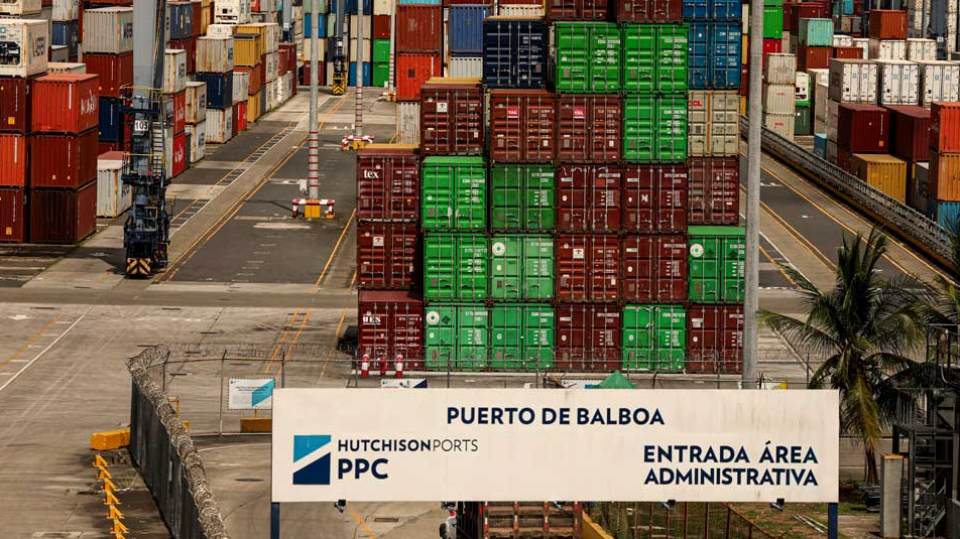
The Panamanian government formally took over the two ports operated by Hong Kong-based CK Hutchison this week at both ends of the Panama Canal. U.S. officials celebrated the move as part of their larger effort to expel China from the Western Hemisphere.
Washington has now set its sights on the Chinese-owned Chancay mega port in Peru.
But given the extent of Chinese engagement in Latin America, most notably the fact that the region does more than half-a-trillion dollars of trade annually with China, is it even possible for the U.S. to expel the Chinese?
Pedro Armada, a Panama City-based risk consultant who closely follows the U.S.-China rivalry in Latin America, joins Eric to discuss what happens next following the expulsion of CK Hutchison from the canal zone and what it means for the rest of Latin America.
📌 Topics covered in this episode:
- Panama’s takeover of Chinese-operated ports
- U.S. pressure on Peru’s Chinese-built Chancay port
- Trump’s Western Hemisphere strategy toward China
- Narrative battles and misinformation in Latin America
- Trade ties that make decoupling from China difficult
- Whether Beijing is waiting out U.S. political cycles
Show Notes:
- The China-Global South Project: The Paradox of Panama’s “Rule of Law”: Hutchison Ports vs. Minera Panama by Pedro Armada
- The China-Global South Project: Panama and the New U.S. Strategy to Counter China in Latin America by Pedro Armada
About Pedro Armada:
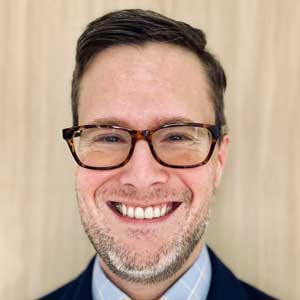
Pedro Armada is the Managing Partner of Armada Risk Consulting, a boutique firm in Panama specializing in strategic intelligence, forecasting, and capital protection. With 15 years of international experience, he advises boards of directors and family offices on strategic decision-making in high-friction markets. Previously, he served as a Director at Nardello & Co., a leading strategic consulting and investigations firm, and led external risk management for the Global Procurement department of Teva Pharmaceuticals.
Transcript:
ERIC OLANDER: Hello, and welcome to another edition of the China Global South podcast, a proud member of the Sinica Podcast Network. I’m Eric Olander. Today, we’re going to focus on the dramatic events that are unfolding in Latin America.
We’re going to talk about what’s happened in Panama this week and also recently in Peru, but I want to start today referring to a fascinating article in Politico that came out this week, Trump’s ultimatum for Latin America, it’s me or her, okay? So they start to spell out a little bit of what the strategy is behind what the U.S. is doing. Now, we got a peek at this when the national security strategy came out and said the U.S. would focus more on the Western Hemisphere, but we really didn’t understand the implications for China. Now it’s starting to become a little bit clearer. And the journalist at Politico quoted Alexander Gray, who was Trump’s National Security Council chief of staff in the first term. So he’s not in the second term, but in the first term.
And here’s what he said. The overall outlook is that you can’t defend the homeland without being predominant in the hemisphere. So you have to defend that.
And then from there, you can project power outward to focus on the other major theater of competition, which is the Indo-Pacific. It’s interesting because that is the basis of the Donroe Doctrine, which is the corollary to the Monroe Doctrine. And all of that, the Monroe Doctrine, what really came into effect after the United States expelled the British from the Caribbean, and then that led the way to the dominance of the Western Hemisphere.
There are some interesting parallels there. Now, how is this all playing out? On Tuesday of this week, Panama took control of two ports previously operated by C.K. Hutchinson, which the Panamanian Supreme Court deemed unconstitutional. These are the ports of Balboa and Cristobal. Very important to note that these two ports are not in the Panama Canal. They were on both sides of the Panama Canal, but not in it.
But nonetheless, C.K. Hutchinson has been booted out of that area of the ports. The Chinese foreign ministry reacted very strongly on Tuesday. A Chinese foreign ministry spokesperson, Mao Ning, said that China will resolutely safeguard the legitimate rights and interests of the enterprise and criticized the takeover by the Panamanians of C.K. Hutchinson. Another flashpoint that we’re going to talk about today that we also need to watch is what’s happening at the port of Chiang Kai in Peru. Now, earlier this month, the U.S. State Department’s Bureau of Western Hemisphere Affairs, they posted on X, they said that they were, quote, and I’m reading from the tweet here or the post, concerned about the latest reports that Peru could be powerless to oversee Chiang Kai, one of its largest ports, which is under this jurisdiction of predatory Chinese owners. They went on to say, we support Peru’s sovereign right to oversee critical infrastructure in its own territory.
Let this be a cautionary tale for the region and the world. Cheap Chinese money costs sovereignty. So again, some alarming developments that are happening in the U.S., China, Latin America, with Latin American countries kind of caught in the middle here among all this. So let’s try and sort out what is happening. And for that, we’re thrilled to have on the show for the first time, Pedro Armada, who’s the managing partner of Armada Risk Consulting in Panama City, where he closely follows U.S., China, Latin American engagement. And Pedro has been kind enough to join us this morning.
And also I’ll post a link in the show notes to an excellent column that he did recently for us on these issues. A very good morning, Pedro.
PEDRO ARMADA: Good morning, Eric. How are you?
ERIC OLANDER: Wonderful. Great to have you on.
Let’s start right in Panama, given that’s where you are. This is an issue that you’ve been following closely. The expulsion of C.K. Hutchinson from the ports of Cristobal and let’s see, and Balboa. We knew this was coming. Here it came. The Supreme Court ruled that it was unconstitutional.
They’d been there for 29 years. What are we supposed to make of what’s happening in Panama with C.K. Hutchinson and the United States?
PEDRO ARMADA: Yeah. Interesting question. So we did know it was coming after the Supreme Court here in Panama ruled the concession unconstitutional.
We entered a sort of legal limbo period where it wasn’t really clear how things would develop. Hutchinson was very vocal about the potential for chaos and actually made, I think, a fair point that this isn’t like handing your keys to someone. There are cranes, infrastructure, proprietary software, intellectual property, and so on.
We had heard from sources about a week ago that there was very strong pressure from the U.S. Embassy to enforce the Supreme Court ruling, certainly by the end of the year. And yesterday, in fact, everything happened in very quick succession. The ruling was formally gazetted and published in the Gazette, and an executive order issued by the president essentially directed the Maritime Authority to occupy both ports in the public interest.
That’s the language that was used, including vehicles, software, computers, programs, and anything that’s on site. I think this is the instrumentalization of a sort of U.S. tack or strategy to try to decouple, where possible, China from the hemisphere, and certainly in Panama, where they have tremendous leverage. I watched the press conference yesterday, the government press conference.
There was a lot of initial uncertainty. There was a lot of wanting to sort of calm people down and say, no, no, the workers are going to be paid. Everyone is going to be paid.
But there was also a sense of uncertainty about how things would play out. So one journalist asked the labor ministry representative and said, “Well, who’s going to pay them?” Is the government going to pay them?
And she said, well, we’re working it out. So, at the moment, the plan is for one port on the Balboa side of the Pacific to be managed by APM Terminals, a subsidiary of Maersk, for at least 18 months. And the other port on the Atlantic side will be managed by TIL, which is a subsidiary of MSC, which is sort of the other large commercial rival to Maersk.
And somewhere in that time period, the government will sort of figure out how they want to structure this and whether they want to do a new tender.
ERIC OLANDER: Okay, so what do you think the US game plan is here? Do they want to expel the Chinese entirely from Panama to the point where Chinese ships will no longer be allowed to pass through the canal? Or is it just to regulate Chinese ship transit through the canal?
What do you think the US objectives are here?
PEDRO ARMADA: I think that if you sort of go back and look at some of the, you know, the US has been, I suppose you could say, displeased about what they saw as Hutchison’s presence in these ports, you know, adjacent to the canal for some time. I think one of the chief concerns that they would bring up in policy papers and hearings was concerns about potential espionage, right? This sort of dual-use infrastructure concerns.
And then concerns that, if in some plausible future there were a conflict, that would be problematic. I suppose that you could say, the game plan is to sort of decouple the Chinese from the region wherever possible. I don’t know to what extent that’s really truly possible, even in Panama, right?
Because I think if you, if you think about this overall, and you sort of zoom out, to me, it looks like the US is notching up certain tactical victories, but ultimately failing strategically in the region. And even some China hawks in DC will kind of admit this if pressed. And then on the other side, I think there’s an argument to be made that China is sort of winning economically long term in the region, but they’re conceding certain narrative battles, like the Chiang Kai-Shek port, for example.
ERIC OLANDER: Well, let’s spend a little bit of time on this one, where you’re saying that the US may be winning strategically in the short term, but long term, or tactically in the short term, but strategically in the long term, may be suffering. Expand on that a little bit.
PEDRO ARMADA: So, I mean, I think part of the issue here is, you know, the US has sort of seen this Hutchison example as a victory, quote unquote, as it were. I think we could see that they will try to export this model as much as possible. So that’s, you know, using all of the levers at its disposal to try to sort of decouple the Chinese from the region, at least where key infrastructure is concerned, at least where things like critical minerals are concerned.
But those levers are distributed unevenly, right? I mean, they have tremendous leverage in a place like Panama, because it’s a small country, we’re dollarized, but it’s… Yeah, it’s a dollar-based economy.
ERIC OLANDER: Yeah, it’s a dollar-based economy. The Americans could just cut the dollars off to Panama, and you basically suffocate economically.
PEDRO ARMADA: They could just say, you know what, you can’t clear transactions through US banks anymore, and that would be it. But the US leverage becomes much more complicated in places like Brazil, for example, or even Peru. I’m of the opinion that it’s, you can’t, not only can you not unwind years of commercial relationships with the level of threats that we’ve seen so far, but at the same time that ultimately in pushing for, trying to force a binary choice, the US in many ways is accelerating the very type of trade diversification that presumably they don’t want.
Because countries will look at this and say, well, I mean, it’s confirming our worst fears about the United States’ reliability in the region. Maybe we should diversify our trade partners. And so you see, even in a place like Panama, where, you know, you have this Hutchison quote-unquote victory, there’s still a Chinese commercial presence.
We have the largest Chinese diaspora in Central America. China Harbor Company built the cruise terminal. A Chinese company is building a fourth bridge over the canal.
There’s a Chinese company in charge of a section of the third line of the Panama City Metro. So, there are other examples. You’ve covered some of this.
You know, Javier Mille in Argentina, right? I’m never going to do business with China, but who did they sell their soybeans to, right? Even Bukele.
ERIC OLANDER: Bolsonaro in Brazil was the same way too. Very anti-China, but yet the business kind of rolled on, even though the rhetoric was quite hostile.
PEDRO ARMADA: Even Nayib Bukele in El Salvador was very aligned with Donald Trump on many issues. I mean, there are still Chinese infrastructure projects happening there. And then, you know, so that’s the U.S. side. And then, you know, on the other side, I think, you know, as I said, there’s an argument to be made that the Chinese are sort of strategically or economically winning in a sense in the region, but they’re conceding some of the narrative.
ERIC OLANDER: Yeah. Just one point that you made about diversification of trade, we saw some really just interesting pictures this week of Lula, the president of Brazil, with Narendra Modi in India, holding hands and signing a very big critical minerals deal, rare earths coming from Brazil. And I think that is part of this de-risking strategy, maybe, of trying not to rely wholly on the United States and on China, by the way.
And so finding other partners beyond these two so that, again, if these two get into a fight, you’re not going to go down with them. Let’s shift our attention to Peru. Peru is a very different situation than Panama, again, when we talk about leverage.
So the United States issued this tweet out of the State Department basically saying, watch out, you know, Peru, you’ve got the Port of Chiang Kai is very different than the ports of Cristobal and the Panama Canal ports that C.K. Hutchinson had. This is owned by the Chinese, by Costco. This is not a concession by the Peruvian government.
So expelling the Chinese from the Port of Chiang Kai would be something cataclysmic in terms of investor confidence in Peru, because it’s basically the nationalization of a major infrastructure asset that would signal that if the Chinese went today, potentially anybody could go tomorrow. So investor confidence would probably plummet. But what is the United States trying to do in Peru?
Because the situation between Peru and Panama is very different.
PEDRO ARMADA: Yeah, very different. Although I would say I’m not certain that what’s happening here will ultimately be good for investor confidence, but that’s a separate topic, I suppose. But Peru is a very different situation.
I think my view of the Peru situation is that the United States is very, I mean, even the tweet that you read out, right? This is where I would say, for example, that China has these economic relationships, that they’re building essentially world-class infrastructure, but conceding the narrative. And I’ll give you a concrete example.
So last week, I went on Instagram, I won’t name names, but I ran into a video by a Panamanian influencer, and it’s about the Chancay Port. And in this reel, I mean, it was just, everything was either, you know, manipulated or demonstrably false, and it was very much this narrative of, here come the Chinese with their sneaky duplicitous contracts, and now they own 60% of this port and they can do whatever they want because of this court ruling, and there’s no regulatory oversight. And if you actually read the court ruling, it points out in the ruling itself that there is a lot of regulatory oversight from the National Port Authority, from the Navy, from the antitrust regulator, and so on and so forth.
This was a court ruling on a very narrow question: whether, in this type of port where it’s 100% private finance and not a concession, it’s not a public good, and the government didn’t bring in a foreign company to operate it. So the question becomes, to what extent can the transport regulator specifically regulate this sort of thing? And somehow this gets turned into, it’s predatory, there’s no oversight, and now they can do whatever they want.
And so this is what I mean by, in many ways, you could say that China is sort of winning strategically, but conceding the narrative because, you know, you invest $3.5 billion in building what is by all accounts a world-class port, and you’ve got some guy with a microphone and an iPhone putting out things with 200,000 followers, with over 15,000 views, with over 100 shares, and there’s no real effective response from Costco.
ERIC OLANDER: There’s no rebuttal. So one of the things that I think is also very important is that there are a lot of supporters of China in Peru, in part because one of the things that we saw last year in 2025 was about a 20 to 25 percent increase in exports from Peru that came out of the port of Shanghai. So Peruvians are benefiting directly from this infrastructure, and so it’s going to be a little more difficult for that kind of narrative to gain traction, given that people are actually benefiting from this infrastructure, namely agricultural exporters, critical mineral exporters, and all the things that are coming through that port.
How much traction do you think some of these toxic narratives that either may be coming directly from the U.S. or from influencers and social media more broadly will gain traction in a country like Peru, and then we can look beyond to other countries as well, where the narrative battles are playing out?
PEDRO ARMADA: It’s complex, and it’s difficult to say, but I think to some extent, to the extent that there is economic benefit, that makes it a bit more difficult for those sorts of things to gain traction. But on the other hand, you can’t leave it with a non-effective response, right? You know, you can’t wait weeks to put out a very formal statement about, you know, it’s win-win, and it’s very diplomatic, right?
I mean, you need… Nobody pays attention to that. Nobody pays attention to that.
You need teams on the ground looking at this stuff and saying, ‘No, what are you talking about?’ Of course, we own 60 percent. We invested three and a half billion dollars, right?
The alternative is that this port simply isn’t there. And look at all the economic benefits and so on. And so I think it requires an effective response.
I think it’s maybe less likely to gain traction in circles where people are benefiting. But enough of these guys with, you know, an iPhone and a microphone, and it starts to potentially change public opinion, at least in some socioeconomic circles.
ERIC OLANDER: Yeah, it’s really starting to appear that the inability and the unwillingness of the Chinese to engage in the discourse at all, in any meaningful way, substantive way, in both the Hispanic discourse and the Anglophone discourse is going to hurt them strategically. And they’re just… And this is not just in Latin America; we’re seeing it in other parts of the world as well.
I guess the part that surprises me about all of this is that I was raised in the United States, and I heard for much of my young education that people in Central and South America were always very sensitive to American intervention, given the long history of American intervention. And I guess I’m surprised that, here we are in a period of renewed American intervention in this region, and it’s not provoking a backlash against it. In fact, one of the things that we’ve seen now in Chile, Bolivia, Argentina, obviously with Millet, and now Honduras as well, is a right-wing shift into the pro-Trump, pro-American ideology.
And I guess I’m just surprised this hasn’t sparked a stronger reaction from the left in a region where the left has traditionally been very active.
PEDRO ARMADA: That’s a fair point. I mean, I think, like I said, you know, in Panama, I think if you speak to people here, they’ll say, you know, there’s concern. There’s concern about how this will be perceived.
There’s concern about both the practical side in terms of the effectiveness of the transition and how these logistical nodes are going to function, because ultimately this can cascade very quickly if it doesn’t go well into the rest of the economy here. But also concerned about how this leaves us in terms of the rule of law. But also, on the other hand, you know, people will say, well, you know, maybe there’s a case to be made that they should have looked at this contract.
But at the same time, what can we do, right? I mean, if it’s the United States, what can we do, right? What’s interesting is that I think there is another case.
So it has nothing to do with ports. But in 2023, there was an issue not dissimilar to this involving a copper mine in Panama. So this is a copper mine run by First Quantum Minerals, which is a Canadian firm.
And the government approved the concession in 2023. There was significant social unrest because of environmental issues and the structure of the contract and the perception that this was kind of done quickly and not beneficial to the country. Indigenous groups got involved.
Unions got involved. Ultimately, there was a Supreme Court case. And the Supreme Court struck down the concession using much the same arguments that they did in this case.
It’s not in the public interest. It’s a violation of territorial sovereignty and so on. But in contrast, the copper mine is sort of in a stasis and everyone pretty much knows or has a sense that the government is going to find a way to reopen it, probably in short order.
But, you know, this case, I mean, if you went on social media or looked at the comments on the articles yesterday, a lot of it was, well, why one case and not the other? And I think then it becomes kind of, you know, it’s interesting and becomes kind of clear when you think about it. So one thing is that one of the largest individual investors in First Quantum Minerals is actually Jiangxi Copper, right, which is a Chinese copper company.
But the rest of it, the bulk of it, is U.S. institutional investors. And so I don’t know. It’s an interesting contrast.
But I think ultimately we sort of feel that we’re, and this is probably not uncommon in the region, as we sort of feel that we’re kind of stuck between both of these parties.
ERIC OLANDER: I think that’s a, yeah, that is definitely becoming increasingly apparent. In preparation for our discussion today, I reached out to a friend who’s a Chinese journalist covering Latin America. And I asked for his take, and he’s in Beijing.
And I said, and I was getting curious about the Chinese response. And he said something very interesting that I’d like to get your take on. He said that there’s a sense in among some policymakers in Beijing and think tank circles that, yes, the U.S. is huffing and puffing right now about Latin America, but they’ve done this in the past before. They feel like they’ve seen this before. And every single time it happens, the administration gets distracted by a war in South Asia or a war in the Middle East. And he pointed to the fact that the United States now has more military hardware deployed in the Persian Gulf than at any point since the 2003 Iraq war.
And so there is a sense that with the midterms coming that may not go Donald Trump’s way with more foreign policy quagmires potentially sitting ahead of the Americans, they’re going to lose interest in Latin America again. Okay. This has been a long pattern of the United States.
And so there’s a little bit of a sense in China of like, hold on, calm down. Let’s just see how this kind of plays out. And again, right after the U.S. intervention in Venezuela, everybody was screaming and saying this is a big setback, a strategic failure for the Chinese. And yet, what did Donald Trump do? He said they can continue selling oil to the Chinese. And so it really wasn’t as big of a strategic setback as many had forecasted.
I’d be interested to get your take on that, if that maybe the Chinese strategy is to let and see this play out. Again, U.S. political cycles work in very different sync than Chinese political cycles do. So maybe they can wait two or three years to see if they can wait this out and a new administration won’t be anywhere near as interventionist as Donald Trump has been.
That was the vibe of what he was saying. I’d be interested to hear your take on that.
PEDRO ARMADA: Right. No, that’s certainly possible. I think part of it is the political cycles work differently.
Right. And so that gives sort of the Chinese side a bit of the advantage of strategic patience, as it were. I think it wouldn’t be unprecedented for the U.S. to become distracted, particularly as we approach the midterm elections. And, you know, I think on the other hand, you could make the case that the issue of of China as a sort of, you know, quote, unquote, national security concern is pretty much bipartisan. But you could also make the case that even though there was a piece the other day, I can’t remember if it was the New York Times or the Wall Street Journal, but the gist of it was essentially that the argument that tariffs aren’t necessarily going away because they create constituencies that, you know, have benefited. And, you know, there are people on the Democratic side who are sort of moving away from this sort of postwar consensus of trade, peace through trade and open trade, which we’ve lived under for so many decades.
Whether that’s true or not.
ERIC OLANDER: Well, Biden kept a lot of the China tariffs in place after Trump. So there is a part of the Democratic constituency that does like these tariffs. And as you pointed out, among the very few things that Democrats and Republicans agree on in Washington, slapping China is pretty much one of the only things.
And so there is some consensus there.
PEDRO ARMADA: Right now, whether the approach under a theoretical Democratic administration would be the same my way or the highway. And if you don’t do it, I’m going to tariff you or I’m going to threaten to take your canal or whatever the case might be. Probably not, I suppose.
But, you know, maybe we’ll see a more constructive approach. I mean, I think that’s part of the tragedy of the U.S. approach is precisely that it’s so shortsighted, right? Because they had a stronger hand to play.
ERIC OLANDER: What do you think expelling China from the Western Hemisphere actually means when this is a relationship that the Chinese have, to the tune of about half a trillion dollars a year in trade? In fact, several South American countries have China as their largest trading partner. We just saw the president of Uruguay in Beijing.
And this could be, and Lula as well. And not only is it a major source of trade, but it’s a growing source of investment. Very important to note that the U.S. is a much larger investor in the Western Hemisphere than China is. But on trade, China is the big player. Untangling that would be next to impossible, in part because private enterprises do much of this trade. And you would have to force country by country to say you cannot trade with China, which seems impractical and impossible by today’s standards.
But then again, we didn’t expect a lot of what’s happened in 2025 to be possible. So I don’t know. But what’s your take on untangling this trade relationship, if that’s what the Americans want to do, if it’s even possible?
PEDRO ARMADA: I don’t see it as entirely possible for the reasons that you outlined. Not only is there significantly more, not only is there you know, there’s the quantum of investment, and there’s all those industries, but there’s quite a lot of. And actually, you covered this as well.
Right. With the episode earlier this month on Belt and Road investment globally, it was up 48% in Latin America between 2024 and 2025. Not evenly distributed.
A lot of it was Brazil, but still more diversified, different sectors, and so on. But on the trade side as well, I mean, again, look, even in you look at motor vehicles, right? Motor vehicles in Panama, I think the market share now of Chinese brands is almost 40%.
And if you went back to 2018, it was maybe less than five. So just tremendous growth in trade on the part of private enterprise. I don’t think that that’s really entirely possible to untangle.
Now, look, the US could kind of go ballistic and say, well, we’re going to impose secondary sanctions on anybody that pays, I don’t know, Huawei or something like that. But that would be, I think, even more shooting yourself in the foot, right? Because it’s just kind of outright economic warfare.
You’re potentially accelerating the dollarization. So I think there’s a point past which that sort of becomes self-defeating, you know? So yeah, that’s sort of my take.
ERIC OLANDER: Yeah. Very quickly, I just want to get your take on a fascinating column that was written in the Brookings Institution website by Henrietta Levin, who is an analyst, a China analyst at the Center for Strategic and International Studies. And she wrote, if this contestation between the US and China in Latin America and the Caribbean distracts Washington from competing in regions more important to Asia, more important to Beijing, Asia foremost among them, Chinese officials will likely conclude they are coming out ahead.
And I think this goes back to one of your earlier points on tactics versus strategy. That is, the US could actually get bogged down in the Western Hemisphere if it pursues this so aggressively. Meanwhile, taking resources away from a much more strategically important region for the Chinese, and to some extent, even the Americans, which is out here in Asia.
So, a flip of my earlier question of the US getting distracted and leaving, there might be a scenario where the US doubles down and gets even more engaged in Latin America, but then takes its eye off the ball elsewhere around the world. What do you think of that as a forecast and what Henrietta’s saying?
PEDRO ARMADA: Well, it’s so interesting because I think, you know, if you look at Latin America, a lot of countries here sort of felt for the last 15 odd years that they had been kind of ignored precisely because the US wanted to pivot into APAC, right? And so now we’re sort of, you know, renewed focus, but in this kind of very aggressive way. And so there is that sentiment of like, look, you have to come with something constructive, right?
You can’t just sort of say, I forget you for, you know, X amount of time and then come back and say, well, now it’s my way or the highway, right? Again, you know, entirely possible, right? That they sort of over-focus in one place and neglect other places.
There’s certainly historical precedent for it.
ERIC OLANDER: What are you forecasting? What are you telling your clients about the rest of 2026 in terms of this US-China duel in Latin America? What should we expect?
PEDRO ARMADA: I think that people need to start thinking, particularly if they’re involved in large infrastructure projects or large investments, they need to start thinking about the geopolitical angle. I think they also need to be conscious that, in Latin America, the question is often not what the black-letter law says. The question is, who decides on enforcement?
How is it enforced? When is it enforced? And why is it enforced at that particular time?
And that’s a lot more to sort of manage and map out. I think you need to be aware of your stakeholders. And I think you need to start thinking about how things might develop and take that as a jumping-off point to plan out potential contingencies, maybe diversification and investments, et cetera, because it’s going to be a bumpy ride.
ERIC OLANDER: It’s going to be a bumpy ride. I think that’s for sure. Well, Pedro, thank you so much for your time today and your fascinating insights.
And again, we’re going to put some of Pedro’s writing in the show notes, and so you can follow what he’s doing. Pedro Armada is the managing partner at Armada Risk Consulting in Panama City, where he closely follows US-China engagement in Latin America. Thank you so much for joining us today.
Thank you, Eric. It was a pleasure. And I want to thank everybody else for joining us, and thank you for watching and for listening.