U.S. War Against Iran Gives Beijing Intelligence Dividend
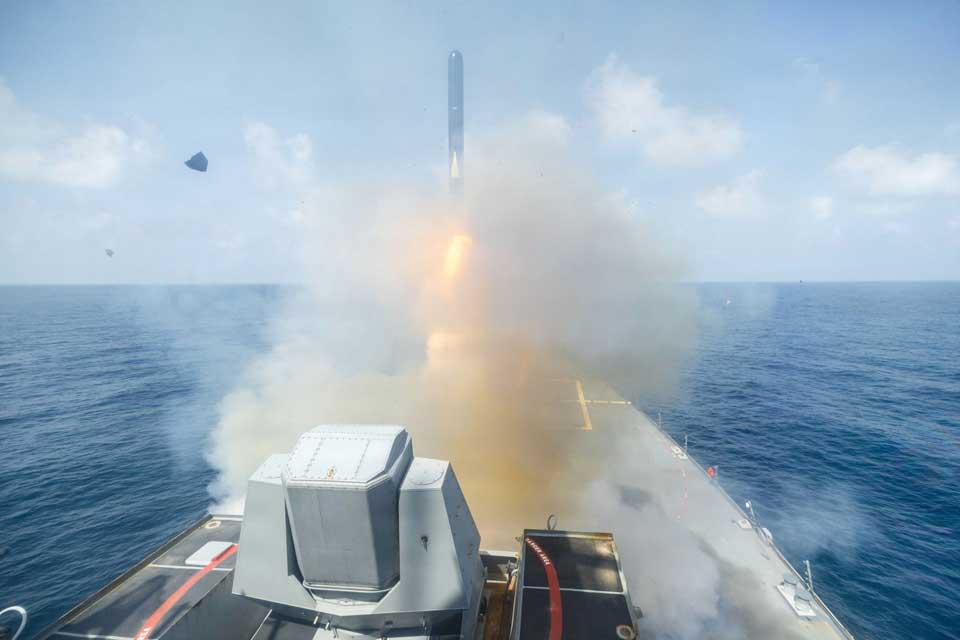
Arleigh Burke-class guided-missile destroyer USS Spruance fires a Tomahawk Land Attack Missile in support of Operation Epic Fury, at an undisclosed location, February 28, 2026. U.S. Navy/Handout via REUTERS
By Sophie Wushuang Yi
Operation Epic Fury has given Chinese military planners something no simulation can replicate: a live stress-test of American high-end warfighting capacity in a prolonged, high-intensity conflict against a determined regional power. The more consequential question is not whether the US can strike Iran — it plainly can — but what the campaign reveals about the sustainability of that power over time, and what those lessons mean for a contingency closer to home.
The sinking of IRIS Dena off Sri Lanka by a U.S. Navy submarine — the first US submarine torpedo kill since the Second World War — made headlines.
The Islamic Republic of Iran Navy destroyer had just completed India’s MILAN 2026 exercise; Iranian officials described her as unarmed, which the U.S. Indo-Pacific Command (INDOPACOM) disputed. India’s equivocal response to the campaign — declining to censure Washington despite the proximity to its own naval exercises — illustrates Beijing’s long-held argument that partners prioritize self-interest when stakes are high.
U.S. Central Command (CENTCOM) reported over 1,000 Iranian targets struck on 28 February and more than 12,300 as of 2 April. In retaliation, Iran has launched hundreds of ballistic missiles and thousands of drones at U.S. bases and Gulf states across nine countries.
U.S. Secretary of State Marco Rubio noted the asymmetry: Iran produces over a hundred offensive missiles per month; the U.S. manufactures only 96 Terminal High Altitude Area Defense (THAAD) interceptors per year. The June 2025 Twelve-Day War alone consumed an estimated 100-150 THAADs — some 30 percent of the entire U.S. stockpile — and at that rate, half the inventory would be exhausted within four to five weeks of sustained combat, according to CSIS. Offensive munitions are depleting equally fast: over 400 Tomahawk cruise missiles were expended in the first 72 hours of Epic Fury — 10 percent of the entire U.S. inventory — prompting a pivot to cheaper Joint Direct Attack Munitions (JDAMs, which are kits that turn “dumb” bombs into more precise GPS-guided ones).
A CSIS study warns that a Taiwan contingency could exhaust US long-range strike munitions within three weeks. Drawing down THAAD components from South Korea — over Seoul’s reservations — reduces assets protecting ROK forces still further. Beijing’s restrictions on rare earth minerals — critical to F-35s, missile guidance, and radar manufacturing — extend US recovery timelines further.
U.S. allies in Asia are watching whether Washington can sustain such an operational tempo and drain on munitions inventories across two theaters.
China has provided humanitarian aid to Iran, not weapons, but this has nonetheless shaped how Tehran fights. Beijing granted Iran full military access to its BeiDou satellite navigation system in 2021 — experts assess it may now be guiding Iran’s strikes.
Chinese components have been found in Iranian drones. In March 2026, two Islamic Republic of Iran Shipping Lines (IRISL) vessels departed China’s Gaolan Port, probably carrying sodium perchlorate — a key rocket fuel precursor. Unverified reporting suggests China’s HQ-9B surface-to-air missile (SAM) systems failed to intercept U.S.-Israeli strike packages — a performance question Beijing will study closely.
Whether the shortfall reflects technical limits or saturation by coordinated salvos, the system anchors China’s own coastal air defenses, making Iran an important testing ground.
Iran’s strategic fate matters to Beijing beyond the battlefield. The relationship is not an alliance — China’s partnership with Tehran has been primarily transactional, built around energy and infrastructure. But Iran anchored China’s Middle East positioning. Its dismantlement at low US cost signals to China’s partners that economic partnership without military backing offers no protection. Wang Yi’s pointed criticism of Washington reflects a recognition of this dynamic, not ideological outrage.
For countries hosting U.S. military bases central to any Taiwan Strait contingency, the Iran parallel is operational. Within hours of the opening strikes, Iranian missiles and drones targeted Al Udeid in Qatar, Ali Al Salem in Kuwait, the US Navy Fifth Fleet headquarters in Bahrain, and Al Dhafra in the UAE — every significant US forward platform in the region was struck simultaneously.
The Pentagon’s 2025 report confirms the PLA Rocket Force has spent a decade building an arsenal for an identical opening salvo across the First and Second Island chains. The DF-26 — the ‘Guam Killer’ with a range of up to 5,400 km — places Kadena Air Base in Japan, the nine Enhanced Defense Cooperation Agreement (EDCA) sites in the Philippines, and Andersen Air Force Base in Guam at risk. China’s second-strike nuclear capability raises the escalation threshold Washington and its allies would face in a Taiwan contingency.
U.S. allies in Asia are watching to see whether Washington can sustain such an operational tempo and the resulting drain on munitions inventories across two theatres. Manila has signed the Acquisition and Cross-Servicing Agreement (ACSA) and the EDCA with Washington, with the nine sites hosting American troops. Japan hosts the largest concentration of U.S. forward-deployed forces in the Indo-Pacific; Kadena and Misawa lie directly in range of PLA rocket artillery.
With roughly a third of U.S. Navy ships in the Gulf and Tomahawk deliveries to Japan already behind schedule, the question for Manila and Tokyo is no longer whether Washington would honor its mutual defense treaty commitments, but whether it could do so while simultaneously engaged elsewhere. In a Taiwan Strait contingency, the opening phase would be measured in days.
What the campaign provides Beijing is an intelligence dividend: evidence of American lethality pitted against real questions about offensive and defensive munitions sustainability, interceptor production ceilings, and the basing hesitancy of U.S. partners.
Depleting THAAD stockpiles, the rapid drawdown of Tomahawk magazines, Manila’s insistence that EDCA sites not be used for offensive action, and New Delhi’s restrained posture tell Beijing considerably more than any simulation could.
Some Chinese analysts argue that THAAD’s redeployment to the Gulf and any weakening of the US presence in the Asia-Pacific work to Beijing’s advantage over Taiwan. Yet military opportunism has a ceiling: PLA institutional restructuring, economic exposure, and nuclear escalation risks constrain Beijing’s options, and any mobilization would be as visible to U.S. intelligence as the U.S. carrier and bomber build-up that preceded Operation Epic Fury was to observers.
In addition, the Iranian regime has proven far more resilient than expected, which underscores the truism that countries that wage war should assume it is against an intelligent and highly adaptable adversary. Several days after Trump declared the war against Iran ‘nearing completion’, two US aircraft — a F-15 Strike Eagle and an A-10 Warthog — were shot down.
Tehran is now threatening to extend its maritime blockade to the Bab el-Mandeb. Beijing has consistently stated that peaceful reunification is its preferred option and military means a last resort. Sun Tzu’s counsel of subduing one’s adversary without fighting remains the wiser path.
Sophie Wushuang Yi is a Postdoctoral Teaching Fellow at the Schwarzman Scholars Program at Tsinghua University.
This article originally appeared on Fulcrumand was republished here with the permission of the ISEAS-Yusof Ishak Institute.
The Pentagon, specifically its Africa Command, or AFRICOM, has become the U.S. government agency that most consistently speaks out on China-Africa issues. As a whole, the Trump administration doesn’t seem very interested in ...
The top commander for U.S. forces in Africa (AFRICOM), General Stephen Townsend, thought it would be a good idea to re-surface the old trope that China is looking to build a new military ...
We all woke up to a different world today with the shocking images of Monday’s bungled U.S. evacuation from Kabul still overflowing our social media feeds and this nagging feeling that something big, ...
The story of China in the Global South has always carried a frisson in the West. A large part of that feeling has to do with China’s size, the way it simply doesn’t ...
What is The China-Global South Project?
Independent
The China-Global South Project is passionately independent, non-partisan and does not advocate for any country, company or culture.
News
A carefully curated selection of the day’s most important China-Global South stories. Updated 24 hours a day by human editors. No bots, no algorithms.
Analysis
Diverse, often unconventional insights from scholars, analysts, journalists and a variety of stakeholders in the China-Global South discourse.
Networking
A unique professional network of China-Africa scholars, analysts, journalists and other practioners from around the world.
We use cookies on our website to remember your login status and manage your subscription access. By clicking “Accept”, you consent to the use of ALL the cookies.
This website uses cookies to improve your experience while you navigate through the website. Out of these, the cookies that are categorized as necessary are stored on your browser as they are essential for the working of basic functionalities of the website. We also use third-party cookies that help us analyze and understand how you use this website. These cookies will be stored in your browser only with your consent. You also have the option to opt-out of these cookies. But opting out of some of these cookies may affect your browsing experience.
Necessary cookies are absolutely essential for the website to function properly. These cookies ensure basic functionalities and security features of the website, anonymously.
Cookie
Duration
Description
cookielawinfo-checbox-analytics
11 months
This cookie is set by GDPR Cookie Consent plugin. The cookie is used to store the user consent for the cookies in the category "Analytics".
cookielawinfo-checbox-functional
11 months
The cookie is set by GDPR cookie consent to record the user consent for the cookies in the category "Functional".
cookielawinfo-checbox-others
11 months
This cookie is set by GDPR Cookie Consent plugin. The cookie is used to store the user consent for the cookies in the category "Other.
cookielawinfo-checkbox-necessary
11 months
This cookie is set by GDPR Cookie Consent plugin. The cookies is used to store the user consent for the cookies in the category "Necessary".
cookielawinfo-checkbox-performance
11 months
This cookie is set by GDPR Cookie Consent plugin. The cookie is used to store the user consent for the cookies in the category "Performance".
viewed_cookie_policy
11 months
The cookie is set by the GDPR Cookie Consent plugin and is used to store whether or not user has consented to the use of cookies. It does not store any personal data.
Functional cookies help to perform certain functionalities like sharing the content of the website on social media platforms, collect feedbacks, and other third-party features.
Performance cookies are used to understand and analyze the key performance indexes of the website which helps in delivering a better user experience for the visitors.
Analytical cookies are used to understand how visitors interact with the website. These cookies help provide information on metrics the number of visitors, bounce rate, traffic source, etc.
Advertisement cookies are used to provide visitors with relevant ads and marketing campaigns. These cookies track visitors across websites and collect information to provide customized ads.