The United States government’s rationale for last Friday’s military incursion into Venezuela to detain President Nicolás Maduro has evolved over the months from combating narco-terrorism to asserting control over the country’s vast oil reserves. But amid the varying justifications for the intervention was a concern about China’s influence in the South American country.
China is among Venezuela’s most outspoken supporters and the largest buyer of the country’s oil, accounting for about 4% of China’s total crude imports. This point, in particular, is concerning for the United States.
On Sunday, U.S. Secretary of State Marco Rubio made it clear that reducing Chinese oil engagement in Venezuela was a factor in the decision to detain Maduro.
“What we’re not going to allow is for the oil industry in Venezuela to be controlled by adversaries of the United States,” Rubio said in an interview on NBC News. “You have to understand – why does China need their oil? Why does Russia need their oil? Why does Iran need their oil? They’re not even in this continent. This is the Western Hemisphere.”
For more on China’s role in all of this, I spoke with Alonso Illueca, CGSP’s non-resident fellow for Latin America & the Caribbean. His comments have been lightly edited for clarity.
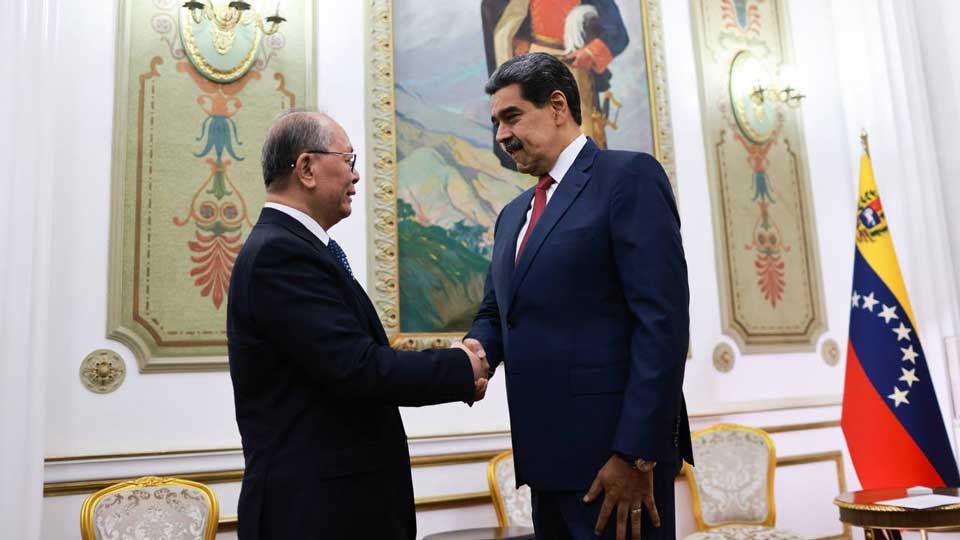
What should we make of the fact that the detention of Nicolás Maduro by the United States took place just hours after the deposed president met with China’s special envoy? Was that purely coincidental in your view, or is there some connection between these two events?
There are plenty of theories surrounding Maduro’s meeting with China’s special envoy. One of the most interesting ones is that China’s envoy was personally conveying to Maduro that an action from the United States against him was imminent.
In that scenario Maduro did not took the warning seriously enough, leading to its capture. China would have had the information at hand because of an early warning by U.S. forces – which seems unlikely after not signaling its actions against Iran last year – or because of intelligence gathered by its own security bodies.
In any event the proximity in time between the two events (the capture and the meeting) also flags that an incident involving the Chinese delegation could have taken place, recalling the 1999 bombing of the Chinese Embassy in Belgrade.
On the other hand, an alternative scenario is one where the Chinese were unaware of the U.S. actions in Caracas, which would be read as an intelligence failure from their behalf. This together with swift and surgical precision of the operation, signals to Beijing that it still lags Washington in this sort of things.
Part of the rationale for the U.S. detention of Maduro was his close ties with U.S. rivals in Iran, Russia, and China. Do you think what happened this weekend will provoke Latin American governments to reconsider those ties, particularly with China?
The detention of Maduro is part of a concerted effort from the U.S. to signal its non-hemispheric rivals, most especially China, that the Hemisphere as a whole is out of play in their strategic competition. It also bluntly says that Washington means business; it is not only a rhetorical exercise. In doing so and by taking out the leader of an ally of China, Russia, and Iran, the U.S. is taking the Trump Corollary to the Monroe Doctrine to the operational level by exerting and projecting dominance over the Hemisphere.
In most capitals of Latin America, the U.S. actions are being read with an abundance of caution which will potentially lead some States to reconsider their ties with Beijing, naturally leading to a cooling off period in the short run.
Do you think the fall of Maduro creates new risks or new opportunities for China in the Americas?
The fall of Maduro, together with the China ‘trend’ in recent elections throughout the Americas, is part of a new set of risks that China is facing in the region. With a new model of spheres of influence taking form, history would suggest that restraint from China in the Americas would be in order.
However, contemporary dynamics are very atypical, and amid strategic competition with the U.S., there is also a sense of opportunity for China. In this regard, Beijing could continue to build its leadership profile as a law-abiding actor that promotes diplomacy, multilateralism, and international law, particularly through the Global Governance Initiative, in the face of U.S. unilateral actions.
Alonso Illueca is a Panama-based researcher on China-Latin American affairs and CGSP’s non-resident fellow for Latin America & the Caribbean.