
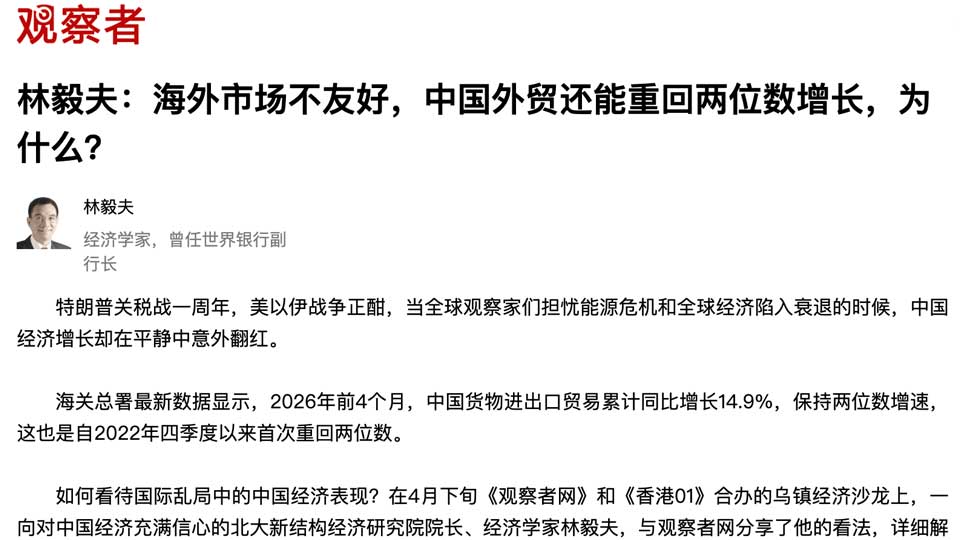
One of China’s most famous and influential economists, Lin Yifu, recently gave an interview to the Chinese online news platform Guancha (“观察者/The Observer”), primarily explaining why China’s foreign trade remains resilient despite growing international pressure.
At its core, however, the interview is not simply about trade performance. It is an argument about the future direction of China’s external economic strategy and the role that the Global South, particularly Africa and Latin America, is expected to play within it.
The interview is valuable not so much for what it reveals about China’s economy alone, but for what it shows about how influential academic and policy circles close to the Chinese leadership increasingly understand China’s relationship with the developing world.
Before engaging critically with Lin’s arguments, it is important to summarize the central propositions he advances.
Lin Yifu’s Core Argument
Lin’s interview is structured around several interconnected claims.

First, he argues that China’s economic difficulties are exaggerated and largely external in origin. According to Lin, the slowdown in Chinese exports and industrial pressure stems primarily from rising protectionism in developed economies, particularly the United States and Europe, rather than from structural weaknesses within China itself.
Second, Lin argues that China’s manufacturing competitiveness remains fundamentally intact. Chinese industry, he claims, continues to possess decisive advantages in infrastructure, industrial ecosystems, labor productivity, logistics, and state support. For this reason, he believes Chinese exports can continue growing even in an increasingly hostile global environment.
Third, and most importantly, Lin presents the Global South as the central solution to China’s future trade strategy. Since developed economies are becoming more protectionist, Chinese companies, he argues, should increasingly “go south” (向南), deepening their presence in Africa, Latin America, Southeast Asia, and Belt and Road partner countries.
This strategy would take two principal forms:
- Exporting “high-quality, affordable” Chinese-manufactured goods (物美价廉);
- Increasing direct investment and localized production in developing countries in order to circumvent trade barriers imposed by Western economies.
Lin repeatedly frames this process as mutually beneficial. China would gain new markets and production platforms, while developing countries would gain access to affordable goods, industrial investment, manufacturing capacity, and economic development opportunities.
A fourth major argument concerns industrial upgrading and localization. Lin presents the establishment of assembly plants and manufacturing facilities in developing countries as evidence that Chinese firms are becoming more globally integrated and that China is contributing to industrialization abroad.
Fifth, Lin insists that the Chinese development experience itself offers a “valuable reference” for developing countries. In his telling, China’s rise demonstrates that state-led industrialization, infrastructure investment, export-oriented manufacturing, and pragmatic economic governance can produce rapid development.
Finally, Lin situates these economic arguments within a broader political and civilizational framework. He invokes the Chinese diplomatic concept of a “community of shared destiny for humanity” (人类命运共同体), portraying China’s engagement with the Global South as part of a cooperative and non-hegemonic international order distinct from Western dominance.
A Rebuttal
These are serious arguments — many internally coherent, several supported by real empirical developments — and it is not the rigor of any single one that is ultimately problematic.
The difficulty lies, rather, in the way they are assembled into a broader rhetorical framework whose purpose seems less to illuminate than to reassure, and less to analyze than to legitimize; reading Lin critically requires holding apart the economic observations themselves from the political work they are made to perform.
The key question, particularly for countries in the Global South and African states in Lin uses seemingly rigorous analytical tools to support a predetermined conclusion: that China is performing well, that its difficulties are largely caused by external factors, and that its future is bright.
Those who criticize it are either poorly informed or acting in bad faith.
As long as our products are “high-quality and inexpensive” and can meet the needs of other countries, it will be difficult to completely block [us out of] the market.
Lin Yinfu, economist and peking university professor
One point emerges immediately: Africa and the broader “Global South” appear in the interview solely as objects of strategy, never as strategic actors in their own right.
African countries are neither directly addressed, specifically identified, nor granted meaningful agency. Instead, they function merely as variables within the calculus of Chinese interests, a fact itself revealing.
Lin states his recommendations explicitly: Chinese enterprises, he argues, should deepen their presence in African, Latin American, and Belt and Road markets by exporting “high-quality, affordable” goods (物美价廉) and by investing directly in those regions in order to circumvent the trade barriers imposed by developed economies.
Although framed as a mutually beneficial strategy, this formulation opens the door to at least five contradictory interpretations from an African perspective:
A Genuine Opportunity
It is undeniable that access to low-cost Chinese-manufactured goods has produced tangible gains in purchasing power for many underserved African populations. Solar electrification systems, mobile phones, motorcycles, and construction materials have become accessible at scales and prices that Western industries were often no longer willing or able to provide. In this respect, Lin is not inventing the benefits he describes.
The Trade Specialization Trap
Yet what Lin leaves unsaid is just as revealing as what he emphasizes. The structure of Sino-African trade remains marked by a deep asymmetry: Africa exports primarily raw materials — oil, minerals, and agricultural commodities—while importing Chinese manufactured goods.
Despite twenty-five years of expanding ties, this underlying pattern has changed remarkably little.
Lin celebrates the fact that more than 60 percent of Chinese exports now flow to the “Global South,” but he never interrogates the composition of those trade flows or their long-term implications for local industrialization. It is precisely here that the work of Harvard University economist Dani Rodrik offers a crucial critical lens.
In a 2015 study on premature deindustrialization, Rodrik shows that this phenomenon has struck most severely in precisely the two regions targeted by Lin’s “Going South” (向南) strategy: Africa and Latin America.
The decline is evident in both manufacturing value added and industrial employment. Countries are now reaching their manufacturing peak at income levels roughly three times lower than those attained by earlier industrializers.
In other words, the historical window through which manufacturing once enabled broad-based industrialization is narrowing structurally, precisely at the moment when Lin presents this same pathway as a development opportunity for China’s partners in the Global South.
China as a Driver of That Closure
Rodrik identifies globalization, and more specifically the expansion of manufactured exports, as one of the key drivers of premature deindustrialization in African and Latin American economies.
For small open economies, as most African countries are, deindustrialization is often not primarily the result of domestic dynamics, but of imported global price pressures.
The declining relative price of manufactured goods on world markets, driven largely by the extraordinary productivity of Asian export economies, reduces the industrial share of economies unable to compete at a similar scale or cost.
China has been one of the principal engines of this transformation.
Lin presents indigenization (本地化), the establishment of assembly and manufacturing facilities in host countries, while higher-value functions remain concentrated in China, as a development opportunity for economies in the Global South. Yet he leaves unaddressed a fundamental paradox: what China is offering Africa today is structurally different from what China itself received during its own industrial ascent.
The foreign investment that contributed to China’s industrialization in the 1980s and 1990s brought not only capital but also technology transfer, managerial expertise, and integration into upward-moving global value chains. By contrast, the model Lin proposes for African economies is concentrated largely at the terminal end of those chains: low value-added assembly, unskilled labor, and domestic or regional sales.
In other words, the functions being relocated are precisely those that, according to Rodrik, lack the transformative pull effects historically associated with manufacturing-led industrialization.
The Chinese Experience as a Universal Model
The conclusion of the first part of the interview is particularly revealing. Lin Yifu argues that the Chinese experience offers “a valuable reference for developing countries.”
This claim—repeated frequently across Chinese diplomatic and academic discourse—raises a question that African scholars are increasingly willing to pose openly: to what extent can the Chinese model truly be transposed to contexts whose initial conditions differ so profoundly in terms of market size, institutional capacity, colonial legacies, demographic structures, and access to public finance?
To present China’s trajectory as a ready-made pathway for Africa, without fully accounting for these profound structural differences, risks reproducing a form of developmental universalism.
The distinction is that this developmental vision now appears in Sinocentric rather than Western form, mirroring the same asymmetrical assumptions about development that African critical scholarship has long challenged in the context of Western aid and cooperation models.
Anti-Dumping Proceedings
Lin also addresses the anti-dumping investigations initiated by countries of the Global South. He acknowledges that, according to his own figures, more than half of the anti-dumping and anti-subsidy proceedings brought against China at the WTO since 2024 originate from Global South countries.
While we have not been able to independently verify this claim for 2024, WTO statistical data clearly point to a deeper structural pattern: over the period from 1995 to 2025, economies of the Global South accounted for approximately 68 percent of all anti-dumping proceedings initiated against China at the WTO. India alone represented roughly 17 percent of the global total, followed by Argentina, Brazil, Turkey, and Mexico.
This predominance of Global South countries in such proceedings is therefore not a recent by-product of the U.S.–China trade war. It long predates it. More importantly, it reflects a genuine industrial frustration among developing economies, one that cannot simply be dismissed as anti-Chinese rhetoric imported from the developed world.
Lin should also acknowledge that competition cannot easily be described as “fair” when one participant is the world’s second-largest economy, equipped with an unparalleled capacity for state intervention, industrial subsidization, and strategic financing.
In the concluding section of the interview, Lin invokes the rhetoric of the “community of shared destiny for humanity” (人类命运共同体). Since the mid-2010s, this concept, formulated at the highest levels of the Chinese Communist Party, has occupied a central place in Chinese diplomatic discourse, presenting itself as a vision of horizontal solidarity among nations.
African audiences, however, are likely to interpret it in sharply different ways. Some political elites embrace the language sincerely or at least regard it as more acceptable than the democratic conditionality historically associated with Western aid and Bretton Woods institutions.
For certain governments, Chinese cooperation, framed as “non-interventionist,” has indeed expanded the room for political and economic maneuver.
Yet skepticism toward this rhetoric has grown steadily among segments of African civil society, academics, trade unions, and even some governments.
The notion of a “community of shared destiny” presumes convergent interests where economic structures remain profoundly asymmetrical. Within the logic of this interview, the phrase arrives only at the conclusion of an argument structured overwhelmingly around China’s own commercial and geopolitical imperatives.
Under such conditions, appeals to horizontal solidarity become difficult to receive without critical distance.
Perhaps the most striking feature of the interview, however, is what it omits entirely: the question of debt and development finance.
At no point does Lin address sovereign debt burdens, the lending practices of Chinese policy banks, debt restructuring negotiations, or the tensions that have emerged in several African countries around Chinese-financed infrastructure projects.
This silence is unlikely to be accidental in an interview that foregrounds trade and investment while presenting them primarily through the language of mutual benefit.
Ultimately, Lin mobilizes concepts such as comparative advantage, trade-led development, technology transfer, and “South–South cooperation” in support of a broader strategy that positions China as both model and market-maker for the Global South.
The agency of partner countries largely disappears within this framework. An implicit civilizational hierarchy also runs through the discourse, particularly in the invocation of a “community of shared destiny” articulated from Beijing.
To an African reader attentive to the underlying distribution of power and interests, the structure remains familiar: a center exporting its model, capital, and manufactured goods to a periphery whose developmental needs continue to be defined from that center.