2026 marks a strategic turning point for Laos in its ambition to become the “Battery of Southeast Asia”, with two mega power transmission projects advancing this year.
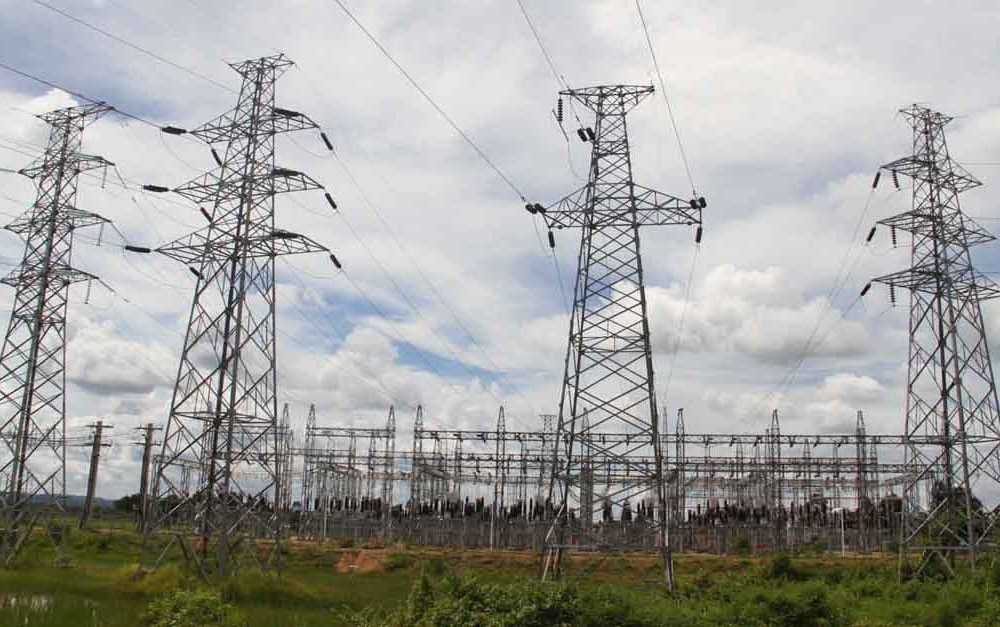
On the first day of January 2026, the 230 kV Thavieng-Mahaxay transmission line project officially broke ground. Designed to connect northern and central Laos, the project is managed by Électricité du Laos Transmission Company (EDL-T), a joint venture in which China Southern Power Grid Company (CSG) holds a 90% stake.
In parallel, the China-Laos 500 kV cross-border power line project is entering its final stage. While the 230 kV line strengthens domestic connectivity, the 500 kV interconnection forms part of a high-voltage backbone designed for long-distance regional power trade. Currently 86% complete, it is set to enable high-volume electricity exchange between Laos and China’s Yunnan province, with wider regional implications.
Behind these ambitious projects lies a major reshuffle of the regional power system. China is stepping up its role in shaping Southeast Asia’s grid infrastructure, with impacts that go beyond steel and wires.
The “Battery of Southeast Asia” Strategy
Thanks to its mountainous terrain and the Mekong River, Laos has rich hydropower potential that generates electricity for local households and exports to neighboring countries. As of 2023, the latest data available show that Laos’ hydropower generation reached 38.8 TWh, accounting for 75.9% of total electricity output.
Laos’ “Battery of Southeast Asia” strategy was first introduced in the early 2000s. The goal was to tap into this natural wealth to export cheap and stable electricity while driving the country’s economic development. Today, energy exports are among the leading sources of trade revenue. In 2024, electricity exports brought in over $2.6 billion in revenue for Laos, making it almost a quarter of the country’s total export earnings ($10.7 billion).
However, despite being a net exporter, Laos was forced to spend more than $177 million on seasonal electricity imports in 2024. This paradox is caused by weak internal connectivity; the lack of investments in transmission and distribution infrastructure has constrained nationwide grid coordination.
During the dry season, when water levels drop, the internal grid cannot effectively move electricity to where it is needed most.
The 500 kV interconnection project can help to solve this specific issue. It enables a two-way exchange between Yunnan province and Laos. With the high-voltage transmission line, Laos can buy the power back from Yunnan during the dry season when hydropower production is low.
This prevents the government from spending excessive amounts of money to import electricity from other neighbors and improves seasonal stability.
The China Factor: From Roads and Rails to Power Grids
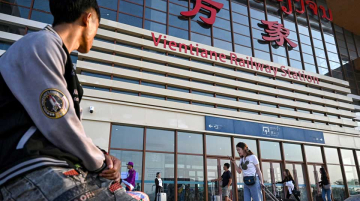
Chinese investment is signaling a shift in the nature of engagement with Laos. In its early phases of the Belt and Road Initiative (BRI), investments were centered around railways construction and trade zones, with the Lao-China railway (2021) as a flagship project. With the launch of the two high-voltage transmission projects, 2026 marks a transition towards integrated power grids.
Under the 2020 agreement establishing EDL-T, China acquired 90% of the share in the joint venture and a 25-year concession to manage Laos’ transmission assets. This gives China substantial control over Laos’ electricity transmission system, and more broadly, greater influence over regional connectivity.
Transmission infrastructure is inherently strategic. Power grids decide how electricity flows, who sets the standards and how the regional connectivity is designed. By having the long-term management of Laos’ grid system, China is becoming the architect of Southeast Asia’s power network.
Power Grids and ASEAN Integration
On January 14, Laos, Thailand and Malaysia signed an agreement under the Lao PDR–Thailand–Malaysia–Singapore Power Integration Project (LTMS-PIP), which took effect immediately. This “phase 2” agreement allows Laos to export up to 200 MW of clean electricity through the existing regional network.
While the LTMS-PIP uses existing lines, the 500 kV interconnection project will significantly strengthen Laos’ capacity to support such multilateral exports. This development illustrates how China is reshaping grid infrastructure in Southeast Asia. Unlike railways, control over power grids positions China not only as a financial backer, but also as a long-term technical operator.
In doing so, China is deepening its structural integration into the region’s energy network at a systemic level.
Chen Heyi is an independent China-Southeast Asian relations analyst.