Washington’s intervention in Venezuela and the capture of President Nicolás Maduro have sent shockwaves across Chinese social media, triggering surprise, anger, and unease. Beyond that, a more intriguing conversation emerged – Taiwan.
U.S. forces carried out the lightning strike on Caracas on January 3, shortly after the attack was reported, President Donald Trump said U.S. troops had captured Maduro and his wife and taken them out of the country.
For some Chinese netizens, the lightning strike, which could result in a successful regime change by capturing its leader, carried strong implications. While no Chinese official media outlets or think tanks have linked Washington’s action in Venezuela to Taiwan’s future, discussions on media such as Weibo and Douyin were rife with comparisons between Venezuela and the self-ruled democracy.
Some users are asking whether Beijing could one day attempt a similar move against Taiwanese President William Lai Ching-te. “China should learn from the U.S… yet we still give aid to Taiwan,” a comment on Weibo read, with a disappointing tone.
Cross-Strait Echoes
Across the strait, Taiwanese citizens are discussing the same situation on social media, such as PTT and Threads.
“Sending out a president to avoid a war – sounds like a good deal?” one post on PTT read, while some users on Threads went further, saying it would be better to send the Kuomintang – Taiwan’s largest opposition and Beijing-friendly party instead.
Despite China’s commentators remaining a collective silence on such comparisons, Taiwan’s media is discussing it intensively. SETN(三立新聞網)quoted Lev Nachman, a professor at National Taiwan University, saying Trump’s actions have “created greater justification for taking action against Taiwan.”
The media on January 4 also quoted Shi Yinhong, a prominent professor at China’s Renmin University, who said China’s action depends on its “still insufficient capability,” other than “what Trump did in a remote continent.”
Yet for Chinese media commentators and international observers, Trump’s move is less about Taiwan, but a signal about China’s future global footprint – particularly in Latin America and the Global South.
The operation followed weeks of Beijing’s steadfast support for Maduro’s leadership amid Washington’s sabre-rattling, turning Venezuela into the most intense confrontation between the two powers in the region since the Panama Canal saga.
The strike took place only hours after Maduro met China’s special envoy, Qiu Xiaoqi, in Caracas.
Official Media Reaction
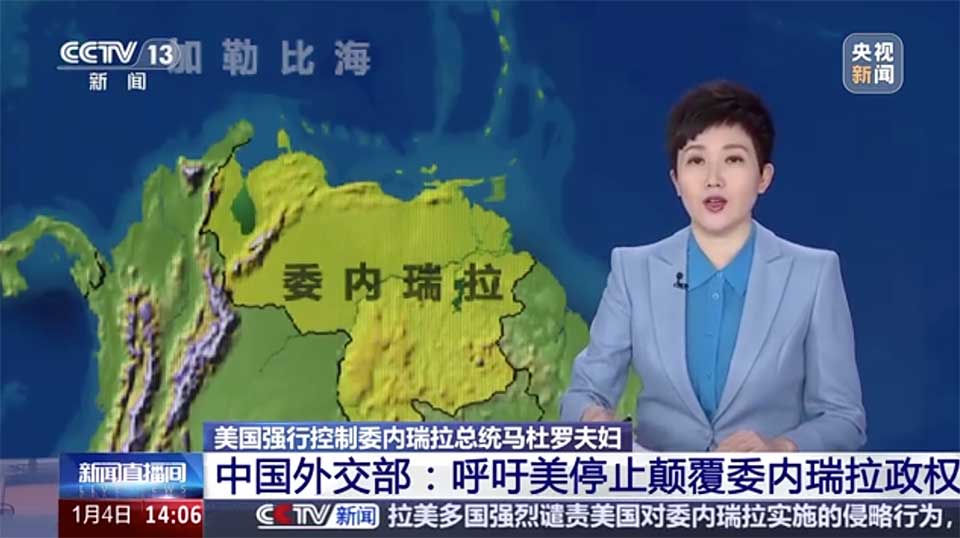
Without much hesitation, China’s state-owned news agency Xinhua sent a quick and strong condemnation of Washington. The mouthpiece of Beijing described the U.S. as “blatant hegemony” and “resource imperialism” in its January 4 commentary, defining the central government’s attitude towards the attack.
“First, fabricating charges, and then, using forces to destroy a sovereign government and overthrow its regime, Washington clears the way for its own capital to move in and carve up the country’s natural resources,” it read, adding that the U.S. has “effectively dragging the world back to an era of colonial plunder.”
Global Times, another state-owned outlet run by China’s Communist Party, quoted a Chinese military expert as saying countries should view the operation as a systemic U.S. approach to pursuing regime change rather than an isolated incident.
“The U.S. has repeatedly conducted similar military operations to overthrow regimes. Such operations are not just tactical operations, but they have deep political and strategic implications,” the expert named Zhang Junshe, was quoted as saying.
Non-state-backed professionals, on the other hand, started to sense the unease as Beijing lost one of its most important strategic partners in Latin America. A report from Longxing Zhice Jingwei (龙兴智策经纬)warned of multiple risks China will face after Washington takes over Venezuela, ranging from energy, finance, to geopolitics.
Beijing could see a large number of investments and contracts signed with Caracas rendered invalid or have their equity stakes stripped. Venezuela’s debt to China, estimated at around $11–12 billion, is also at risk, it said.
Since Venezuela has in recent years accepted Chinese currency for some energy payments, any disruption would also deal a blow to Beijing’s efforts to promote de-dollarisation in global energy trade.
However, despite China losing a pillar partner in Latin America, the strike also offers an opportunity to Beijing, it added, as Trump’s action again promoted China as a stabilising force in the globe, at least in the Global South’s mind.
“China should fully leverage the sense of anxiety across the Global South to seize the moral high ground in international public opinion and take the lead in shaping a more just and equitable international order,” it said.