
By Felix Brender 王哲謙
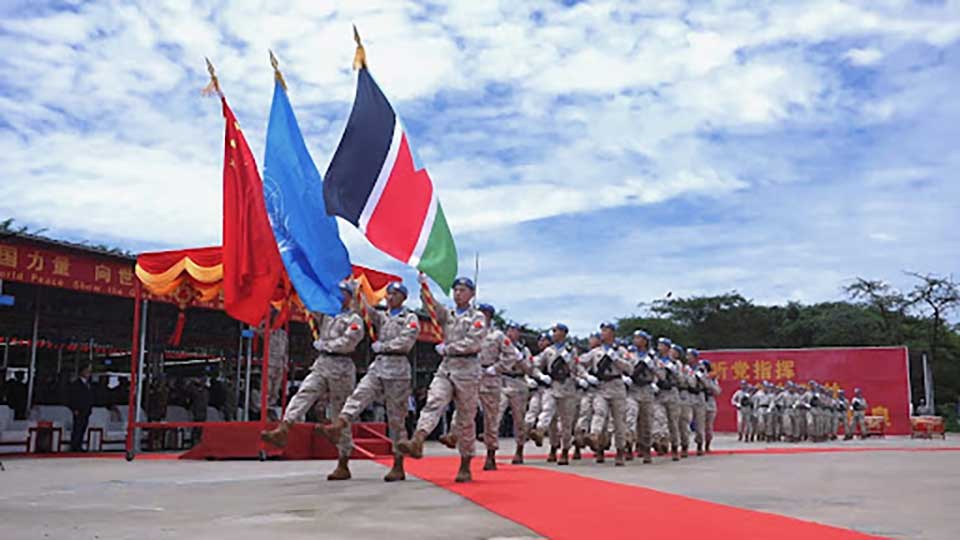
When seven hundred members of China’s 11th Peacekeeping Infantry Battalion were awarded the United Nations Peace Medal of Honour in Juba on 23 October 2025, Chinese media celebrated. State broadcaster Xinhua framed the event as proof of Beijing’s deepening commitment to global peace and its steady evolution into a “responsible great power.”
Yet beneath the pageantry, the language of both Chinese and UN commentary reveals something subtler. Official statements emphasise what the battalion did—the number of patrols, escorts, and days on duty—but remain silent on what the battalion achieved in terms of measurable security improvements or strengthened local institutions, for instance. Chinese reporting noted that the unit “completed 308 days of guard duties and 586 authorised tasks including armed escorts, city patrols, and long- and short-distance patrols,” and how the battalion “passed the systematic combat-readiness assessment … organised by UNMISS,” evaluating command, planning, emergency response, and equipment performance.
These formulations celebrate outputs (tasks executed, training passed) and preparedness (combat-readiness, discipline, logistics), rather than outcomes (reduced violence, improved civilian protection, governance gains). The same rhetorical pattern appears in UN commentary. A UNMISS statement commended Chinese peacekeepers for their “training, discipline, and professionalism” and for providing “exceptional support to communities, humanitarian partners, and the mission.” The praise is genuine—but carefully confined to readiness, conduct, and contribution.
That caution is revealing. In the diplomatic semantics of peacekeeping, “professional” and “well-trained” are safe compliments: they affirm diligence without implying political effectiveness. The Juba medal ceremony thus serves two masters—UN gratitude toward a major troop contributor and China’s self-presentation as a cooperative, capable partner—each wrapped in mutually reinforcing language that highlights output, not outcome.
China’s peacekeepers unquestionably operate under demanding conditions and merit recognition for their service. Yet the Juba episode is less an anomaly than a demonstration of how adeptly Beijing works within the UN’s broader peacekeeping idiom. The UN’s own praise for troop contributors—Chinese or otherwise—tends to emphasise professionalism, readiness, and delivery rather than measurable impact. What makes China distinctive is how it has turned that shared diplomatic language into a strategic tool: a means of projecting reliability, moral authority, and “responsible great-power” status.
The absence of outcome language in both UN and Chinese narratives thus speaks volumes—not of indifference, but of diplomacy. It allows China to celebrate its contribution while keeping questions of effectiveness at arm’s length, converting bureaucratic recognition into geopolitical capital. In this sense, Juba tells us less about the peace achieved in South Sudan than about how China crafts its peacekeeping story—an exercise in image management as much as international service.
Felix Brender 王哲謙 is a project associate with China Foresight at LSE IDEAS.
