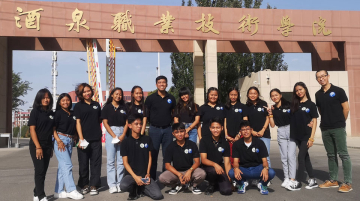
When it comes to the China-Africa story, most people first think about infrastructure. Those who follow it more closely might think of diplomacy. But China-Africa relations is also a story about hundreds, maybe even thousands, of African students trained in China through scholarships and bilateral partnerships.
One might expect those students to return home and put their expertise to work, where their governments and institutions reap the benefits of their foreign education. Instead, it ends up being the story of Africans who migrate elsewhere and put their new skills to work in countries other than their own.
This is the story of two men, who we’ll call Romain and Paul. Through their home countries’ partnerships with Beijing, they each earned the opportunity to study in China at one of its most prestigious universities, where Romain earned a PhD in economics and Paul, a master’s degree in international relations.
Once they returned home, they eagerly sought out jobs in which they could apply their new skills and degrees. After a period of searching and finding no real prospects, Romain and Paul moved to Canada, where they were welcomed with open arms and ample opportunities. Over time, they each started families, settled into Canadian society and eventually acquired Canadian citizenship.
Fast forward, a few years later, both were hired by the Canadian Foreign Affairs Ministry. They slowly climbed the ladder and were set to be assigned to Canadian diplomatic missions abroad. Romain ended up being appointed as a diplomat in the economic section of the Canadian Embassy in China.
Romain is proud of the choices he made and the path he took, and no one can fault him for that. His current position is the result of hard work and personal effort, but also of a country and a system that recognized his potential and opened doors for him.
Romain and Paul’s story is not unique. Unfortunately, it is all too common among the African academic diaspora who have passed through China. Not all of them emigrate elsewhere, and not all of them become diplomats in foreign countries. Still, the vast majority disappear into the maze of their home countries’ systems — systems that are not ready, nor equipped, or perhaps even willing to welcome them back.
Nearly thirty years after the beginning of active Sino-African cooperation, Africa is still struggling to reap the human dividends of this cooperation. China has done well to capitalize on its vast numbers of students sent to study at Western and Asian universities, absorbing foreign expertise and deploying these skills for its own development. Meanwhile, African countries have struggled to take advantage of the opportunities offered by Beijing.
At the heart of this problem lies the absence of government strategies or public policies to incorporate returning graduates into a long-term development vision. There is little ambition to reintegrate them into the workforce in ways that would harness their skills.
Yet these academic exchange programs offer unique advantages: they build technical capacity while also fostering long-term China expertise and understanding at home — a crucial asset considering the scale and depth of China-Africa engagement.
As part of my work, I interact with dozens of African officials. I am always struck by how little they know about China. And yet it is not for lack of human resources and expertise. These resources exist; they are ready and waiting to be used. The brightest among them end up seeking greener pastures elsewhere, should they have the means to do so.
If they are lucky, like Romain and Paul were, they end up taking on a new citizenship and settling into their new homeland. Others find a second home in China.
When I think of Romain’s or Paul’s story, I cannot help but imagine the bewilderment, perhaps even the disillusionment, of the Chinese authorities reviewing their files. How could this African student, awarded a scholarship as part of China’s bilateral relations with his country, return thirteen years later as a Canadian diplomat?
Do they wonder, in the end, if this has been a waste of resources? Vain efforts expended in service of countries unwilling to take advantage of the academic cooperation offered, even as access to Western universities becomes increasingly restricted for African students.
Do they grimace at the realization that, while African counterparts often lack China expertise, the most knowledgeable graduates take their education and skills to third countries?
The China-Africa story is about economics and infrastructure, yes. But it is also about this: a story of waste and squandered potential.