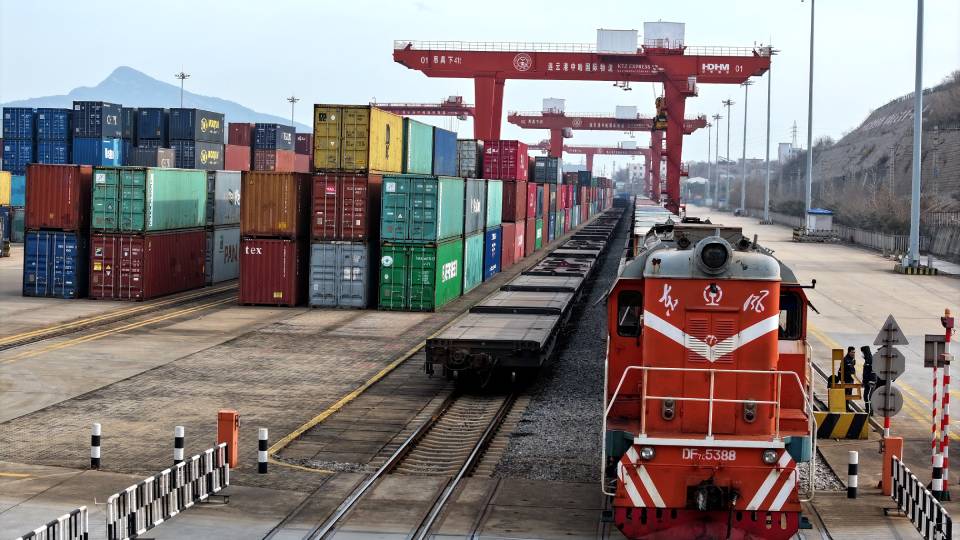
2025 marked an important inflection point in China-Central Asia relations. Not because China’s presence in the region was new, since Beijing has been a significant economic actor for more than a decade, but because the composition and structure of that engagement began to change in more visible and measurable ways.
At a time when global foreign direct investment (FDI) flows continued to soften, China’s investment footprint across Eurasia expanded, with Central Asia accounting for a growing share. By mid-2025, China’s FDI stock in the broader Eurasian region reached an estimated USD 66.1 billion, with more than half concentrated in Central Asia.
This distribution highlights the region’s increasing relevance within China’s external economic geography. More notably, the sectoral profile of Chinese investment has gradually diversified away from a narrow concentration in oil, gas, and extractive industries toward manufacturing, renewable energy, and industrial processing.
Diversification and Its Strategic Drivers
This shift appears to reflect both structural and policy-driven factors. Over the past decade, extractive industries have declined in relative importance within China’s regional investment portfolio, while manufacturing and energy-related activities have expanded. In Central Asia, renewable energy projects and selected downstream manufacturing initiatives, particularly in Uzbekistan and Kazakhstan, have emerged as prominent areas of new investment.
For China, these developments are consistent with broader domestic pressures, including industrial overcapacity, rising production costs, and the need to diversify supply chains amid increasing geopolitical fragmentation. For Central Asian governments, manufacturing and energy investments are often viewed as offering opportunities for value addition, employment generation, and export diversification.
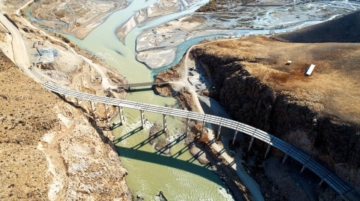
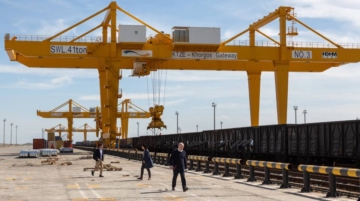
Taken together, these dynamics suggest a gradual convergence of interests that extends beyond infrastructure financing alone. China’s role in the region increasingly involves participation in domestic production systems rather than a focus limited to resource access and transit infrastructure.
Institutionalization Beyond Investment
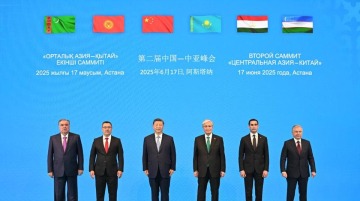
Alongside changes in investment patterns, 2025 also saw a degree of institutional deepening in China–Central Asia relations. The Second China–Central Asia Summit formalized a broader agenda that extended beyond trade and investment cooperation. Agreements covering areas such as poverty reduction, education exchanges, environmental management, and trade facilitation indicated an effort to expand cooperation across economic, social, and governance-related domains.
The joint designation of 2025–2026 as the “Years of High-Quality Development of Cooperation” points to an intention to frame engagement in longer-term and more structured terms. From an institutional perspective, such frameworks may help reduce volatility by anchoring cooperation in mechanisms that can endure leadership changes, commodity price cycles, and external shocks, particularly as Central Asia attracts growing attention from the European Union, the United States, and Gulf economies.
What 2026 May Bring
Looking ahead, 2026 is likely to be characterized less by major announcements and more by consolidation.
First, Chinese investment activity may continue to expand in manufacturing and processing sectors, reinforcing the gradual rebalancing away from extractive industries. This trajectory aligns with both Central Asia’s industrial development objectives and China’s interest in geographically diversified production networks.
Second, private Chinese firms are expected to play a more visible role. While state-owned enterprises remain important, their share of total Chinese investment in the region has declined from 62% to 53%, while private firms’ share has risen to 27%.
This trend suggests a greater emphasis on commercially driven projects, even as state support and policy alignment continue to shape the overall investment environment.
Third, cooperation is likely to broaden into non-traditional sectors, including digital infrastructure, selected artificial intelligence applications, digital payments, pharmaceuticals, and advanced nuclear energy cooperation. These areas reflect China’s technological capabilities as well as Central Asia’s demand for modernization and economic resilience.
Soft Power as a Complementary Dimension
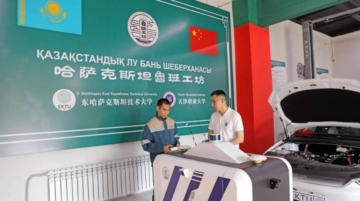
At the same time, there appears to be growing recognition in Beijing of the limitations of an engagement model centered primarily on capital and infrastructure. In 2026, initiatives such as vocational training programs, academic exchanges, media cooperation, and cultural projects may gain greater prominence. These efforts aim to strengthen societal linkages and familiarity, complementing China’s economic presence in the region.
Moving Forward
China-Central Asia relations are increasingly characterized by what can be described as structured interdependence. Investment patterns have become more diversified, institutional ties more developed, and cooperation more multidimensional. While competition from other external actors is likely to intensify, China’s early and embedded presence provides it with a degree of structural advantage.
The central question for 2026 is not whether China will remain an influential actor in Central Asia, but whether this evolving relationship can translate into sustainable development outcomes for Central Asian states while advancing China’s longer-term strategic objectives. The answer will have implications not only for the region’s political economy, but also for broader assessments of China’s engagement across the Global South.
Yunis Sharifli is CGSP’s Non-Resident Fellow for Central Asia.