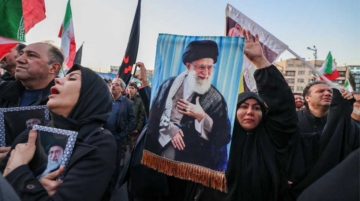

Iran will hardly see a total “regime change,” but the Middle East has undoubtedly returned to the “jungle” it once was, facing growing military threats in the future, according to three prominent Middle East scholars in China whose views were widely disseminated in major national news publications in response to the assassination of Iranian Supreme Leader Ali Khameni by U.S. and Israeli military forces on Saturday.
Fan Hongda, one of China’s most outspoken and prominent Middle East scholars, told Qianjiang Wanbao (钱江晚报), an official newspaper owned by Jiangsu Province, a coastal province north of Shanghai, that it is “nearly impossible” for the U.S. and Israel to overturn the whole Islamic system by a single assassination.
“Iran’s political system is deeply rooted in complex religious, social, and historical foundations, making it extremely difficult for external military strikes to uproot it,” Fan said, who leads Shaoxing University’s Middle East studies.
Moreover, since the “12-day war” last year when the U.S. President Donald Trump struck Iran’s nuclear facility, the late Supreme Leader had already started to “decentralize power”, he added.
Fan believes that, at least for Washington, a more practical goal is to pick an Iranian leader who is ‘acceptable,’ and to push Tehran to make major concessions on key issues such as its nuclear program.
Back to the Jungle
Although Chinese scholars remain uncertain on the future trajectory of Tehran, one thing is for sure: the Middle East as a whole is now facing one of the biggest military spillover threats in decades.
Sun Degang, Shanghai Fudan University’s Director of the Center for Middle Eastern Studies, who is among China’s leading Mideast scholars, believes that Tehran might no longer adhere to the rules of limited warfare, as this engagement concerns the “survival of the regime.”
Iran is expected to launch a major retaliation, which may include direct ballistic missile strikes on Israeli military and strategic oil targets, along with threats to U.S. military bases in the Middle East. Furthermore, Iran might blockade the Strait of Hormuz, a move that could significantly disrupt global supply chains and drive up international oil prices, Sun told Xiake Island(侠客岛), which is affiliated with the Communist Party’s largest newspaper, People’s Daily.
Another prominent expert, Liu Zhongmin, who leads the Middle East Studies Institute at Shanghai International Studies University, concurred with Sun’s analysis. He cautioned that Iran’s domestic political strife might compel the nation to escalate the conflict beyond “controllable limits”.
In his interview with guancha.com, a nationalist Chinese online news portal, Liu said it is important to check if the conflict could further “spillover” in the short term to the whole Middle East, such as the Gulf region.
“Despite suffering severe setbacks previously, the Iran-led ‘Axis of Resistance’ has not collapsed,” he warned.
Liu also said the current conflict will trigger “widespread negative repercussions across the Middle East,” further deepen the regional security dilemma, exacerbate the security anxieties of various countries, and worsen the already highly complex situation in the region.
WHY IS THIS IMPORTANT? As Iran is one of China’s closest partners in the Middle East, its political turmoil has undoubtedly captivated Chinese scholars. This intense focus stems not only from Iran’s uniquely critical role in Beijing’s Middle East strategy, but also because the survival of the Islamic regime serves, to some extent, as a cautionary tale for Beijing.
While Chinese media is currently saturated with diverse academic opinions, Fan, Sun, and Liu have long been recognized as authoritative and rational voices in the field of Middle East studies. Their converging assessments suggest that the current actions involving Iran are sliding toward an unpredictable and highly dangerous trajectory.