The emerging mineral deals between the United States and the Democratic Republic of the Congo are posing direct challenges to China’s mineral domination in Africa, some Chinese media warned, urging stakeholders to rapidly look for alternative solutions such as diversifying from its heavy reliance on a single country or bringing foreign capitals into their investment.
Xiao Wenhao, an analyst at Shanghai Metals Market (SMM), warned in a recent WeChat post that the U.S. and Congo DR’s deals could have an immediate effect on China’s mineral supply chains, especially cobalt, potentially resulting in what he characterized as a “structural deficiency”.
Therefore, he said, the response must be quick, writing that China must do more to diversify its cobalt supply, such as by sourcing more from Indonesia.
Washington-backed mineral giants are now racing to conquer critical mines in the DR Congo. For instance, Swiss-based mining giant Glencore is now in talks to sell a 40% stake in its copper and cobalt operations in the DR Congo to the U.S.-backed Orion Critical Mineral Consortium.
Last year, the U.S. and the Congo signed a partnership agreement that effectively secured output from several strategic sites, from gold to critical minerals such as copper, cobalt, and lithium.
“The primary alternative strategy currently is to accelerate market expansion in Indonesia by securing mining rights or establishing strategic partnerships with local mining companies to secure resources,” said SMM analyst Xiao.
Another widely-followed WeChat account that tracks Chinese investment flows to the DR Congo, Economic Observation of the DR Congo (刚果金经济观察), also cautioned that more deals led by U.S. corporations will begin to compete with China’s dominance of critical minerals in the African country.
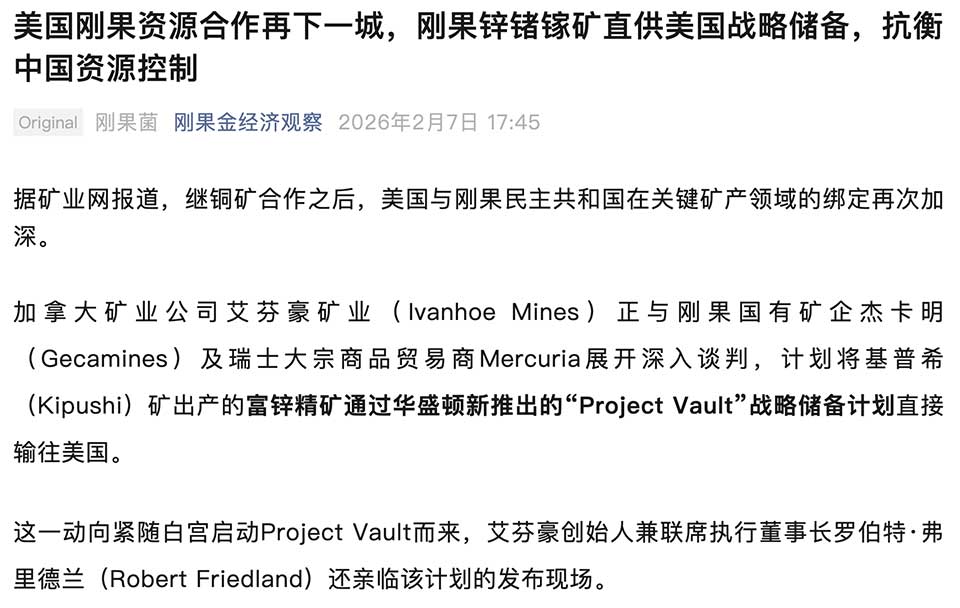
The author of the unsigned article mentioned a deal between Canada’s Ivanhoe Mines and Congo DR’s state-owned Gécamines that plan to ship high-grade zinc and other concentrates directly to the U.S. as part of Project Vault, the Trump administration’s newly-announced initiative to create $12 billion stockpile of critical minerals.
“The DR Congo is being thrust to the center of a global contest over resources. Under Project Vault, Trump is using capital, loans, and political agreements to channel African minerals directly into American strategic stockpiles, reducing reliance on Chinese processing and supply chains.”
This is only the beginning of the “new cold war resources competition”, the article added.
Hopeful Observation (好望观察), a Shenzhen-based WeChat account that tracks African investment, suggested that Chinese companies actively involve foreign capital, particularly from Saudi Arabia and the UAE, to divert targets away from the US. Meanwhile, establishing legal and audit trails backed by Western institutions could also help guard against potential disputes.
However, the article underscored what it described as China’s irreplaceable strength in manufacturing and infrastructure development.
China should therefore keep its focus on the country’s industrialization, namely extend the industrial chain by building copper and cobalt smelters and refineries locally in Congo DR that could benefit regional stakeholders, to hedge America’s policy risk.
WHY IS THIS IMPORTANT? There is a growing sense in all of these articles and the larger discourse about critical mineral competition with the U.S. that China is now facing the first real threat to its multi-decade-long dominance of this sector. Beyond the top line warnings that the Chinese government and mining companies will have to move quickly to defend their position, is an underlying confidence that China’s lead in critical mineral refining will likely remain unchallenged for years to come.
Several of the analysts quoted in these stories noted that Chinese companies lost huge amounts of money building out the vast processing facilities that now dominate the sector and that U.S. and European companies, in particular, may not have the endurance to suffer such losses, particularly when the prices of several of these commodities, like nickel and cobalt, remain at multi-year lows.