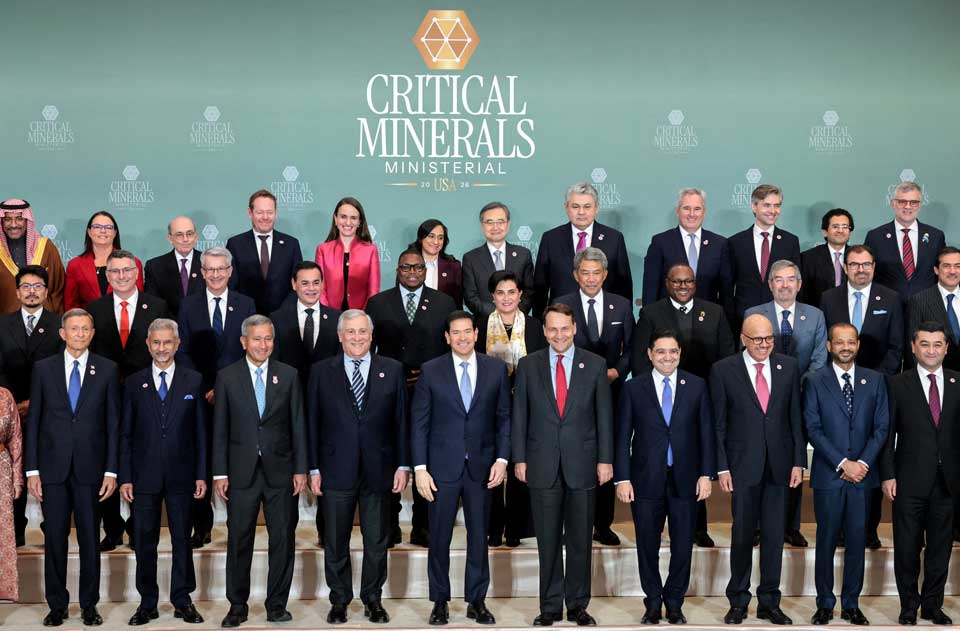
As Washington and its allies rally around a rare point of consensus under U.S. President Donald Trump on stockpiling critical minerals, a move clearly targeting China’s dominance in this sector, some Chinese scholars are questioning how durable this alignment will be for one simple reason: cost.
In an interview with The Strait Herald (海峡导报大台海), a large state-run provincial newspaper in southeastern Fujian province that reports closely on Taiwan, Xie Binghan, a popular commentator, wrote in a post on the outlet’s Douyin channel that China’s extraordinarily low cost in rare earth processing is hard to challenge by any alliance.
“They now want to form this global team, but the problem is that you’re looking at at least a decade of losses. And even after ten years, your costs will still be higher than in China. So where exactly is your business value?” Xie said.
Publications like The Strait Herald in Fujian and other coastal Chinese provinces that report on Taiwan affairs are particularly interested in issues related to critical mineral supply chains, given Taiwan’s dominance in high-end semiconductor manufacturing, which relies heavily on many of these resources.
China dominates the processing of a number of critical minerals, including rare earths, lithium and cobalt. Some reports suggested that 90% of critical mineral processing is under China’s control.
“The United States’ current efforts remain at the rudimentary stage of ‘throwing money at the problem,’” said Song Youguo, a prominent expert from Shanghai’s Fudan University, “the real challenge is yet to come.”
He told Wenweipo, a Hong Kong-based pro-Communist Party newspaper closely aligned with Beijing, that the U.S. must rebuild the rare-earth supply chain, which requires technology and expanded production capacity, a task Song bluntly said “cannot be resolved through simplistic measures.”
“The Western rare earth supply chain inherently requires time to develop. The reality is that the rare earth sector outside China suffers from gaps in both experience and specialized expertise,” an opinion piece from guancha.cn, China’s well-known nationalist news and opinion portal that is closely aligned with the state.
Caixin, a business news publication widely seen as among China’s most liberal outlets, points out another obstacle that Trump’s alliance will face: oversupply.
Although obscured by current geopolitical tensions, critical minerals are seeing a growing oversupply crisis, which could impose huge challenges on a sustainable business model.
“In fact, the rare earth industry currently faces an overall supply surplus, with no new demand drivers emerging. It remains uncertain whether policy-driven initiatives alone can establish the industrial chain and achieve sustainable commercial operations,” it wrote.
WHY IS THIS IMPORTANT? These Chinese media reports reveal a key part of the critical minerals narrative that is not widely discussed in U.S. and European discourses on the topic: the enormous effort required to build a refining industry capable of operating at a scale rivaling China’s current capacity. It took China more than 20 years to build its current processing capacity, a country that back then was significantly less regulated than the U.S. and European countries are today in terms of water use, power consumption, and the massive pollution these refineries generate.
U.S. Vice President JD Vance sought to challenge Chinese skeptics who contend that they won’t be able to rival China’s low-cost advantage by ensuring that critical minerals have a price floor. That will be difficult, through, to enforce if China, one of the largest producers in the world, does not abide by the price floor and undercuts other suppliers.